Whynter Wine Cooler Review: Is It the Premium Choice for Your Collection?
Expert analysis on cooling performance, design durability, and value for money.
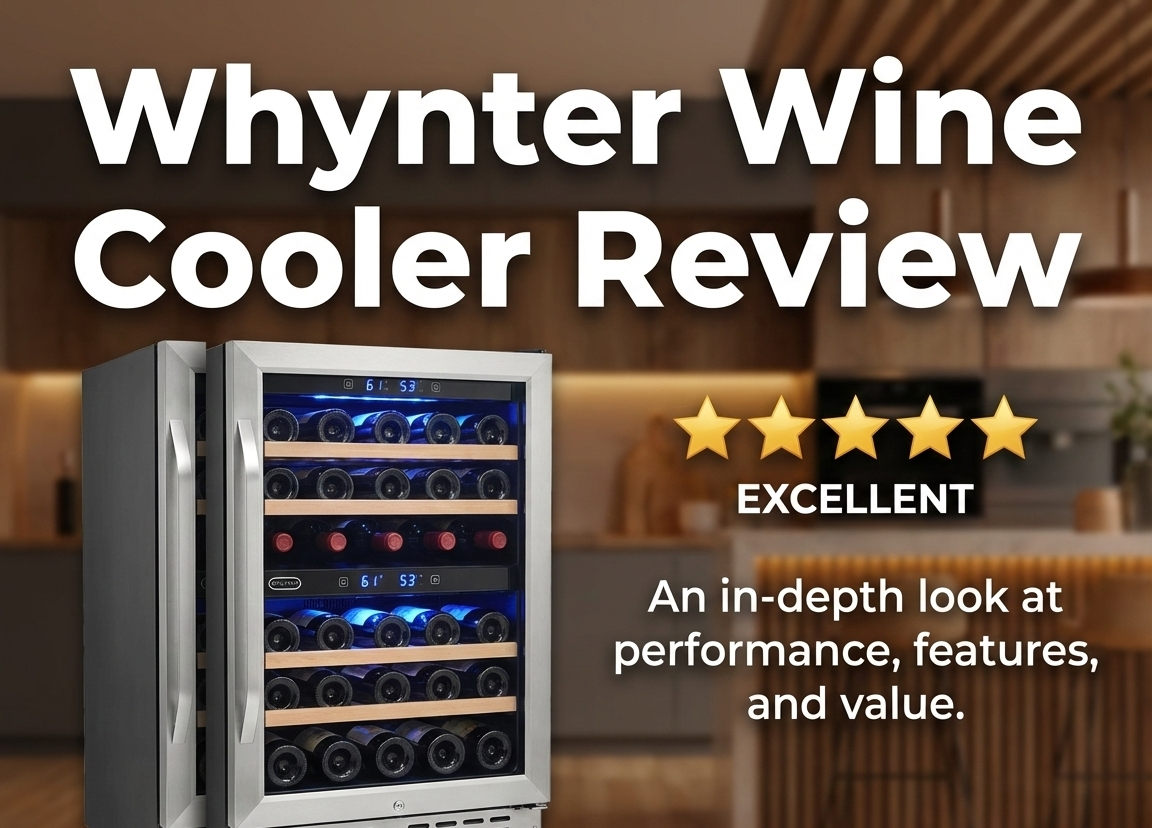
Introduction & Why Whynter?
Selecting the right environment for your wine collection is often the difference between a bottle that sings and one that falls completely flat. For serious enthusiasts, a standard kitchen refrigerator simply will not cut it — vibration issues, incorrect temperature ranges, and humidity fluctuations all conspire against long-term wine quality. This brings us to Whynter, a brand that has positioned itself comfortably between entry-level appliance brands and luxury cellar builders.
In this comprehensive Whynter wine cooler review, we move well beyond the marketing material to examine real engineering decisions, real-world performance, and the long-term ownership experience of these units. If you have read our guide on how to store wine at home, you know that consistency is the cornerstone of good wine storage. Temperature spikes, vibration events, and humidity swings all chip away at a wine’s development over time.
Whynter is renowned for its compressor-based cooling systems, which claim superior temperature stability versus thermoelectric counterparts. But does the reality match the specification sheet? Whether you are looking to age delicate vintage reds over many years or keep your Sauvignon Blanc crisp for weekend gatherings, understanding the nuances of these coolers is essential before committing to a purchase. We evaluate their flagship dual-zone model, their compact thermoelectric option, and their serious collector’s unit — then compare all three against the broader market landscape.
Who Is Whynter? Brand History & Specialization
Whynter is a specialized appliance manufacturer headquartered in California, operating with a deliberately narrower product focus than major household appliance conglomerates. While companies like GE or LG manufacture everything from washing machines to microwave ovens, Whynter concentrates its engineering resources on two primary categories: air comfort (portable air conditioners and evaporative coolers) and precision refrigeration. This focused approach carries a meaningful implication for buyers: the engineering team is not stretched across forty product categories. Cooling technology is what Whynter does, and the depth of their execution reflects that focus.
The brand’s origin sits in the practical recognition that mid-market consumers were poorly served by the wine cooler category. At one end of the spectrum were cheap thermoelectric units that looked appealing but failed in any room warmer than a controlled cellar. At the other end sat luxury European brands priced well beyond what most home collectors could justify. Whynter built a product philosophy around filling that gap with industrial-quality compressor technology, front-venting built-in capability, and premium shelving — at a price accessible to the serious upper-middle market.
Their reputation has grown steadily through word-of-mouth in wine enthusiast communities, and their BWR (Beverage and Wine Refrigerator) series has become a benchmark in reviews and forum discussions about mid-range wine storage. The brand does not spend heavily on lifestyle marketing; instead, they invest in specifications that experienced buyers notice: the type of refrigerant used, the method of vibration dampening, the material and rail design of their shelving.
Their products are widely available through major retailers including Amazon, Home Depot, and Costco, and they maintain a domestic customer service operation with documented responsiveness. Unlike some budget brands that essentially rebadge generic overseas units with minimal quality control, Whynter’s engineering choices — particularly their adoption of R600a refrigerant and rubber-mount compressor isolation — reflect deliberate decisions rather than cost-cutting defaults.
Technology Deep-Dive: Compressor, R600a & Vibration Dampening
The Compressor Advantage
Most Whynter models in the BWR series use R600a refrigerant compressors — a distinction worth understanding in detail. R600a (isobutane) is an eco-friendly refrigerant with a global warming potential (GWP) of just 3, compared to the older R134a refrigerant’s GWP of 1,430. Beyond its environmental credentials, R600a has genuinely superior thermodynamic properties: it operates more efficiently at the narrow temperature band relevant to wine storage (40–66°F), which means the compressor runs shorter cycles to maintain the set point. Shorter cycles mean less energy consumption, less mechanical wear, and crucially for wine — less vibration per unit of time.
Vibration Dampening: Rubber Mount System
This is where Whynter distinguishes itself from the field in a way that photographs poorly but matters enormously for wine. Their BWR-series compressors are mounted on rubber shock absorbers rather than being bolted directly to the chassis. The physics here are straightforward: a compressor bolted to a metal frame transmits its mechanical oscillation directly through the frame, into the shelving rails, and into every bottle. Over time — particularly relevant for wines with sediment — this vibration disturbs the particles undergoing chemical maturation and can subtly but meaningfully affect the flavor trajectory of an aged red.
The rubber-mount system breaks the transmission path. Vibration from the compressor motor is absorbed by the elastomeric mounts before reaching the chassis, dramatically reducing what the shelving and bottles actually experience. This is the same principle used in precision scientific equipment and audiophile electronics to prevent vibration contamination. For wine storage, it is a feature worth paying for — and one that is not universally present even in more expensive units from competing brands.
Thermoelectric Cooling (Compact Line)
Whynter also offers thermoelectric models for their compact tier. Thermoelectric cooling uses the Peltier effect — electrical current through a semiconductor junction creates a temperature differential — to cool without any moving parts beyond a small fan. The benefits are genuine: zero mechanical vibration (no compressor to dampen), virtually no noise, and low standby power draw. The limitation is also genuine: thermoelectric units can only cool approximately 20–30°F below the ambient room temperature. In a cool, air-conditioned room at 68–70°F, that range is adequate for wine storage. In a warm kitchen or unconditioned room in summer, the unit may struggle to reach or maintain proper storage temperature.
Activated Carbon Filter
A feature specific to Whynter’s premium compressor models is the activated carbon filter built into the interior ventilation path. Activated carbon has an enormous surface area per unit of mass — a single gram of activated carbon has a surface area comparable to several tennis courts — which makes it highly effective at adsorbing volatile organic compounds, odors, and airborne contaminants. Inside a wine cooler, this means that ambient odors from cork, from bottles with minor label-adhesive off-gassing, or from any minor mold traces are continuously scrubbed from the interior air rather than being recirculated past open bottles. The filter should be replaced every 12–18 months; replacement filters are available directly from Whynter and through major retailers.
UV-Resistant Double-Pane Glass
All BWR-series Whynter models use double-paned tempered glass with a gray smoke tint. The double pane provides thermal insulation — reducing heat transfer from the room into the cooler — while the smoke tint filters UV radiation. UV light degrades tannins and anthocyanins in wine, accelerating oxidation and causing color degradation in both red and white wines. As we explain in our wine terminology guide, this phenomenon — sometimes called “light strike” — can make wine taste flat and cardboard-like within weeks of exposure. The combination of double-pane insulation and UV tint in Whynter’s glass is a genuinely protective feature, not a cosmetic one.
Fan-Forced Internal Circulation
Whynter compressor models use fan-forced air circulation rather than relying on passive convection. This matters for temperature uniformity: in a convection-only system, warmer air rises and cooler air falls, creating temperature stratification within the cabinet. The top shelf of a convection-cooled unit can be 4–6°F warmer than the bottom. Fan-forced circulation equalizes this gradient, ensuring that the bottle on the top shelf of your upper zone experiences the same temperature as the bottle at the bottom — which is particularly important for dual-zone models where precise zone separation is a key selling point.
Model Series Overview: BWR, Compact & Vault Lines
Whynter organizes their wine cooling products into three meaningful tiers. Understanding which tier aligns with your needs prevents both overspending and the frustration of discovering a model’s limitations after delivery.
- R600a compressor cooling
- Front-venting (true built-in)
- Rubber-mount vibration dampening
- Sliding beech wood shelves
- Activated carbon filter
- Fan-forced air circulation
- Dual-zone standard
- Ideal for kitchens & bar areas
- Thermoelectric cooling
- Zero mechanical vibration
- Near-silent operation
- Rear-venting (freestanding only)
- Wire shelving
- Smaller footprint
- Best in cool, conditioned rooms
- Ideal for apartments & offices
- Full-height freestanding units
- 100–164+ bottle capacity
- Seamless stainless door
- Key lock security
- Display shelf for label-forward bottles
- Robust dual-zone compressor
- Available in built-in variants
- Ideal for serious collectors
The BWR naming convention is worth decoding: BWR stands for Beverage and Wine Refrigerator. The number that follows (e.g., 462 in BWR-462DZ) reflects approximate bottle capacity and model generation. The suffix “DZ” designates Dual Zone. Understanding this convention helps when comparing models on retail sites where the full product description may be truncated.
Review 1: Whynter BWR-462DZ (46-Bottle Dual Zone Flagship)

Design & Build Quality
The first thing you notice when opening the BWR-462DZ is the substantial weight of the door — a tangible indicator of the double-pane glass construction. The stainless steel trim is seamless along the door frame, with a professional towel-bar pull handle that feels appropriately solid in hand. The gray smoke tint on the glass provides UV protection while offering a clean, understated aesthetic that integrates well with modern kitchen appliances in both stainless and matte black finishes.
Cooling Performance
The R600a compressor system with fan-forced circulation performs impressively in thermal recovery testing. After opening the door and loading ten bottles, the unit returns to set-point temperature within approximately 25–35 minutes, depending on ambient room temperature — a result that reflects both compressor capacity and the efficiency of fan-driven air distribution. Temperature variance across both zones holds within 1–2°F of the set point during normal operation, which is excellent for long-term storage.
- Upper Zone: 41°F – 50°F (Ideal for Whites & Sparkling)
- Lower Zone: 50°F – 72°F (Ideal for Reds & Aging)
The zone separation barrier does consume a small amount of total volume, and it is important not to overstuff shelves — both zones require at least one or two empty shelf positions for adequate airflow around bottles. If you pack every available space, the fan-forced circulation becomes less effective and temperature uniformity degrades.
Shelving & Ergonomics
The unvarnished beech wood shelves are a genuine highlight of the BWR series. They slide out on metal rails with smooth, full-extension action, allowing you to inspect or retrieve bottles from the back of any row without displacing those in front. The unvarnished surface avoids any chemical off-gassing that varnished or painted shelves can introduce in an enclosed environment. Unlike wire racks that can abrade paper labels over years of storage, the smooth beech surface protects both labels and the bottles themselves from contact scuffing.
Capacity reality: the rated 46 bottles assumes standard 750ml Bordeaux-profile bottles throughout. Mixed collections including Burgundy or Champagne-style bottles will see real capacity closer to 38–42 bottles. If you collect primarily wide-shoulder bottles, account for this in your capacity planning. See our complete bottle compatibility guide further in this review.
- ✓ True zero-clearance built-in via front toe-kick venting
- ✓ Temperature stability within 1–2°F of set point
- ✓ Premium beech wood shelves — full-extension, label-safe
- ✓ Activated carbon filter eliminates interior odors
- ✓ R600a refrigerant: eco-friendly & energy-efficient
- ✓ Rubber-mount compressor minimizes vibration transfer
- ✗ Compressor cycle audible (40–44 dB)
- ✗ Rated 46 bottles assumes Bordeaux profile only
- ✗ Blue LED aesthetic; harder to read labels
- ✗ Zone divider reduces total usable volume slightly
Review 2: Whynter WC-28S (28-Bottle Compact Thermoelectric)

Thermoelectric Cooling in Practice
The WC-28S uses Peltier thermoelectric cooling rather than a compressor — making it unusual within Whynter’s lineup but strategically important as their entry point for buyers who prioritize silence and zero vibration above all else. Without a compressor, there are literally no moving parts except a small internal fan, which means there is no mechanical vibration transmitted to the bottles and no compressor hum. For sediment-heavy aged wines, this is a theoretically ideal environment.
The critical operational constraint is ambient temperature dependency. Thermoelectric units can typically cool only 20–30°F below the surrounding room temperature. In an air-conditioned room at 70°F, reaching and maintaining 50–55°F for wine storage is entirely achievable. In a room that reaches 82–85°F in summer, the unit will struggle to get below 60–65°F — which is within the safe range for reds but too warm for whites over extended periods. Before placing this unit, assess your room’s maximum summer temperature honestly.
Design & Placement
The platinum finish and mirrored glass door present as significantly more premium than the price suggests. The mirrored surface, while visually striking, does show fingerprints readily — which is worth noting if the unit will be in a high-traffic area. Its compact footprint makes it suitable for countertops, dining room corners, or home offices where a larger unit would be disproportionate. Note that rear venting means at least 4–5 inches of clearance behind the unit is mandatory — never recess it into cabinetry.
The wire shelves are the one area where this model reflects its price point. While functional, wire racks can abrade paper wine labels over years of storage, and bottle removal from full rows requires more care than wooden slide-out shelves allow. If label preservation matters to you, consider placing a thin adhesive felt liner on the wire surfaces.
- ✓ Virtually silent — no compressor hum
- ✓ Zero vibration, ideal for aged wines with sediment
- ✓ Compact footprint for apartments and offices
- ✓ Stylish mirrored glass door
- ✗ Rear-venting — cannot be built into cabinetry
- ✗ Cooling performance depends heavily on ambient room temperature
- ✗ Wire shelves can abrade bottle labels over time
- ✗ No activated carbon filter
Review 3: Whynter BWR-1642DZ (164-Bottle Collector’s Vault)

Capacity & Layout
The 164-bottle rating applies to standard Bordeaux bottles. In a mixed collection including Pinot Noir, Syrah, and Chardonnay bottles, realistic capacity is 130–145 bottles. The unit ships with a dedicated display shelf that positions bottles at a viewing angle — labels forward, corks moist — which is a premium feature designed for collections that are meant to be admired as much as consumed. For the serious oenophile who has progressed beyond casual enthusiast territory into buying cases at auction, the BWR-1642DZ is the logical Whynter endpoint before commissioning a custom cellar.
Advanced Features
The seamless stainless steel door design — no visible gap at the frame joint — is both aesthetic and practical: it eliminates the dirt-trapping crevice found on standard frame-and-door constructions. The key lock is genuinely useful beyond security theater; in households with multiple people, a locked cellar unit prevents the casual “just grabbing one” that gradually depletes a curated collection. The dual-zone compressor system scales effectively to the larger volume, maintaining consistent temperature across a much greater thermal mass than the smaller models require.
Bottle Size Compatibility Guide
Whynter rates their units based on standard 750ml Bordeaux bottles, which have a relatively slim cylindrical profile. If your collection includes wider or taller formats, the following guide will help you plan realistically before purchasing.
| Format | Volume | Diameter | Whynter Compatibility | Practical Workaround |
|---|---|---|---|---|
| Bordeaux (Standard) | 750 ml | ~75 mm | ✅ Full rated capacity | None needed |
| Burgundy / Pinot Noir | 750 ml | ~83–88 mm | ⚠️ Reduces capacity ~15–20% | Remove one shelf per wide row; plan for 38–40 actual bottles in BWR-462 |
| Champagne / Sparkling | 750 ml | ~88 mm | ⚠️ Fits lower rows only on standard models | Remove a shelf to create clearance; store base-down in the lower zone |
| Riesling / Alsatian | 750 ml | ~68 mm (tall) | ⚠️ Height can be restrictive | Angle slightly on shelf; works better in lower zone of taller units |
| Magnum | 1.5 L | ~105 mm | ⚠️ Requires shelf removal in BWR series; display shelf in BWR-1642 accommodates | Remove two adjacent shelves to create a Magnum bay |
| Half Bottle (Demi) | 375 ml | ~60 mm | ✅ Fits comfortably | Use small bottle inserts or lay horizontally on shelf |
| Double Magnum / Jeroboam | 3 L | ~120 mm | ❌ Does not fit standard Whynter shelving | Store horizontally on the floor of the BWR-1642 if space permits |
Temperature Guide by Wine Varietal
Configuring your Whynter’s dual zones correctly requires knowing what temperature ranges actually benefit your specific wines. The following guide covers storage temperatures — what to set your zones to — as well as a note on serving, since the two are different requirements.
Optimal Dual-Zone Configuration for the BWR-462DZ
For the most common collector scenario — whites for near-term drinking and reds for medium-term aging — we recommend setting the upper zone of the BWR-462DZ to 46°F and the lower zone to 60–62°F. This lets you pour a white directly from the cooler to the table without additional chilling, while your reds rest at a temperature that allows slow, steady development. When you are ready to serve a red, pull it 15–20 minutes before pouring to allow it to warm slightly and open up its aromatics.
Where to Place Your Whynter Cooler
Placement affects cooling performance, energy efficiency, compressor lifespan, and whether your warranty remains valid. Each environment has specific considerations.
Kitchen Undercounter Installation
The BWR series is purpose-built for this scenario. Front-venting through the toe-kick grille allows the unit to sit flush with surrounding cabinetry without requiring side clearance. The standard 24-inch width matches most kitchen cabinet cutout dimensions. If you are replacing a dishwasher or a trash compactor, these spaces often accept a Whynter built-in unit directly. Ensure the floor surface is level and use the adjustable feet to achieve perfect horizontal alignment — a slightly unlevel unit can cause the door to swing open under its own weight, degrading the seal and raising energy consumption.
Living Room or Dining Room
For freestanding BWR models in living spaces, noise becomes the primary concern. At 40–44 dB, the BWR compressor is audible in a quiet room, particularly during the cycle-on phase. Most users adapt to this quickly, but if you are extremely sensitive to ambient sound — for a home office or bedroom adjacent to where you’d place the unit — the thermoelectric WC-28S is the appropriate choice at 28 bottles. Place freestanding units away from heat sources (ovens, radiators, direct sun exposure) to minimize compressor workload and energy draw.
Basement or Cellar Room
Basements are thermally ideal for wine storage — naturally cool, shielded from sun, and relatively humidity-stable. A Whynter compressor unit in a basement operates with minimal compressor cycling because the ambient temperature is already close to the target storage range. This is the most energy-efficient placement and the gentlest on the compressor over its lifespan. The main basement concern is dampness: if your basement exceeds 70–75% relative humidity regularly, surface condensation on the exterior of the cooler can eventually cause minor corrosion at the base and on the hinge hardware. A basic dehumidifier in the room is an effective preventive measure.
Garage Placement
Garages represent the highest-risk placement for any compressor wine cooler. Summer ambient temperatures can exceed 95–100°F in many climates, which pushes any compressor unit beyond its rated operational ceiling. Most Whynter compressor models are rated for ambient temperatures up to approximately 90°F (32°C); exceeding this triggers the thermal safety cutoff, causing the unit to shut down intermittently. Even within the rated range, hot ambient temperatures force continuous compressor operation, significantly accelerating wear. If garage storage is unavoidable, position the unit in the coolest corner (typically the north-facing interior wall), ensure front-venting clearance is completely unobstructed, and consider operating a portable fan in the space during peak summer heat.
Installation, Setup & First-Use Tips
The Mandatory Wait After Delivery
This is the step that most buyers skip — to the detriment of their new cooler’s compressor. Wine coolers are shipped on their sides for logistical efficiency in packaging and transport. During shipping in this horizontal orientation, the compressor’s lubricating oil can migrate from its reservoir into the refrigerant lines. Plugging the unit in immediately after delivery and powering the compressor before this oil has settled back causes the compressor to run partially unlubricated — leading to premature wear or immediate damage.
Whynter recommends standing the unit fully upright and waiting at least two hours before plugging it in. Most appliance technicians advise four hours as the safe standard. This is not a suggestion — it is a functional requirement that directly determines how long your compressor will last.
Leveling the Unit
All BWR-series Whynter models include adjustable front feet (the rear feet are typically fixed). Use a spirit level placed on a shelf inside the unit and adjust the front feet until the cabinet reads level side-to-side. Then add a deliberate 1–2 degree tilt backward (rear lower than front). This slight backward tilt uses gravity to keep the door gasket pressed firmly against the frame, improving the thermal seal and preventing the door from swinging open on its own. It also ensures that any minor condensation inside the unit drains toward the rear collection point rather than pooling near the door.
Door Reversal
Select Whynter BWR models include hinge hardware to allow door reversal — switching the opening direction from right-hinge to left-hinge or vice versa. This is useful for kitchen installations where the standard opening direction would swing the door into an adjacent wall or appliance. The reversal process involves removing the door, relocating the hinge bracket to the opposite upper and lower mounting points, and reattaching. If your model includes a manufacturer logo sticker on the door, peel it carefully before reversal and reapply it in the correct orientation afterward. Check your specific model’s documentation, as hinge hardware varies across the BWR range.
Interior Cleaning Before First Use
Before loading any bottles, wipe the interior surfaces with a solution of two tablespoons of baking soda dissolved in one quart of lukewarm water. Baking soda is mildly alkaline, which neutralizes any manufacturing odors without leaving scented chemical residue. Never use soap-based cleaners, bleach, or scented cleaning products inside a wine cooler — even trace amounts of fragrance molecules can be adsorbed by natural wine corks over time and subtly contaminate the wine’s aroma profile.
Activating the Carbon Filter
The activated carbon filter in BWR-series models ships sealed in plastic. Before powering on, locate and unseal the filter (it slides into a slot on the interior wall — check your model’s manual for the exact location). An unsealed, properly positioned filter begins working immediately once the internal fan circulates air through it. Install it before adding any bottles to ensure the interior air quality is optimal from day one.
Temperature Settling Period
After powering on, allow the empty unit to reach its set temperature — typically 60–90 minutes for the BWR-462DZ — before loading bottles. When loading, add no more than half the capacity on the first day. A full immediate load of room-temperature bottles creates a large thermal demand spike that forces the compressor to run continuously for several hours. While the compressor can handle this, it is hard on the system early in its life. Loading gradually over 24–48 hours gives the compressor appropriate operating conditions from the start.
Energy Efficiency & Running Costs
A wine cooler operates continuously, every hour of every day. Modest differences in efficiency accumulate meaningfully over a decade of ownership. Here is what to expect from Whynter’s cooling technologies.
R600a Refrigerant: The Efficiency Advantage
The choice of R600a refrigerant in Whynter’s compressor models is not only an environmental decision — it also delivers measurable efficiency benefits. R600a has a higher latent heat of vaporization than R134a (the older standard), meaning it can transfer more heat per unit mass as it cycles through the refrigeration loop. The practical result is that the compressor needs to run shorter cycles to remove the same amount of heat, reducing total runtime and thus electricity consumption. Over a 10-year ownership period, this translates to a meaningful cost saving relative to otherwise comparable units using older refrigerants.
| Model Type | Approx. Running Watts | Est. Annual Cost* | Best Placement |
|---|---|---|---|
| BWR Compressor (R600a) | 60–80 W (cycling) | ~$84–$112 | Kitchen, basement, living room |
| WC-28S Thermoelectric | 25–48 W (room temp dependent) | ~$35–$67 | Conditioned rooms only |
| BWR-1642DZ (Large) | 90–130 W (cycling) | ~$126–$182 | Basement, dedicated bar room |
*Estimated at $0.16/kWh U.S. average. Actual costs vary by region and ambient temperature.
Reducing Running Costs in Practice
The most impactful single action you can take to reduce energy consumption is keeping the condenser coils clean. Dust accumulation on the coils insulates them, reducing their ability to expel heat to the surrounding air and forcing the compressor to run longer and harder to compensate. Cleaning the coils every six months — a two-minute task with a vacuum or soft brush — can reduce energy consumption by 15–25% compared to a heavily dust-loaded coil. Secondly, avoid placing the unit next to ovens, dishwashers, or in direct sunlight, as ambient heat from these sources forces more frequent compressor cycles.
Humidity Control & Mold Prevention
Whynter units generally maintain relative humidity between 50% and 70% — the recognized safe range for wine storage. This humidity band prevents two failure modes: corks drying out at low humidity (below 50%), which allows air infiltration and premature oxidation; and mold growth on corks and labels at high humidity (above 75%), which while rarely damaging to the wine itself, is aesthetically problematic and can eventually compromise cork integrity on very long-term storage.
How Compressor Cooling Affects Humidity
Compressor-based refrigeration has a slight dehumidifying effect compared to ambient air, because cold air holds less moisture. This means that in very dry climates (ambient RH below 40%), a compressor wine cooler may pull interior humidity below 50% over time. If you live in an arid region and store wine for many years rather than months, monitoring interior humidity with a small wireless hygrometer is worthwhile. A passive humidity control packet placed on a shelf — the kind used in guitar cases and cigar humidors — can supplement the cooler’s natural humidity management without any active mechanism.
Mold Prevention Checklist
- Dry bottles completely before placing them in the cooler — surface moisture on bottles is the primary mold introduction source.
- Wipe the door gasket with a diluted white vinegar solution (1 part vinegar, 3 parts water) every three months. Vinegar is antifungal and safe for rubber gasket material.
- Replace the activated carbon filter every 12–18 months to maintain its odor-adsorbing effectiveness.
- Leave at least one shelf position empty in each zone to allow air circulation rather than packing every space.
- Inspect the drip tray or condensation collection area annually and clean it with the baking soda solution to prevent stagnant water accumulation.
Long-Term Maintenance Schedule
Whynter compressor units are designed for a 7–10 year lifespan under normal operating conditions. Achieving the upper end of that range requires a basic maintenance discipline that takes no more than 30 minutes per year in total.
| Frequency | Task | Purpose |
|---|---|---|
| Monthly | Check door gasket for cracks, tears, or debris accumulation | A compromised gasket causes the compressor to cycle continuously, raising energy costs and accelerating wear |
| Every 3 Months | Wipe interior walls and shelves; clean gasket with diluted vinegar solution | Prevents mold accumulation and eliminates odors before they become embedded |
| Every 6 Months | Vacuum or brush condenser coils (typically on the rear bottom panel) | Dust-loaded coils reduce thermal efficiency by up to 30%; most common cause of declining cooling performance |
| Every 12–18 Months | Replace activated carbon filter; verify temperature accuracy with a calibrated external thermometer | Saturated filters provide no benefit; digital displays can drift 2–3°F over time without recalibration |
| Every 2–3 Years | Inspect condensate drain and drip tray; clean with baking soda solution | Stagnant water is a mold and off-odor risk; drain blockage can cause water pooling inside the unit |
Troubleshooting Common Problems
Most issues with Whynter wine coolers fall into a small number of categories that can be diagnosed and resolved without professional service.
Unit Not Reaching Set Temperature
Work through this diagnostic sequence before contacting support. First, confirm the unit has adequate clearance — for freestanding side-venting models, verify there are at least 4 inches of clearance on left, right, and rear. For front-venting BWR models in built-in positions, confirm the toe-kick grille is not blocked by debris or a rug edge. Second, clean the condenser coils — this is the single most common root cause of progressive cooling decline. Third, check the door gasket by inserting a piece of paper into the seal and pulling; it should grip firmly. A loose gasket allows warm air infiltration that continuously undermines cooling. Fourth, if you’ve recently added a large batch of warm bottles, give the unit 4–6 hours to thermally stabilize before reassessing performance.
Excessive Noise or Vibration
Whynter’s rubber-mount compressor system is designed to isolate vibration, but shipping can occasionally dislodge or compress the rubber mounts. If you notice unusual vibration or rattling that wasn’t present immediately after setup, check that the unit is perfectly level — an unlevel cabinet can create resonance vibration. Also check that no bottles are in contact with the interior walls or each other across shelves, as bottle-to-glass contact transfers compressor vibration directly. If a specific bottle position always produces rattling, reposition it so it contacts only the wooden shelf surface.
Power Outage & Temperature Memory
All current Whynter BWR-series models include non-volatile temperature memory. When power is restored after an outage, the unit automatically returns to the last set temperatures for both zones without any user intervention. For short outages of a few hours, a well-loaded unit retains its temperature adequately due to the thermal mass of the wine bottles themselves — glass and liquid together act as a significant heat reservoir. For extended outages of 12+ hours, monitor interior temperature with a wireless thermometer if available; wines that warm above 75–80°F for an extended period begin to age acceleratedly, though a single such event rarely causes irreversible damage.
Error Codes on the Digital Display
Whynter’s digital control panels display error codes as “Exx” (e.g., E1, E2) when specific faults are detected. E1 typically indicates a sensor fault; E2 often relates to the compressor thermal cutoff having been triggered. Consult your model’s manual for the complete error code table, as codes can vary between BWR generations. For E2 specifically: unplug the unit, allow it to sit for 30 minutes in a well-ventilated area, then restore power. This resets the thermal cutoff and allows you to identify whether the trigger was a one-time event (e.g., direct sun exposure) or a recurring condition requiring investigation.
Beginners vs. Serious Collectors: Which Whynter Model?
Whynter’s lineup genuinely scales from first wine cooler to serious cellar investment. Matching your buyer profile to the correct tier prevents both buyer’s remorse and the frustration of outgrowing a unit within a year.
The Casual Drinker (Under 25 Bottles at Any Time)
If you buy wine to drink within days or weeks and rarely hold more than two cases simultaneously, the WC-28S thermoelectric model fits well. You’re not aging wine — you’re storing it through the week. The near-silent operation, zero vibration, and attractive footprint serve the casual scenario perfectly without the complexity of dual-zone management. The important caveat is room temperature: assess whether your kitchen or dining room stays below 75°F in summer before choosing thermoelectric over a small compressor model.
The Regular Enthusiast (25–60 Bottles)
The BWR-462DZ is the natural home for this buyer. You’re building a modest cellar, mixing near-term drinking bottles with a few special reds you’re laying down for one to three years. The dual-zone capability allows genuinely different temperature regimes for your whites and reds simultaneously — not just a temperature compromise. The activated carbon filter and rubber-mount compressor serve aging wines well. This is the model we would recommend to the widest range of buyers reading this review.
The Serious Collector (60–165 Bottles)
The BWR-1642DZ was built for the buyer who purchases by the case rather than the bottle, tracks their cellar by vintage and producer, and expects to hold bottles for five to fifteen years. At this level, the key lock, seamless door construction, and display shelf become genuinely useful features rather than marketing additions. The unit also scales well as a primary cellar piece in a dedicated bar room or basement installation, particularly in its built-in variant if your renovation plan includes a wine bar area.
Whynter vs. The Competition
Whynter vs. Wine Enthusiast
Wine Enthusiast is arguably Whynter’s most direct aspirational competitor. In our Wine Enthusiast wine cooler review, we noted that they focus heavily on aesthetics and digital integration — touch screens, app connectivity in some models, and design-first finishes. Whynter, by contrast, feels more engineering-first: the compressor spec, the refrigerant choice, and the filter system are the headline features rather than the door handle design. If you want a “furniture piece” that doubles as a wine cooler, Wine Enthusiast may edge Whynter on looks. If you want a machine that will hold temperature reliably for a decade, Whynter has a stronger engineering foundation.
Whynter vs. Ivation
Ivation occupies the budget-to-mid-range tier. As seen in our Ivation wine cooler reviews, they offer solid compressor performance but typically use simpler wire shelving and lack the activated carbon filter and premium vibration dampening found in Whynter’s BWR line. For buyers on a tighter budget who don’t need the premium shelving, Ivation represents excellent value. For anyone planning to store wine for more than a year, the beech wood shelves and vibration isolation of the Whynter justify the price difference.
Whynter vs. Vinotemp
Vinotemp builds products with a distinctive aesthetic — dark racking, bold design choices, and some unique built-in formats. Our Vinotemp reviews show they are competitive for built-in installations, particularly for renovations with custom cabinetry. Whynter typically edges Vinotemp on parts availability and customer service accessibility for the consumer market — a consideration worth weighing if you’re buying a unit you’ll depend on for a decade.
Whynter vs. NewAir
This is a comparison many buyers face directly. NewAir has invested heavily in design aesthetics and consumer-facing features — the Shadow Series’ fingerprint-resistant glass, beech wood shelves, and strong online presence reflect a brand optimizing for the lifestyle buyer. Whynter, conversely, leads on engineering depth: the R600a refrigerant, the activated carbon filter, and the vibration-dampening compressor mount are features that wine-specific buyers recognize as substantively useful rather than visually appealing. For a kitchen showpiece, NewAir may win. For a serious cellar unit where what happens inside the cabinet matters more than how the door looks, Whynter is the stronger technical choice. Read our full NewAir wine cooler review for a side-by-side breakdown.
| Feature | Whynter (BWR Series) | Wine Enthusiast (N’Finity) | Ivation (Standard) |
|---|---|---|---|
| Cooling Technology | R600a Compressor | Standard Compressor | Compressor & Thermoelectric |
| Vibration Dampening | Rubber-Mount System | Basic | Basic |
| Carbon Filter | ✅ Included | ❌ Not standard | ❌ Not standard |
| Shelving | Sliding Beech Wood (High Quality) | Wire / Wood Combo | Wire or Basic Wood |
| Noise Level | Low (40–44 dB) | Low (39–42 dB) | Moderate |
| Price Point | $$$ | $$$$ | $$ |
| Warranty | 1 Year / Extended Options | Varies | 1 Year |
Customer Service & Warranty Experience
The quality of after-purchase support is a consideration that many buyers underweight until something goes wrong. A wine cooler is a significant appliance investment expected to function continuously for nearly a decade — understanding how the manufacturer handles problems is part of evaluating the true cost of ownership.
Standard Warranty Coverage
Whynter’s standard warranty for consumer wine coolers is one year covering defects in materials and workmanship. This covers the compressor, the cooling system, and the electronic control components. It does not typically cover cosmetic damage resulting from improper installation, normal wear items such as door gaskets and replacement filters, or damage resulting from operating the unit outside its specified ambient temperature range. The latter exclusion is worth noting particularly for buyers considering garage placement in warm climates.
Extended Warranty Options
Whynter offers extended warranty coverage through their website and through authorized retailers. A two-to-three year extended plan covering the compressor specifically is worth considering for any unit intended for long-term cellar use — the compressor is both the most expensive component to replace and the most stress-tested over time. The math on extended warranty coverage tends to favor buyers who are making a significant storage investment rather than casual buyers who can tolerate a shorter appliance lifespan.
Support Experience
Community feedback from wine enthusiast forums and retailer review platforms consistently notes that Whynter’s support team is knowledgeable about their products’ technical specifications — a meaningful distinction from generic appliance support desks. Representatives are able to diagnose error codes, guide troubleshooting over phone or email, and in cases of delivery damage or early manufacturing defects, process replacement component shipments without requiring the full unit to be returned. For larger units like the BWR-1642DZ, the ability to resolve issues through part replacement rather than full-unit returns is a significant practical benefit.
Optimizing Your Wine Experience
Buying the right cooler is step one in building a genuinely satisfying home wine experience. The accessories and serving tools you use after pulling a bottle from your Whynter are equally important in translating good storage into good drinking.
If you are opening a vintage red that has been developing for several years, a reliable opener is non-negotiable. A quality electric wine opener removes corks with zero vibration disturbance to the sediment you have spent years allowing to settle. Before opening, use a foil cutter for a clean cut that avoids any metal residue on the lip of the bottle.
For young wines that have not yet had time to open in the bottle, the aerator vs. decanter question matters. An aerator achieves rapid, aggressive oxidation suitable for a young Cabernet that you want to serve immediately; a decanter allows slower, gentler breathing over 30–60 minutes, which suits more nuanced wines that would be overwhelmed by aggressive aeration. Neither replaces proper aging, but both can meaningfully improve the experience of a wine pulled young from storage.
If you open a bottle and don’t finish it, how you preserve the remainder determines how good the next glass will be. Standard corks reinserted improperly allow significant oxygen ingress. The best wine stoppers provide an airtight or low-oxygen seal that extends a bottle’s life by 2–5 days. For collectors who want to sample a single glass without committing to a full bottle, the Coravin system is the gold-standard solution — it allows you to pour through the cork using argon gas pressure without ever removing the cork, leaving the remainder of the bottle in essentially its original condition. Pairing a Whynter cellar unit with a Coravin effectively transforms your storage into a by-the-glass service setup for your finest bottles.
Frequently Asked Questions
Final Verdict: Should You Buy a Whynter Wine Cooler?
After a thorough examination of engineering decisions, real-world performance, placement considerations, and the ownership experience, Whynter sits firmly in the “sweet spot” of the wine storage market. They offer professional features — front-venting built-in capability, R600a refrigerant, rubber-mount vibration dampening, activated carbon filtration, and beech wood rolling shelves — at a price that is justifiable for the serious home collector without requiring a luxury budget.
The BWR-462DZ remains our top recommendation for most buyers: it brings everything Whynter does well into a capacity that suits the 25–60 bottle enthusiast building a real cellar. The BWR-1642DZ earns its place for collectors at the serious end of the home market. The WC-28S fills a genuine niche for the apartment dweller who needs silence and zero vibration in a small, temperature-controlled space.
We recommend Whynter if:
- You need a versatile unit capable of genuine built-in installation.
- You want dual-zone precision for serving whites and aging reds simultaneously.
- You care about what is happening inside the cabinet — refrigerant quality, vibration isolation, air filtration — as much as how the door looks.
- You want a long-term appliance backed by knowledgeable customer support.
Look elsewhere if:
- You need absolute silence and your room is well temperature-controlled (consider thermoelectric alternatives for small collections).
- Your budget is tight (consider Ivation for entry-level value).
- You have a large collection primarily in Magnum or other non-standard formats requiring custom racking solutions.
Whether you are just learning how to read a wine label or curating a cellar for investment-grade bottles, Whynter provides a reliable, well-engineered, and visually respectable solution to keep your wine exactly as it should be — until the moment it is ready to be opened.