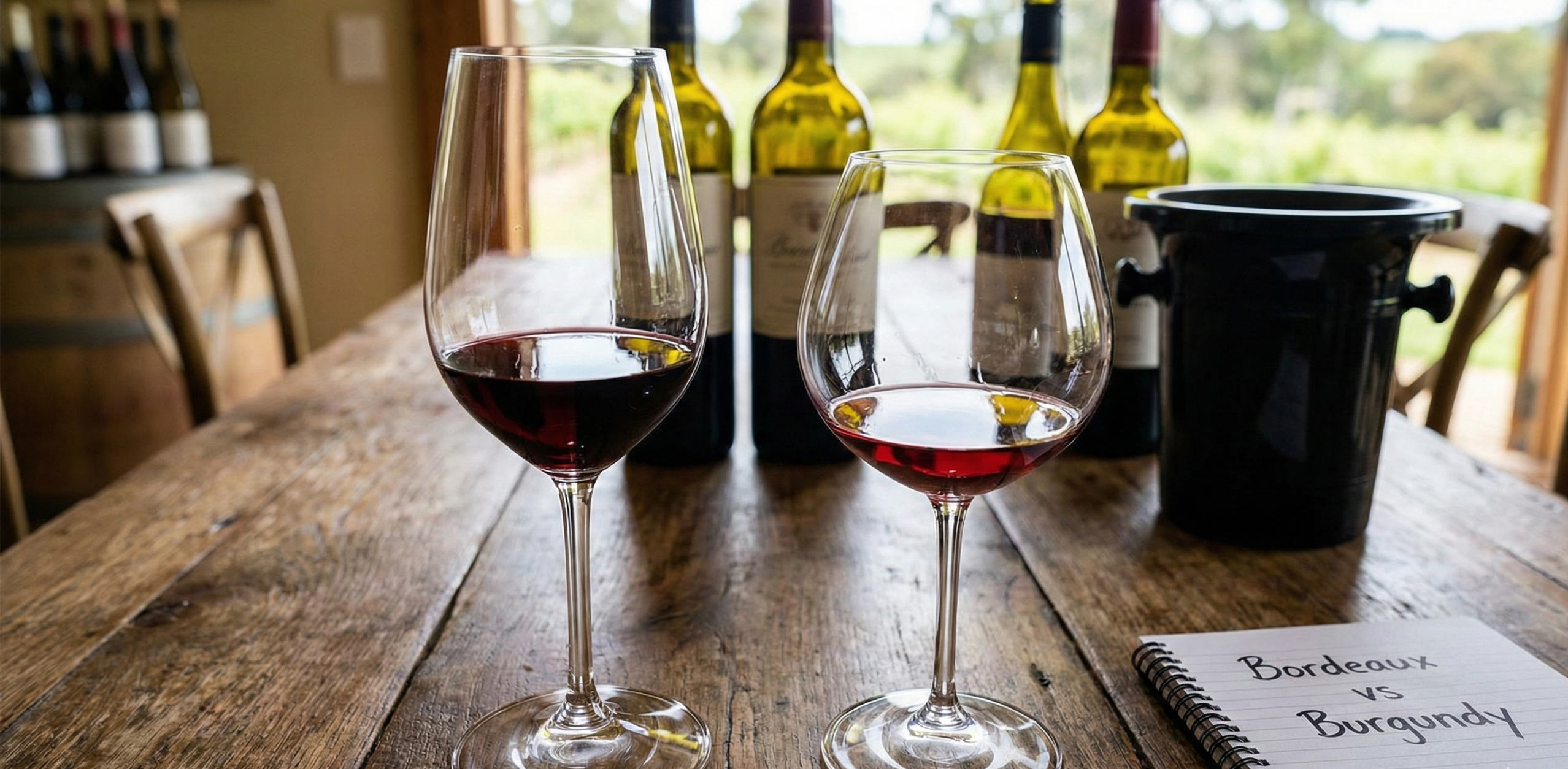
Bordeaux Glass vs Burgundy Glass: The Battle of the Bowls
Unlocking the physics of flavor: Why the shape of your stemware dictates the potential of your Pinot and the character of your Cabernet.
Introduction: More Than Just Aesthetics
For the uninitiated, the wall of glassware at a premium kitchen store can be intimidating. Is it really necessary to have a different glass for every varietal? If you are just drinking table wine on a Tuesday, perhaps not. But if you have invested in the best affordable wines of 2025 or are pulling a vintage bottle from your cellar, the vessel matters immensely.
The debate of Bordeaux glass vs Burgundy glass is the most critical distinction in the red wine world. While we have previously covered the broad differences in red wine glass vs white wine glass, the nuances between specific red varietals are where the true science of sommelier-grade service comes into play.
These two glasses are designed to handle tannins, acidity, and alcohol vapors in fundamentally different ways. The Bordeaux glass is the workhorse of the red world—tall, broad, and imposing. The Burgundy glass is the artist—wide, tapered, and delicate. In this comprehensive guide, we will break down the anatomy, the physics, and the practical applications of each, ensuring you never pour a delicate Pinot Noir into a tannin-taming Bordeaux chimney again.
At a Glance: The Tale of the Tape
Before we dive into the fluid dynamics, here is a quick reference guide to help you identify the differences instantly.
| Feature | Bordeaux Glass | Burgundy Glass |
|---|---|---|
| Bowl Shape | Tall, broad, slightly tapered | Wide, balloon-like, “Fishbowl” |
| Rim Diameter | Medium-wide | Narrower relative to bowl width |
| Height | Generally Taller | Generally Shorter stem, wider bowl |
| Primary Function | Directs wine to back of mouth (tannin control) | Directs wine to tip of tongue (flavor precision) |
| Ideal Wines | Cabernet Sauvignon, Merlot, Syrah | Pinot Noir, Gamay, Nebbiolo |
| Aeration Speed | Moderate | Fast (High surface area) |
A Brief History of Varietal-Specific Glassware
The concept that different wines deserve differently shaped vessels is not a modern marketing invention. It stretches back centuries, rooted in the traditions of the great wine regions of France, Germany, and Austria. Understanding this history helps explain why the Bordeaux and Burgundy glass shapes are so specifically engineered—they evolved organically from the wines themselves, long before the science of organoleptic chemistry existed to explain why they worked.
Ancient Vessels and Regional Traditions
Roman traders and medieval monks each developed regional stemware shapes based on the local wine styles they were drinking. Early Burgundy goblets were notably wider than those used in Bordeaux—a reflection of the delicate, aromatic nature of Pinot Noir versus the structured, tannic nature of Cabernet-based blends. These regional traditions persisted for centuries, quietly influencing glassblowers across Europe even as the science remained unexplained and anecdotal.
The earliest dedicated wine glasses emerged in Venice in the 15th century, when Venetian glassblowers on the island of Murano mastered the art of creating thin, clear “cristallo” glass. For the first time, drinkers could observe the color and clarity of wine—a revelation that turned the glass from a purely functional vessel into a sensory instrument. Murano’s influence spread north into France and Germany, where glassblowers adapted the Venetian techniques to suit their own regional wine cultures.
Georg Riedel and the 1958 Revolution
The modern era of scientifically designed varietal-specific glasses begins with a single pivotal moment: in 1958, Claus Riedel—then head of the 250-year-old Austrian glass dynasty Riedel—introduced the Sommeliers range, the world’s first wine glasses designed explicitly around the characteristics of individual grape varieties. This was a radical idea. The prevailing assumption was that a wine glass was a wine glass, and that differences in shape were decorative rather than functional.
Riedel’s insight, which he developed through collaboration with sommeliers, winemakers, and researchers, was that the shape of a glass determines which volatile aromatic compounds reach the nose, how much ethanol evaporates before the wine reaches the palate, and where on the tongue the wine first lands. His Sommeliers Bordeaux glass—tall, with a wide base tapering toward the rim—became the template that has defined what a “red wine glass” looks like for the 65 years since. His Sommeliers Burgundy glass—shorter, with an extravagantly wide bowl—was the first glass that specifically honored the delicate aromatics of Pinot Noir.
The wine world was skeptical. Many critics dismissed Riedel’s claims as marketing theater. Then, in the 1990s, researchers at the Austrian Chemistry Institute used gas chromatography to analyze the vapor concentration above wine poured into differently shaped vessels. The results were unambiguous: glass shape profoundly altered the density, position, and composition of the aromatic vapor cloud above the wine. Riedel had been right all along, and the era of scientifically-grounded stemware was firmly established.
Riedel introduced the first varietal-specific wine glass in 1958 with the Sommeliers range. The company, founded in 1756 in Bohemia, remains the most recognized name in fine stemware more than 65 years after that innovation. Today over 40 individual varietal-specific shapes exist in their catalog alone.
The Complete Anatomy of Wine Glasses: A Glossary
To understand why these two glasses perform differently, you first need to speak the language of glassware design. Each component of a wine glass has a functional purpose, and small differences in each measurement produce dramatically different drinking experiences. Here is the full anatomy of a wine glass and what each part does.
The Base (Foot)
The flat, weighted base that stabilizes the glass. Larger bases improve stability, which matters particularly for wide-bowled Burgundy glasses. The base should be heavy enough that the glass does not tip when the bowl is empty.
The Stem
The narrow shaft connecting base to bowl. You hold the glass here to prevent body heat from warming the wine and fingerprints from clouding the bowl. Longer stems on Bordeaux glasses increase elegance; shorter stems on Burgundy glasses compensate for the wide bowl’s top-heaviness.
The Bowl
The widest, most functional part of the glass. The size and curvature of the bowl determines how much wine can be swirled, how much surface area is exposed to oxygen, and how aromas accumulate and concentrate before reaching the nose.
The Shoulder
The point at which the bowl begins to taper inward toward the rim. The angle of the shoulder determines how aromas are trapped or released. A sharp inward taper (as in the Burgundy glass) captures more volatile aromatic compounds; a gentler taper (as in the Bordeaux glass) allows them to dissipate more freely.
The Chimney
The cylindrical space between the wine’s surface and the rim of the glass. In a Bordeaux glass, this is significantly taller—the space allows harsh ethanol vapors to partially dissipate before reaching the nose, softening the aromatic impact of high-alcohol wines.
The Rim
The very top edge of the glass where wine makes contact with your lips. A thinner rim (characteristic of high-quality crystal) creates less physical interruption between the wine and your palate, allowing the wine to flow more naturally onto the tongue. The diameter of the rim relative to the bowl width determines where wine first lands on the tongue.
How Bowl-to-Rim Ratio Determines Flavor Perception
The ratio of bowl width to rim diameter is the single most functionally significant measurement in glass design. In a Burgundy glass, the bowl is dramatically wider than the rim. As you tip the glass to drink, the wine must travel across the wide bowl surface and then funnel inward—this funnel effect concentrates the aromatic vapor precisely under your nose just as the wine reaches your lips. The funnel also means the wine flows forward, landing on the tip of the tongue where delicate sweetness and fruit are first perceived.
In a Bordeaux glass, the bowl and rim are closer in diameter. The wine does not funnel as dramatically; instead, it flows more directly from the bowl to the back of the palate. This is ideal for tannic wines because it minimizes the wine’s contact with the front of the mouth (where astringency is most acutely perceived) and delivers the wine to the rear where the finish can develop smoothly.
The Bordeaux Glass: The King of Tannins
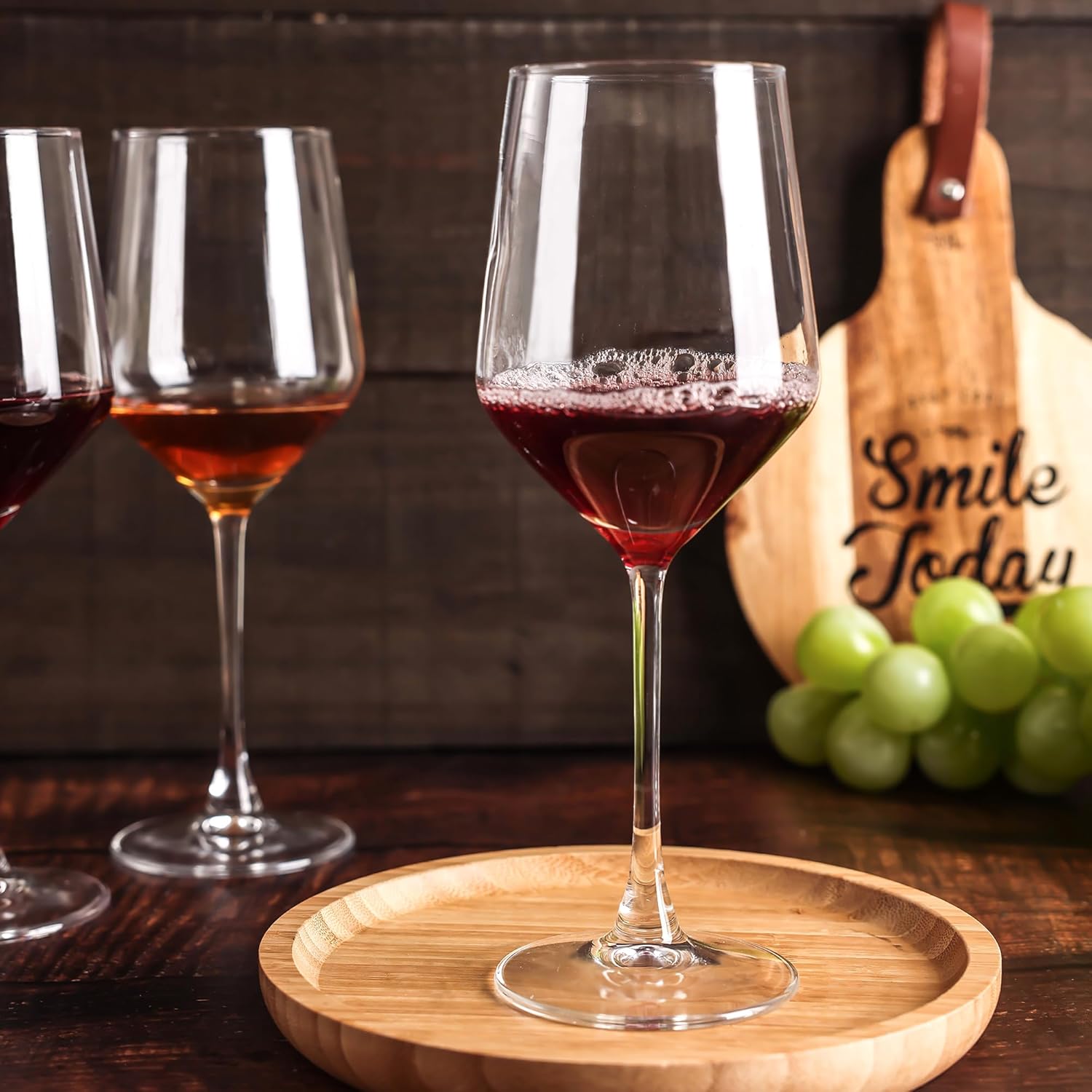
The Bordeaux glass is likely what you picture when you think of a “red wine glass.” It is the tall, majestic vessel seen on steakhouse tables worldwide. But its design is not just about looking regal; it is an engineering marvel designed for heavy hitters.
The Anatomy of the Chimney
Bordeaux wines (blends of Cabernet Sauvignon, Merlot, and Cabernet Franc) are known for being full-bodied and high in tannins. What is tannin in wine? It is that drying sensation that coats your gums. If a wine is too young, tannins can be harsh and bitter.
The Bordeaux glass features a tall bowl with a broad base that tapers gently upward. This height creates a distance between the wine and your nose, allowing ethanol vapors (which can burn the nose in high-alcohol wines) to dissipate slightly before you inhale the aroma.
Fluid Dynamics on the Palate
The most crucial aspect of the Bordeaux glass is the rim opening. It is designed to direct the flow of wine to the back of the tongue. By sending the wine straight to the back, it bypasses the sides of the tongue (often associated with acidity) and minimizes the initial contact with the gums, thereby reducing the perception of astringency. This makes a bold, tannic Cabernet taste smoother and more velvety.
Best Wines for this Glass:
Cabernet Sauvignon, Merlot, Bordeaux Blends, Malbec, Syrah/Shiraz, and Petit Verdot.
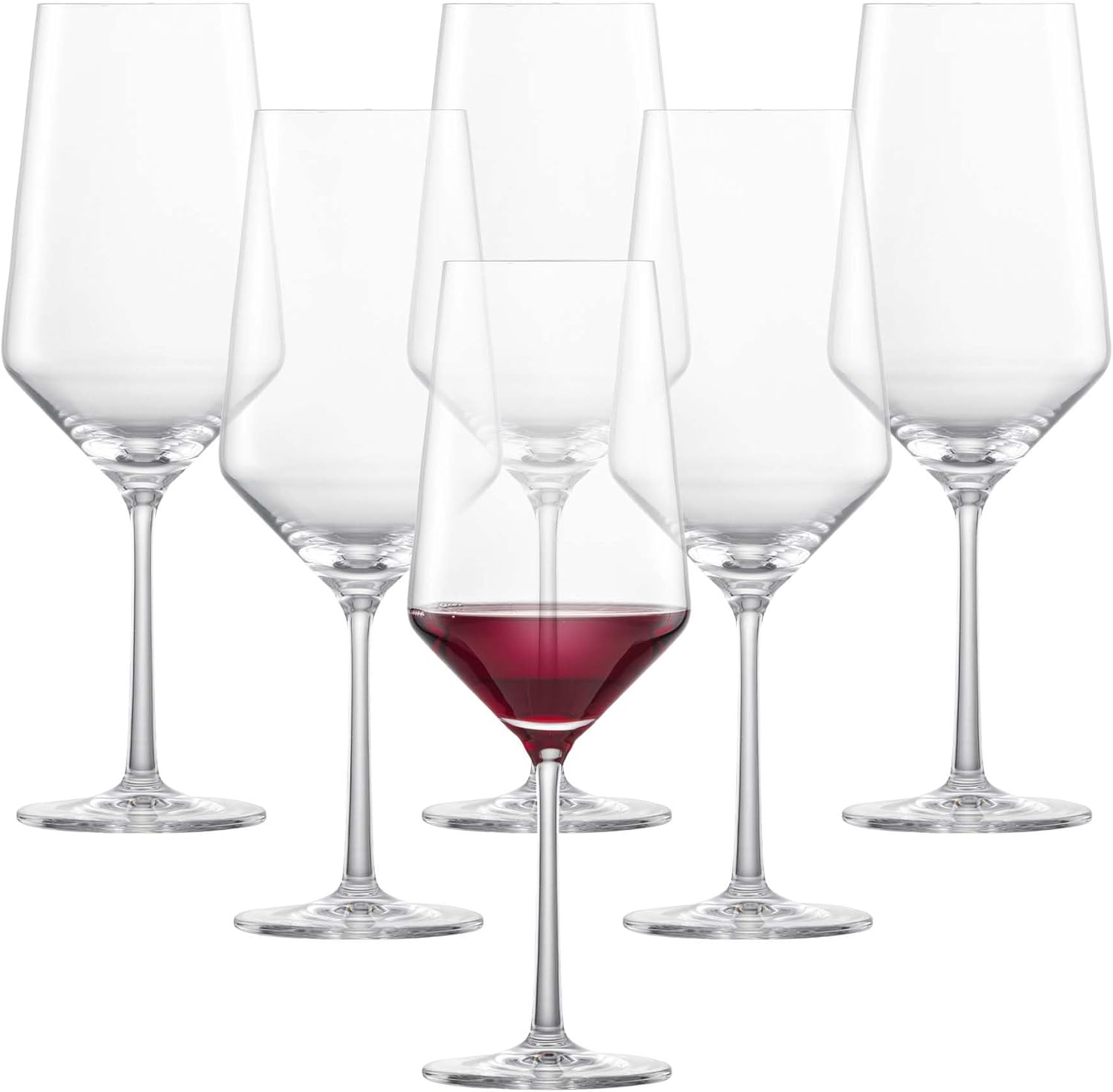
Our Top Pick: Riedel Vinum Bordeaux (Set of 2)
The industry standard for enjoying heavy reds. Crafted from fine crystal to perfectly balance tannin and fruit.
Check Price on AmazonThe Burgundy Glass: The Aroma Collector
If the Bordeaux glass is a skyscraper, the Burgundy glass is a stadium. It is shorter, but significantly wider. To the unobservant eye, it looks like a fishbowl on a stem. This unique shape is vital for wines that are driven by aromatics rather than power.
The Balloon Bowl Effect
Wines like Pinot Noir and Nebbiolo are lighter in color and lower in tannin but possess incredibly complex, volatile aromas (floral, earthy, red fruit). These aromas are delicate. If you put them in a tall Bordeaux glass, they might get lost in the “chimney.”
The massive surface area of the Burgundy bowl allows the wine to breathe rapidly. As you swirl, the wine coats the vast sides of the glass, encouraging evaporation. The rim, however, is tighter than the bowl. This traps the bouquet inside the glass, concentrating it right under your nose. When you stick your nose in, you get an explosion of scent that you would miss in a narrower glass.
The Tip of the Tongue
Unlike the Bordeaux glass, the Burgundy glass has a lip that tends to direct the flow of wine to the tip of the tongue. This is where we perceive sweetness. By hitting this area first, the glass highlights the delicate fruit flavors of the wine before the acidity kicks in, creating a balanced, elegant sip.
Best Wines for this Glass:
Pinot Noir, Red Burgundy, Gamay (Beaujolais), Nebbiolo (Barolo), and even high-end Oaked Chardonnay.
If you are exploring these varietals, check out our guide on wine varietals explained to understand which grapes fit this flavor profile.

The Enthusiast’s Dream: Zalto Denk’Art Burgundy
Mouth-blown, feather-light, and designed to unlock every hidden note in your Pinot Noir.
Check Price on AmazonThe Science of Aroma Delivery: Vapor Density and Glass Shape
The relationship between glass shape and aroma perception is not intuition or tradition—it is measurable chemistry. Wine contains over 800 aroma-active volatile compounds, including esters, terpenes, aldehydes, and pyrazines, each with different molecular weights, vapor pressures, and concentration thresholds. The shape of a wine glass directly determines which of these compounds reach the olfactory receptors in your nose at what concentration—and that determines much of what you perceive as “flavor.”
How Volatile Compounds Stratify in Different Bowl Shapes
Aromatic compounds in wine do not mix uniformly in the air space above the wine. They stratify—lighter, more volatile compounds (such as floral esters and fruit aldehydes) rise toward the top of the glass while heavier, less volatile compounds (like oak-derived lactones and earthy terpenoids) remain closer to the wine’s surface. This stratification is why experienced tasters move their nose from the rim downward: the aromatic profile shifts with each centimeter.
In a Bordeaux glass, the tall chimney creates a long stratification column. As you bring the glass toward your face, the lighter aromatic compounds—bright fruit, floral notes—are at the top of the glass close to your nose. The heavier compounds are trapped closer to the wine at the bottom. This architecture is ideal for complex, concentrated wines where you want to pick out aromatic layers progressively. For a young Cabernet Sauvignon, the height also allows harsh sulfurous or reductive notes (which dissipate quickly at higher concentrations) to escape before the more pleasant compounds reach the nose.
In a Burgundy glass, the wide bowl dramatically accelerates evaporation across a much larger surface area. The inward taper of the shoulder then acts as a collecting funnel, gathering the aromatic vapor cloud and directing it upward toward the narrower rim. When you bring a Burgundy glass toward your nose, you are essentially inhaling from a concentrated aromatic funnel—an extraordinarily effective delivery mechanism for the subtle rose, raspberry, and forest floor notes of a fine Pinot Noir that might otherwise be too diffuse to detect.
The Role of Ethanol Vapor
Ethanol is the enemy of aromatic perception when present in high concentration. At concentrations above approximately 14% ABV, ethanol vapors create a burning or stinging sensation in the nasal passages that masks aromatic compounds. This is why high-alcohol wines (many New World reds top 15% ABV) tend to “blow your nose off” in certain glasses but not others.
The tall chimney of a Bordeaux glass creates exactly the right distance for ethanol vapor to partially dissipate before reaching nose level. If you were to pour a 15.5% Napa Cabernet into a short, wide glass and immediately nose it, the ethanol would dominate and the fruit and oak would be masked. The Bordeaux glass’s height solves this problem architecturally. This is also why sommeliers often recommend opening and decanting high-alcohol wines before serving—the decanting process does for the bottle what the Bordeaux glass chimney does at the point of service.
Austrian Chemistry Institute research demonstrated that glass shape directly alters the “density and position of vapours” above wine. These vapour differences were measurable using gas chromatography and directly correlated with tasters’ aroma perception reports. The science has since been replicated multiple times and is now the foundation of professional stemware design.
How to Swirl: Technique Differences for Each Glass Shape
Swirling is not merely theatrical affectation—it is the single most effective action a drinker can take to accelerate aeration and release aromatic compounds before the first sip. However, the technique differs meaningfully between a Bordeaux and a Burgundy glass, and doing it incorrectly with a Burgundy glass in particular can send wine flying across a white tablecloth.
Swirling a Bordeaux Glass
The Bordeaux glass’s tall, relatively stable shape makes it forgiving to swirl. The standard technique—keeping the base on the table and moving the stem in small counterclockwise circles—works well and creates a gentle vortex that efficiently mixes the wine with air without risk of spillage as long as the glass is less than half full. Because the bowl is relatively narrow relative to the pour volume, even an aggressive swirl rarely risks overflowing. Fill to no more than one-third full for comfortable swirling; at this level, the vortex reaches the sides of the bowl without approaching the rim.
Swirling a Burgundy Glass
The Burgundy glass demands respect. Its wide bowl amplifies the swirl effect enormously—a movement that would barely disturb a Bordeaux glass creates a dramatic, swooping vortex in a Burgundy bowl. This is a feature, not a flaw: that wide vortex coats the entire interior surface of the bowl with a thin film of wine, massively increasing the evaporation surface area. However, fill a Burgundy glass more than one-quarter full and attempt an aggressive swirl and you will learn this lesson quickly at the expense of your table linen.
For Burgundy glasses, restrict the fill to no more than 20-25% of the bowl’s capacity and use small, controlled wrist movements rather than wide arm circles. The wide bowl means even tiny movements generate significant wine movement. An experienced sommelier’s swirl in a Burgundy glass is barely perceptible to an observer but creates a generous, slow-moving vortex inside the bowl.
Always swirl wide Burgundy glasses on the table surface rather than in the air. Keeping the base in contact with the table limits the amplitude of the swirl and dramatically reduces the risk of spillage. This is standard sommelier practice for good reason.
How Much to Pour: Fill Levels by Glass Type
| Glass Type | Recommended Fill Level | Why |
|---|---|---|
| Bordeaux Glass | 1/3 full (approx. 150-180ml in a standard 550ml bowl) | Allows full swirling range and adequate chimney space for aroma collection |
| Burgundy Glass | 1/4 full (approx. 150-180ml in an 800ml+ bowl) | Prevents spillage during swirling; the large bowl amplifies movement dramatically |
| Universal Glass | 1/3 full | Moderate bowl size tolerates standard fill levels comfortably |
Detailed Comparison: Functionality & Use Cases
Choosing between these two often comes down to your personal drinking habits. Let’s break down the pros and cons to help you decide which set deserves shelf space in your home.
Bordeaux Glass
Pros
- Versatility: Can successfully serve 80% of red wines.
- Tannin Management: Essential for young, bold wines.
- Durability: Often slightly sturdier due to shape mechanics.
- Aesthetics: Looks classic and formal on a table.
Cons
- Aroma Loss: Delicate scents can escape the wide opening too fast.
- Size: Tall stems can be difficult to fit in standard dishwashers.
Burgundy Glass
Pros
- Aromatic Intensity: Unbeatable for smelling complex wines.
- Aeration: The wide bowl acts like a mini decanter.
- Elegant Feel: The round shape feels luxurious in hand.
- Dual Use: Excellent for vintage Champagne and Oaked Chardonnay.
Cons
- Storage Issues: The wide bowl takes up significant cabinet width.
- Fragility: The wide expanse of glass is prone to cracking if tipped.
- Over-Aeration: Can make older, fragile wines fall apart too quickly.
Storage Considerations
Before buying a set of Burgundy glasses, measure your cabinets! The bowls can be 4 to 5 inches wide, meaning a standard shelf might only hold three glasses abreast. If space is tight, consider a modular wine rack system or hanging racks that accommodate wide bases. Proper storage is key—not just for wine bottles as discussed in how to store wine at home, but for the hardware that serves them.
Aged and Vintage Wines: When the “Right” Glass Can Go Wrong
Everything discussed so far about Bordeaux and Burgundy glass design applies most accurately to young-to-medium-aged wines—bottles within roughly ten years of their vintage. Once a wine reaches maturity, the calculus changes significantly, and the same glass that enhances a young wine can destroy an old one. This is one of the most under-discussed topics in stemware guidance, and it is particularly relevant for anyone pulling special bottles from a cellar.
Why Aged Wines Are Fragile
Over years of cellar aging, wine undergoes profound chemical changes. Tannins—those polymerized phenolic compounds that give young reds their grip—have long since linked together into long-chain polymers that precipitate as sediment. The harsh, astringent tannins of a young Cabernet have transformed into rounded, silky tannins in a twenty-year-old Bordeaux. The fruit is no longer the bold, primary expression it was at release; instead, it has evolved into complex tertiary aromas—leather, tobacco, dried fruit, forest floor, truffles.
Critically, these evolved aromatic compounds are significantly more volatile and fragile than the primary fruit aromatics of a young wine. They can dissipate and degrade within minutes of air exposure. This means that the wide, aerating Burgundy bowl—so beneficial for a young Pinot Noir—can actually destroy an old Burgundy by causing too-rapid oxidation of these delicate tertiary compounds. A twenty-year-old Chambolle-Musigny that would smell extraordinary in the first three minutes of decanting can become flat and oxidized within fifteen minutes in a Burgundy glass.
The Right Glass for Aged Wines
For wines with more than fifteen to twenty years of bottle age, many experienced collectors and sommeliers recommend a smaller glass than the varietal standard—sometimes even a mid-sized universal glass rather than the wide Burgundy bowl. The goal shifts from maximizing aeration to protecting fragile aromatics. You want just enough oxygen contact to open the wine but not so much that it collapses.
Similarly, a very old Bordeaux—a thirty-year-old Pauillac, say—may show better in a medium-bodied universal glass than in the full Bordeaux chimney. The chimney that helps dissipate harsh ethanol in a young wine is unnecessary for an old wine whose alcohol has long since integrated; the large open bowl may instead allow the wine’s quieter, evolved perfume to evaporate too quickly.
For wines over 15–20 years old, reduce the glass size by one step: use a medium universal where you would normally choose a Burgundy bowl, and a medium Bordeaux where you would use a full-sized grand cru chimney. Aged wines need protection from air more than they need oxygen. If in doubt, taste the wine in two different glasses simultaneously and compare—old wines will reveal their preference quickly.
Beyond France: Matching Glass Shapes to Global Wine Regions
The “Bordeaux glass” and “Burgundy glass” labels reflect their French origins, but these shapes serve wines from around the world. Understanding how to translate the functional principles—tannin management vs. aroma concentration—to Italian, Spanish, New World, and other regional wines is essential for any serious wine drinker whose collection extends beyond French classics.
Italian Wines: Complex Pairing Rules
Italy presents some of the most fascinating stemware challenges because its major red varietals span both categories. Sangiovese-based wines (Chianti, Brunello di Montalcino, Vino Nobile) are high in both tannins and acidity with moderate aromatics—they respond best to the Bordeaux glass’s tannin-softening delivery. However, a Brunello at peak maturity (fifteen to twenty years old) develops perfumed tertiary aromas that begin to argue for a slightly wider bowl.
Nebbiolo is perhaps the most debated Italian varietal in stemware circles. Young Barolo and Barbaresco are aggressively tannic—seemingly a natural fit for the Bordeaux glass. Yet Nebbiolo’s aromatic complexity (roses, tar, dried cherries, anise) is striking and delicate, more akin to Pinot Noir than Cabernet Sauvignon. Most Italian sommeliers and Piedmontese winemakers prefer a larger-format Burgundy glass for Nebbiolo for exactly this reason: the tannins soften with age anyway, but the aromatics need capturing. Zalto lists Nebbiolo explicitly as a recommended varietal for their Burgundy shape for this reason.
Aglianico—the “Barolo of the South”—is the exception. Southern Italy’s most powerful red, produced in Campania (Taurasi) and Basilicata (Aglianico del Vulture), is so tannic and structured that even at fifteen years of age, the Bordeaux glass remains the preferred delivery mechanism. Its aromatics are robust rather than delicate and benefit from the restraining architecture of the taller chimney.
Spanish Wines
Spanish red wines divide fairly cleanly along the Bordeaux/Burgundy axis. Tempranillo—the backbone of Rioja, Ribera del Duero, and many other Spanish appellations—is a medium-to-full-bodied varietal with moderate tannins and complex, evolved aromatics in barrel-aged examples. Young Tempranillo responds to the Bordeaux glass; aged Gran Reserva Rioja, with its haunting aromas of leather, tobacco, and dried cherry, often benefits from a slightly wider bowl to release those tertiary notes.
Garnacha (Grenache) deserves special mention. Despite being the backbone of many full-bodied southern Spanish blends, Garnacha has an unexpectedly delicate, volatile aromatic profile—fresh red fruit, flowers, white pepper—that is better served by a Burgundy glass. Many Priorat and Châteauneuf-du-Pape producers serve their Garnacha-dominant wines in Burgundy-shaped glasses specifically for this reason.
New World Wines: Climate and Alcohol Considerations
New World reds—particularly from warmer regions like Napa Valley, Barossa Valley, and Mendoza—tend to have higher alcohol (often 14-16% ABV), riper, more primary fruit character, and softer tannins than their Old World counterparts. These characteristics shift the glass preference in interesting ways.
A Napa Cabernet Sauvignon at 15% ABV arguably benefits from the Bordeaux chimney more than a 13% Bordeaux does—the extra height dissipating alcohol vapor is more necessary when the ABV is higher. However, these same New World reds often have more forward, exuberant fruit aromatics than Old World versions, and some collectors prefer a slightly wider bowl to showcase those aromatics rather than restraining them with the taller chimney.
| Varietal / Region | Recommended Glass | Reasoning |
|---|---|---|
| Barolo / Barbaresco (Nebbiolo) | Burgundy | Complex aromatics dominate; tannins soften with age |
| Brunello / Chianti (Sangiovese) | Bordeaux | High acidity + tannin structure benefits from rear-palate delivery |
| Rioja Reserva / Gran Reserva (Tempranillo) | Bordeaux or Universal | Young: Bordeaux for tannin; aged: Universal for evolved aromatics |
| Priorat / Garnacha | Burgundy | Volatile, delicate red fruit and floral aromatics |
| Napa Cabernet Sauvignon (15%+ ABV) | Bordeaux (tall chimney) | High alcohol requires maximum chimney height for ethanol dissipation |
| Barossa Shiraz | Bordeaux | Full-body, high tannins; robust aromatics tolerate tall chimney |
| New Zealand Pinot Noir | Burgundy | Bright, aromatic, lighter-bodied; same logic as French Pinot Noir |
| Argentinian Malbec | Bordeaux | Full-bodied, tannic; violet aromatics are robust enough for chimney |
Crystal vs. Standard Glass: Does Material Matter?
The debate between crystal and standard glass is nearly as old as the debate between Bordeaux and Burgundy shapes. For many casual wine drinkers, the choice seems purely aesthetic—crystal sparkles more, costs more, and feels more prestigious. But the functional differences are real, measurable, and directly relevant to the wine-tasting experience.
What Is Crystal, Actually?
Traditional crystal contains lead oxide (typically 24-30% by weight), which fundamentally alters the material’s optical and physical properties. Lead increases the refractive index of the glass, giving it that signature sparkle and brilliance. More practically for wine drinkers, lead also makes the material more workable—glassblowers can spin it thinner than standard glass without the material becoming brittle. This is why traditional crystal wine glasses have rims that are perceptibly thinner than mass-produced glass alternatives.
Modern “lead-free crystal” (also called “crystal glass”) replaces lead oxide with barium oxide, zinc oxide, or titanium oxide. These alternatives achieve similar workability and optical clarity without the toxicity concerns associated with lead. Today, virtually all premium wine glass manufacturers—Riedel, Zalto, Spiegelau, Schott Zwiesel—use lead-free crystal formulations. When people say “crystal” in the context of modern stemware, they almost always mean lead-free crystal.
Why a Thin Rim Changes the Experience
The most tangible functional benefit of crystal over standard glass is rim thinness. A mass-produced glass wine glass has a rim thickness of approximately 1.5-2.5mm. A quality lead-free crystal glass can achieve 0.5-0.8mm at the rim. This difference is directly perceptible when drinking.
A thick rim creates a physical “step” between the glass and the wine—your lips must bridge the edge, and the wine flows over it at a slight angle. A thin rim creates almost no physical interruption; the wine flows smoothly off the edge onto the tongue without any sensation of the glass itself. Blind tasting trials consistently show that drinkers perceive the same wine as “smoother” and “more refined” when drunk from a thin-rimmed crystal glass versus the same shape in thick glass. The wine hasn’t changed—the delivery has.
Machine-Made vs. Mouth-Blown: Does It Matter?
Premium crystal glasses are produced either by machine pressing/blowing or by hand (mouth-blown). Hand-blown crystal—as produced by artisans for brands like Zalto, Lehmann, and Gabriel-Glas—achieves greater thinness and consistency of thickness throughout the bowl, producing a more uniform drinking experience. Machine-made crystal can be excellent (Riedel Vinum and Schott Zwiesel Tritan are machine-made) but tends to be slightly heavier and have marginally thicker walls.
The practical difference between high-quality machine-made and hand-blown crystal is debated fiercely among collectors. The consensus among professional sommeliers is that the shape difference between, say, a Riedel Vinum Bordeaux (machine-made) and a Zalto Bordeaux (hand-blown) is more consequential for the drinking experience than the manufacturing method per se. A well-designed machine-made glass will outperform a poorly designed hand-blown one.
| Material | Rim Thickness | Weight | Dishwasher Safe? | Price Range |
|---|---|---|---|---|
| Standard Glass | 1.5–2.5mm | Heavy | Yes | $5–$20/glass |
| Machine-Made Crystal | 0.9–1.4mm | Moderate | Usually yes | $15–$50/glass |
| Hand-Blown Crystal | 0.4–0.8mm | Light | Hand-wash only | $50–$200+/glass |
Can’t I Just Use One Glass?
If you live in a small apartment or are looking for practical wine gift ideas, buying two distinct sets of crystal might seem excessive. You have options.
The Universal Glass
Brands like Gabriel-Glas, Zalto, and Glasvin have popularized the “Universal” glass. This shape is a hybrid. It has the slight taper of a Bordeaux glass but a wider bowl curve reminiscent of a Burgundy glass (though smaller). It is designed to be the “Jack of all trades.”
- Verdict: A high-quality Universal glass is better than a cheap varietal-specific glass.
The Decanter Solution
If you own Bordeaux glasses but want to drink Pinot Noir, you can compensate for the lack of bowl width by decanting. Using the best wine decanters allows the wine to oxygenate fully before it even hits the glass. Conversely, if you have a bold Cab and only a smaller glass, using an aerator can mimic the effect of a large Bordeaux bowl.
The Major Brands: Riedel vs. Zalto vs. Spiegelau vs. Schott Zwiesel vs. Gabriel-Glas
The stemware market has never been more competitive or more sophisticated. While Riedel held near-total dominance among serious wine drinkers for decades, the past fifteen years have seen an explosion of credible alternatives that challenge its supremacy at various price points. Here is a frank assessment of the major players and what they offer across both the Bordeaux and Burgundy categories.
Riedel
Founded: 1756, Kufstein, Austria
Range: Sommeliers (hand-blown, premium), Vinum (machine-made, mid-range), Veritas, Performance, Winewings
Bordeaux pick: Vinum Bordeaux — the industry standard mid-range choice, machine-made but excellent bowl geometry.
Burgundy pick: Vinum Burgundy — well-proportioned, dishwasher-tolerant, widely available.
Verdict: The safe, respected choice. The Vinum series represents extraordinary value for the quality. The Sommeliers Grand Cru range is for serious collectors who hand-wash religiously.
Zalto
Founded: 1990s, Vienna, Austria
Range: Denk’Art (6 shapes: Bordeaux, Burgundy, Universal, White, Champagne, Gravitas Omega)
Bordeaux pick: Denk’Art Bordeaux — hand-blown, weighs approximately 95g (vs Vinum’s ~150g), with razor-thin walls and an angular, sculptural silhouette.
Burgundy pick: Denk’Art Burgundy — the largest, most dramatic Burgundy glass commercially available. Holds nearly 1 liter; the wide-angle rim taper creates an extraordinary aromatic funnel.
Verdict: The connoisseur’s choice. Many experienced tasters consider Zalto the best-performing glasses available. The price is significant and they are hand-wash only. The Burgundy bowl is so large that some find it theatrical; those who embrace it report transformative results with delicate Pinot Noirs and aged Burgundy.
Spiegelau
Founded: 1521, Bavaria, Germany (owned by Riedel since 2004)
Range: Authentis, Style, Willsberger Anniversary, Definition
Bordeaux pick: Authentis Bordeaux — finely executed, dishwasher-safe lead-free crystal at a very accessible price.
Burgundy pick: Authentis Burgundy — slightly more restrained bowl than Zalto, which some drinkers prefer for everyday use.
Verdict: Outstanding value, particularly for households that insist on dishwasher use. The quality-to-price ratio in the Authentis line is difficult to beat. Often found in white-tablecloth New York restaurants for this reason.
Schott Zwiesel
Founded: 1872, Bavaria, Germany
Range: Tritan Crystal (proprietary formula), Pure, Cru Classic, Vinos
Notable difference: Proprietary Tritan crystal formula uses titanium and zirconium instead of lead or barium oxide, producing exceptional break-resistance without sacrificing thinness.
Bordeaux pick: Pure Bordeaux — elegant, thin, and dishwasher-safe.
Verdict: The best choice for households with children, clumsy guests, or an institutional environment. Tritan crystal is genuinely significantly harder to break than standard crystal while maintaining good optical clarity and rim thinness. The go-to for restaurants that want quality without constant breakage losses.
Gabriel-Glas
Founded: 2000s, Austria
Range: StandArt, Gold Edition (mouth-blown)
Philosophy: One-glass philosophy — designed to serve all wines from one shape. Not a true Bordeaux or Burgundy glass but a highly refined universal design.
Verdict: Perhaps the best single-glass solution available. Many serious collectors who have simplified their glass collections report that the Gabriel-Glas Gold Edition matches or outperforms their varietal-specific glasses for most wines. Exceptional for restaurants and hosts who want one glass to serve everything from Champagne to aged Burgundy.
Grassl Glass
Founded: Contemporary, Czech Republic
Range: Liberté, Cru, 1855
Notable: Hand-blown in Bohemia with extreme thinness; the Liberté and Cru designs have gathered a devoted following among collectors seeking Zalto alternatives at lower prices.
Verdict: Exceptional quality at a meaningful step below Zalto’s price. Notably fragile — they break more easily than Zalto and dramatically more easily than Schott Zwiesel. For the dedicated hand-washer with good coordination, the Grassl Cru is among the finest Burgundy-style glasses available.
Brand Recommendation Summary by Drinker Type
| Drinker Profile | Bordeaux Recommendation | Burgundy Recommendation |
|---|---|---|
| Casual / Everyday | Spiegelau Authentis | Spiegelau Authentis |
| Dishwasher Required | Schott Zwiesel Tritan Pure | Schott Zwiesel Tritan Pure |
| Enthusiast / Good Budget | Riedel Vinum Bordeaux | Riedel Vinum Burgundy |
| Serious Collector | Zalto Denk’Art Bordeaux | Zalto Denk’Art Burgundy |
| One-Glass Simplicity | Gabriel-Glas Gold Edition (Universal) | |
Building Your Stemware Collection: A Tiered Budget Guide
One of the most practical questions for any wine drinker is: how much should I spend, and where does the money make the most difference? The answer is more nuanced than most stemware marketing suggests. Here is a frank breakdown by budget tier, from the pragmatic to the extravagant.
Entry Level
Brands: IKEA Storsint, Amazon Basics crystal, Libbey Signature. Standard machine-made glass. Adequate for casual drinking but will noticeably limit the expression of fine wine. A good starting point; do not invest in expensive wine until you are ready to upgrade the glass.
Mid-Range
Brands: Spiegelau Authentis, Riedel Vinum, Schott Zwiesel Tritan. This is where the functional step-change happens. Riedel Vinum at this price tier genuinely transforms the experience of fine wine. Best value-for-performance level; most serious enthusiasts live here.
Premium
Brands: Zalto Denk’Art, Grassl Cru, Riedel Sommeliers. Real improvements in rim thinness, weight, and bowl geometry. The difference between this tier and mid-range is real but requires developed palate sensitivity to fully appreciate. Hand-wash only; expect occasional breakage.
Collector
Brands: Riedel Superleggero, bespoke hand-blown studio pieces. Extraordinary craftsmanship with diminishing practical returns for most drinkers. Best suited to professional sommeliers, serious wine educators, and collectors for whom the ritual is as important as the function.
How Many Glasses Do You Actually Need?
The “right” number of glasses in a collection depends entirely on your lifestyle and drinking habits. Here is a practical framework:
- Solo drinker or couple: 2–4 Bordeaux glasses, 2–4 Burgundy glasses (or 4–6 high-quality universals). A small collection enables proper matching without excessive storage demands.
- Regular dinner parties (4–8 guests): 6–8 Bordeaux glasses, 4–6 Burgundy glasses. Many hosts find that guests rarely object to drinking Pinot Noir from a Bordeaux glass if the alternative is rinsing between pours.
- Formal entertaining (8–12 guests): 12 Bordeaux glasses minimum, 8 Burgundy glasses. At this scale, consider doubling up on the mid-range Schott Zwiesel for durability against the inevitable party breakages.
- Wine club or tasting group: 12–24 identical glasses (usually Bordeaux format or universal) so all tasters evaluate wines under identical conditions.
Buy fewer glasses of higher quality rather than many glasses of lower quality. Two excellent Riedel Vinum Bordeaux glasses will give you more wine pleasure than twelve mediocre glass glasses. If budget is limited, start with four mid-range Bordeaux glasses for everyday red wine, then add four Burgundy glasses when your collection and palate expand.
Temperature, Glass Shape, and the Perfect Serve
Wine serving temperature and glass shape interact in ways that most drinkers never consider, yet together they determine a significant portion of the sensory experience. Choosing the right glass without controlling the serving temperature is like buying a fine speaker system and using a poor audio source—the potential is there but not being realized.
How the Bowl Size Affects Wine Temperature Over Time
Once wine is poured into a glass, it begins warming (or cooling) toward room temperature. The rate at which this happens depends on the glass’s surface area, the volume of wine, and the ambient temperature. A Burgundy glass, with its massive surface area, warms wine faster than a Bordeaux glass. A full Bordeaux glass at a deep fill level warms significantly more slowly than a small Bordeaux glass with only a few ounces.
This has a practical implication: if you serve a full-bodied red at 60°F (the ideal for most Cabernet Sauvignon), the wine in a Bordeaux glass will remain at or near that temperature for 20–30 minutes at normal room temperature. The same wine in a Burgundy glass, with its larger surface area, will warm to 68°F within 10–15 minutes. For wines that benefit from gradual warming (allowing aromatics to develop as they approach serving temperature), the Burgundy glass’s faster warming rate can actually be advantageous—the wine evolves in the glass. For wines that you want to maintain at a specific temperature, the Bordeaux glass’s more conservative warming rate is preferable.
The Body Heat Problem
Both Bordeaux and Burgundy glasses are designed to be held by the stem precisely to prevent body heat transfer from the hand to the wine. At rest, human skin temperature is approximately 91°F (33°C)—well above the ideal serving temperature for any wine style. Cupping the bowl with the hand (as many casual drinkers do) transfers significant heat to the wine within minutes, pushing it above its ideal serving temperature.
This problem is somewhat worse with stemless glasses (a popular modern format) and with wide Burgundy bowls if held improperly. Always hold a Burgundy glass by the lower portion of its stem, never by the bowl, and never rest it in the palm of your hand during extended tasting sessions.
What the Research Actually Says: Blind Tasting Experiments
The marketing claims surrounding wine glass design can be difficult to evaluate objectively. Are the differences real and consistent, or are they mostly placebo effect driven by the premium price and elegant appearance of fine crystal? The answer, based on controlled research and blind tasting experiments, is that the effects are real—but the magnitude varies significantly between wine types and between individual tasters.
The “Same Wine, Different Glass” Experiment
The most compelling evidence for glass-shape effects comes from controlled blind tastings where the same wine is served simultaneously in multiple glass types without the taster knowing which is which. Studies conducted by researchers at the Austrian Chemistry Institute, Bordeaux University, and various private glassware companies have consistently demonstrated that:
- Tasters rate the same wine an average of 0.5–1.2 points higher (on a 10-point scale) when poured into an appropriate varietal-specific glass versus an inappropriate one.
- The effect is most pronounced for aromatic, delicate wines (Pinot Noir, aged Riesling, old-vine Chenin Blanc) in properly designed wide-bowl glasses—confirming the Burgundy glass’s superiority for aroma concentration.
- The effect is measurable but less dramatic for full-bodied tannic wines, where the Bordeaux glass’s tannin-softening effect is subtle to most casual tasters but consistent among experienced ones.
- Rim thinness produces effects that are perceptible to most tasters regardless of wine knowledge level—confirming that crystal quality affects experience even when glass shape is held constant.
The “Wrong Glass” Effect
Perhaps more dramatically, the research confirms that the wrong glass can actively harm wine perception. A celebrated example from sommelier training: a Northern Rhône Syrah (Crozes-Hermitage or Saint-Joseph style)—elegant, peppery, medium-bodied—poured into a large Bordeaux grand cru glass tastes thin, hollow, and unimpressive. The same wine in a Burgundy glass or a medium-format universal glass reveals its haunting violet and white pepper character fully. The Bordeaux chimney simply dissipated the wine’s delicate volatile compounds before they reached the nose.
Conversely, a powerful, young Napa Cabernet poured into a Burgundy glass can seem raw, alcoholic, and overwhelming—the lack of ethanol dissipation in the lower chimney concentrates the alcohol vapors directly under the taster’s nose, masking the fruit. In the appropriate Bordeaux glass, the same wine tastes dramatically smoother and more approachable.
The “wrong glass” experiment is a standard demonstration in formal sommelier education programs (WSET Level 3, CMS Advanced, and Court of Master Sommeliers curricula). Trainees are asked to evaluate the same wine in two or three different glass formats and describe the differences. The exercise is considered more effective than many theoretical explanations at demonstrating why glass selection matters in professional wine service.
Wine Glass Etiquette: In the Restaurant and at the Table
Understanding how professional sommeliers use these glasses in a restaurant context reveals additional practical knowledge that translates directly to home service. Restaurant glass service is governed by a set of conventions that exist for functional as well as aesthetic reasons.
How Professional Sommeliers Choose Glasses
In a serious wine restaurant, the glass selection for a bottle is made by the sommelier before the bottle is opened—based on the wine’s varietal composition, appellation, vintage, and probable state of maturity. A young 2021 Barolo will be served in a Burgundy glass to release its perfumed aromatics; a twenty-year-old 2004 Barolo will be served in a slightly smaller universal to protect its evolved, fragile bouquet from over-aeration.
Many fine dining establishments maintain four or more glass formats on the floor at any given time: Bordeaux format for structured reds, Burgundy format for aromatic reds and rich whites, a white wine format (narrower bowl) for crisp whites and young Chardonnay, and a Champagne tulip for sparkling. The selection is made at the point of service based on the wine, not the guest’s preference.
How to Hold and Carry a Wine Glass Correctly
Hold wine glasses by the stem at all times during service and tasting. The only exception is during a brief sensory examination—sometimes tasters cup the bowl with both hands to warm a wine slightly that has been served too cold, but this is a deliberate, temporary action rather than a default hold. When carrying multiple glasses, professional servers hold the glasses by their stems between the fingers of one hand, with the glasses fanned outward to prevent bowl-on-bowl contact. This technique dramatically reduces both breakage and cross-contamination from fingerprints.
When to Ask for a Different Glass in a Restaurant
It is entirely appropriate—and most sommeliers genuinely appreciate—being asked for a different glass format when the one provided is clearly inappropriate for the wine ordered. If you have ordered a delicate Chambolle-Musigny and the sommelier brings a small, narrow, all-purpose restaurant glass, a polite request for a wider Burgundy bowl is the right call. If you have ordered an aged Barolo and the restaurant offers only a giant grand cru Burgundy glass, requesting a slightly smaller format is similarly reasonable.
Avoid requesting glasses from a format the restaurant does not carry—asking for a specific Zalto model when the restaurant uses Spiegelau is unreasonable. The request should be for a size or format difference, not a brand preference.
Wine Glass Gift Guide: The Perfect Set for Every Budget
Quality stemware is one of the most thoughtful, practical, and genuinely appreciated gifts a wine lover can receive—and yet it is surprisingly often overlooked in favor of wine accessories that have less functional impact. Here is a structured gift guide by recipient type and budget.
For the New Wine Enthusiast
Someone who has recently begun exploring wine seriously is best served by a set of four to six high-quality mid-range glasses in the Bordeaux format. The Riedel Vinum Bordeaux set is the canonical recommendation: it is dishwasher-safe, durable enough for daily use, widely available, and represents a genuine, immediately noticeable upgrade over the all-purpose glasses most people start with. A set of six retails in the $80–$120 range, an extremely accessible price for a gift that will visibly improve the recipient’s wine experience from the first pour.
For the Established Red Wine Lover
If the recipient already owns decent Bordeaux glasses, a set of four Burgundy glasses is an ideal progression gift. The Riedel Vinum Burgundy is the safe choice; for a more impactful gift, the Zalto Denk’Art Burgundy (typically $75–$90 per glass) is an extraordinary experience for a Pinot Noir devotee who has never tasted their favorite wine from a properly designed vessel. A set of two Zaltos with a note of explanation about how to use them is a memorable, meaningful gift.
For the Collector or Serious Enthusiast
At this level, the recipient has likely already tried most mainstream glass brands. Consider the Gabriel-Glas Gold Edition (a single-glass philosophy from Austrian master glassblowers), a set of Grassl Cru glasses, or—at the apex of stemware gifting—a pair of Riedel Superleggero Burgundy glasses for a Pinot Noir obsessive. Accompany any premium glassware gift with a dedicated microfiber polishing cloth set (the Riedel Microfiber Polishing Cloths are excellent) and a quality glass polishing stem brush for the Burgundy bowl’s deep interior.
For the Host Who Entertains Frequently
Durability and quantity matter more than ultimate quality for the host who regularly entertains eight or more people. The Schott Zwiesel Tritan Crystal Bordeaux glasses (a case of six retails for $90–$120) are the professional recommendation—hard enough to survive restaurant service, thin enough to elevate the wine experience, and available in consistent stock so broken glasses can be easily replaced.
Caring for Your Crystal
Whether you choose Bordeaux or Burgundy, high-end glassware requires respect. Crystal is porous and can absorb odors.
- Washing: Avoid standard dish soap if possible; it leaves a residue that kills bubbles in sparkling wine and alters flavor. Use hot water and a dedicated brush.
- Drying: Never air dry. Water spots are minerals that can etch the glass over time. Use a microfiber cloth.
- Handling: Hold by the stem, not the bowl. This prevents fingerprints and keeps your body heat away from the wine.
For a full list of tools to keep your glassware pristine, consult our guide on wine accessories every host needs.
Advanced Care: Storage, Odors, and Polishing
Premium crystal, particularly hand-blown glasses, should be stored upright whenever possible rather than inverted in a cabinet. While inverting glasses protects the rim from dust, it can trap odors inside the bowl—particularly if the cabinet has any wood smell (cedar, pine) which crystal absorbs readily. Stored right-side up, any ambient aromas dissipate; stored inverted, they concentrate.
If glasses have developed a musty or cardboard smell from storage, a quick rinse with cold water and air drying is usually sufficient to clear it. For persistent odors, fill the bowl with a dilute solution of white wine vinegar and water (one part vinegar, ten parts water), swirl gently, rinse thoroughly with hot water, and polish immediately with a lint-free microfiber cloth. Never use vinegar on leaded crystal, as the acetic acid can slightly etch the surface over repeated use.
Polishing a Burgundy glass properly requires a technique: insert a small polishing cloth into the bowl and use one hand on the outside of the bowl plus one hand manipulating the cloth inside to polish the interior simultaneously. A standard polishing cloth folded twice and attached to a slim polishing brush handles the deep interior of Burgundy bowls that fingers cannot reach. Schott Zwiesel, Riedel, and Zalto all sell dedicated glass polishing kits that include both the appropriate cloth and the stem brush insert.
Preventing the Most Common Types of Breakage
The most common points of breakage for wine glasses are, in order: the rim (chipped by contact with another glass or hard surface), the stem (snapped under lateral pressure during hand washing), and the base (cracked by being set down too firmly). For Burgundy glasses specifically, the wide bowl’s weight distribution makes the stem more vulnerable than on a Bordeaux glass—the center of mass is higher and further from the stem’s attachment point.
- Always wash glasses one at a time, never two simultaneously in the same hand.
- When washing the inside of a Burgundy bowl by hand, never press a cleaning cloth against the inside while gripping the outside—the lateral force this creates is the primary cause of stem snaps.
- In the dishwasher, face glasses inward toward the spray arm for Bordeaux shapes; Burgundy glasses should not be dishwashered unless the manufacturer explicitly confirms dishwasher safety.
- Never stack glasses inside each other for storage—even glass-on-glass contact gradually chips the rim.
Frequently Asked Questions
Here are the answers to the most common questions regarding the Bordeaux vs. Burgundy debate.
In a pinch, yes. However, the large bowl will cause the white wine to warm up quickly and may over-oxidize crisp whites like Pinot Grigio. It works better for heavy Chardonnays.
You are paying for the material (crystal vs. glass) and the manufacturing. Mouth-blown crystal is incredibly thin, which fundamentally changes the tasting experience by removing the “barrier” between the wine and your palate.
Usually nothing. They are synonyms in the glassware world. Both refer to the tall, large-bowled glass designed for full-bodied red wines.
Stemless glasses are casual and durable, but they warm the wine because your hand cups the bowl. For serious tasting of fine wines, stemmed is always preferred.
Technically yes, but you will miss much of what makes Pinot Noir special. Pinot Noir’s defining character is its aromatic complexity — roses, red berries, forest floor. These delicate compounds need the wide Burgundy bowl to concentrate and present themselves properly. In a Bordeaux chimney, these aromas simply escape before reaching your nose. For an occasional workaround, try decanting the Pinot Noir first to compensate for the glass’s narrower aerating surface.
The science is real. Controlled blind tastings at the Austrian Chemistry Institute and multiple university research programs have demonstrated measurable differences in aromatic vapor profiles above differently shaped glasses filled with the same wine. Gas chromatography analysis shows that glass shape determines which aromatic compounds reach the nose at what concentration. The effects are most pronounced for aromatic, delicate wines like Pinot Noir and aged Riesling, and measurably less significant for simple, low-aromatic wines. That said, rim thinness and crystal quality have a perceptible effect even when shape is held constant — the marketing does sometimes get ahead of the science, but the underlying functional principles are well-supported.
Not always. For aged wines (fifteen years or older), the wide Burgundy bowl can actually cause over-aeration — the fragile tertiary aromatics that develop during long cellar aging (leather, truffle, dried fruit, forest floor) are significantly more volatile than primary fruit aromas and can dissipate within minutes of exposure to a large surface area. Many experienced collectors use a medium-sized universal glass or even a slightly smaller Bordeaux glass for very old Burgundy, reserving the large bowl for wines up to ten to twelve years of age. When in doubt, taste the wine in two different glass formats simultaneously and trust your nose.
Barolo (Nebbiolo from the Piedmont region of Italy) is perhaps the most debated varietal in stemware discussions. Young Barolo is explosively tannic — it might seem like a natural fit for the tannin-softening Bordeaux chimney. However, Nebbiolo’s defining character is its complex aromatic profile (roses, tar, anise, dried cherry), and most professional sommeliers serving serious Barolo choose a large Burgundy glass specifically to honor those aromatics. As the wine ages, this recommendation becomes even stronger: a mature Barolo’s aromatics are extraordinary and fragile and need the wide bowl to express fully. Zalto explicitly recommends their Burgundy shape for Nebbiolo.
For the majority of wine drinkers, Riedel Vinum delivers 85-90% of the experience of Zalto at 25-30% of the price. The marginal improvement from Zalto is real — the thinner walls, lighter weight, and angular bowl geometry do make measurable differences to sensitive tasters — but the improvement is most appreciable when drinking genuinely fine wine (a premier cru Burgundy, a classified Bordeaux) where every element of the experience matters. For everyday drinking of excellent but not extraordinary wine, the Riedel Vinum is the smarter economic choice. If you frequently open bottles over $80, the Zalto investment becomes more justifiable.
The best first-line treatment is immediate rinsing with cold water — hot water can set red wine pigment. For set stains, fill the bowl with a mixture of warm water and a small amount of baking soda, let sit for fifteen minutes, and gently scrub with a soft bottle brush. For stubborn stains in the deep interior of Burgundy bowls (inaccessible to hands), dedicated long-handled glass-cleaning brushes with soft bristles are effective. Avoid using abrasive scrubbing pads — they scratch crystal surfaces and permanently dull the optical clarity. If the stain persists, a small amount of white wine vinegar in warm water, followed by thorough rinsing, is effective and safe for lead-free crystal.
Final Verdict: Which One Wins?
The battle of Bordeaux glass vs Burgundy glass ends in a draw because they fight in different weight classes.
Buy the Bordeaux Glass If:
You love Napa Cabs, French Bordeaux, Malbecs, and hearty dinner wines. This is the safe bet for the majority of red wine drinkers. It handles tannins beautifully and is versatile enough for most occasions.
Buy the Burgundy Glass If:
You are a “Pinotphile,” a lover of Barolo, or someone who spends 10 minutes smelling the wine before taking a sip. If you drink wines for their nose rather than their power, this glass is non-negotiable.
Buy Both If:
Your collection spans styles and regions — which it will, if you follow the wine rabbit hole far enough. The moment you have a serious Barolo next to a Napa Cab in your cellar, the case for owning both glass formats becomes self-evident. The investment is modest relative to the wines they are designed to serve, and the functional difference between the right glass and the wrong one is not subtle.
Ultimately, the best glass is the one that contains a wine you love. Whether you are using the best electric wine opener for a quick glass after work or decanting a 20-year-old bottle, the right tool enhances the art. Cheers!

Best Starter Set: Schott Zwiesel Tritan Crystal
Get the best of both worlds with this durable, high-clarity crystal set that offers tremendous value.
Check Price on Amazon