Top Rated Wine Chiller Reviews: Keep Your Pour Perfect
From rapid electric coolers to elegant marble buckets, we tested the best ways to maintain the perfect temperature for your Pinot Grigio and Cabernet alike.
Introduction: Temperature is Taste
There is a tragedy that occurs in dining rooms every summer: a perfectly crisp bottle of Sauvignon Blanc is brought to the table, opened with a top rated wine opener, and poured. The first glass is divine. The second glass is okay. By the third glass, the wine is lukewarm, flabby, and unappealing.
Temperature is the most critical factor in wine service. Serve a white wine too warm, and it tastes like alcohol and sugar syrup. Serve a red too hot, and it loses its structure. While wine coolers (fridges) are essential for storage, they don’t help once the bottle is on the table.
This is where a top rated wine chiller becomes essential. Unlike a fridge, a chiller is a service tool — a bucket, sleeve, or electric device designed to maintain temperature while you drink. In this guide, we explore the best options on the market, comparing passive insulators against active cooling gadgets to help you find the perfect match for your home bar.
Understanding the Types: Which Do You Need?
Before buying, it is vital to distinguish between the categories. “Wine Chiller” is a broad term that covers several distinct technologies.
1. Passive Insulators (Vacuum & Double-Walled)
These do not actively cool the wine; they insulate it. Examples include double-walled stainless steel buckets like the Huski. They rely on the bottle being cold already. Best for: Dinner parties where the bottle will be finished within 90 minutes.
2. Thermal Mass Chillers (Marble & Stone)
Heavy marble or granite crocks absorb and hold cold when pre-chilled in a fridge or freezer, then slowly release that cold to the bottle. Beautiful but bulky. Best for: Table centerpieces and slow sippers in cool rooms.
3. Active Gel Chillers (Sleeves & Wraps)
Wine chiller sleeves wrap around the bottle like a cold jacket with direct gel contact. Require freezing beforehand but can actually chill a warm bottle, not just maintain temperature. Best for: Picnics, outdoor events, and quick cooling of room-temp bottles.
4. In-Bottle Sticks (Chiller Rods)
Stainless steel or acrylic freeze-and-insert devices that sit inside the bottle, chilling from within. Compact and portable. Best for: Bars, travel, and keeping a cold bottle cold for a single evening.
5. Electric Single-Bottle Chillers
Tabletop appliances using electricity to maintain a precise temperature indefinitely. For a deep dive, see our guide on the best electric wine chillers. Best for: Slow sippers, solo drinkers, and precision enthusiasts.
At a Glance: Top Rated Options
| Product Type | Cooling Method | Portability | Est. Duration | Needs Pre-Chilling? |
|---|---|---|---|---|
| Huski Premium Cooler | Vacuum Insulation | High | Up to 6 Hours | No (bottle must be cold) |
| Marble Chiller | Thermal Mass | Low (Heavy) | 1–2 Hours | Yes (pre-chill marble) |
| Waring Pro Electric | Electric (Thermoelectric) | None (Corded) | Indefinite | No |
| Le Creuset Sleeve | Frozen Gel | Very High | 1.5 Hours | Yes (freeze sleeve) |
| Corkcicle Air Stick | In-Bottle Ice Rod | High | 45 min – 1 Hour | Yes (freeze stick) |
1. The Stainless Steel Vacuum: Huski Wine Cooler
The Huski has taken the wine world by storm, winning design awards for its simplicity and effectiveness. It functions like a high-end thermos for your wine bottle — double-walled vacuum insulation with a copper lining traps cold without ever sweating on your table.
Why it wins: Unlike traditional buckets, it requires no ice, no mess, no water rings. It fits most standard 750ml bottles including many sparkling wines. If you enjoy organic and natural wines in oddly shaped bottles, the adjustable height is a lifesaver.
Performance: In our tests, it kept a chilled Pinot Grigio at drinking temperature for nearly 6 hours — ideal for long summer barbecues or taking wine to a BYOB restaurant using one of the best wine bags.
✅ Pros
- No ice needed — dry table guaranteed.
- Exceptional 6-hour thermal retention.
- Adjustable height for different bottles.
- No condensation, ever.
❌ Cons
- Doesn’t fit ultra-wide Champagne bottles.
- More expensive than a standard bucket.
- Cannot actively chill a warm bottle.

2. The Electric Countertop: Waring Pro PC100
If you are serious about temperature precision, active cooling is the way to go. The Waring Pro allows you to select the exact temperature for the wine you are drinking — ensuring your Bordeaux vs Pinot Noir are served exactly right.
Technology: It uses thermoelectric cooling, similar to what you find in a thermoelectric wine cooler — no vibration, quiet operation, and precise digital control.
Use Case: Perfect for the slow sipper. Open a bottle on Friday night and want it at exactly 55°F for three hours while you watch a film? This is the tool. It also pairs brilliantly with wine preservation systems like Coravin — keep the bottle in the chiller between pours.
✅ Pros
- Precise, indefinite temperature control.
- Looks professional on a countertop.
- Silent thermoelectric operation.
- Can cool a room-temp bottle actively.
❌ Cons
- Takes up permanent counter space.
- Requires a power outlet.
- Not portable — zero outdoor use.

3. The Classic Sleeve: Le Creuset Cooler Sleeve
Sometimes the simplest solution is the best. The Le Creuset sleeve is a thick nylon jacket filled with cooling gel. You keep it in the freezer, and when ready, slide it over the bottle.
Flexibility: The elastic sides stretch over standard Bordeaux bottles, wider Burgundy bottles, and sparkling wine bottles. It fits easily inside portable wine coolers for extra insulation on longer journeys.
Speed: Because frozen gel makes direct contact with the glass, it can actively chill a room-temperature bottle in about 20 minutes — something a marble bucket or vacuum insulator cannot do.
✅ Pros
- Extremely durable and machine-washable.
- Actively chills warm bottles (20 min).
- Very affordable and portable.
- Works on all standard bottle shapes.
❌ Cons
- Casual aesthetics — not ideal for formal settings.
- Must be frozen several hours in advance.
- Loses effectiveness after 90 minutes.

The Science of Temperature: Why Every Degree Matters
Temperature is not a preference in wine service — it is chemistry. The volatility of aromatic compounds, the perception of tannin and acid, the apparent sweetness and alcohol heat of a wine all shift measurably with every degree of temperature change. Understanding the mechanisms behind these shifts transforms temperature management from guesswork into precision.
🔬 What Temperature Actually Changes in Your Glass
Aromatic compounds have specific volatility thresholds — temperatures at which they release from the wine’s surface into the air above the glass. Too cold, and aromas are suppressed: the wine seems dull, closed, and simple. Too warm, and alcohol becomes disproportionately volatile, creating a “hot,” spirit-like quality that overwhelms delicate fruit. The ideal serving temperature is the sweet spot where the wine’s specific aromatic compounds are maximally expressive without alcohol dominance.
Temperature’s Effect on Tannin and Acidity
Temperature dramatically affects the perception of tannin — the polyphenolic compounds responsible for the drying, gripping sensation in red wines. Cold temperatures make tannins feel harder, more astringent, and more aggressive. Warm temperatures make tannins feel softer and more integrated. This is why a young, tannic Barolo served slightly below room temperature (around 60–62°F) feels more approachable than the same wine served at a warm 72°F — paradoxically, the cooler temperature actually makes the wine seem rounder.
Acidity perception works somewhat differently: cooler temperatures heighten the sensation of acidity, making wines feel crisper and more refreshing. This is precisely why serving a high-acid white like Sauvignon Blanc at 45–48°F feels so vibrantly clean, while the same wine at 65°F feels flat and almost syrupy despite having identical chemical acidity.
Sweetness perception decreases at lower temperatures and increases at warmer temperatures. This is why dessert wines — already very sweet — are typically served slightly warmer than dry whites, allowing their sweetness to integrate rather than dominate.
Alcohol Burn and Temperature
Ethanol volatility increases with temperature. A full-bodied red wine at 14.5% alcohol served at 72°F will feel noticeably “hot” and alcoholic in ways that the same wine at 62°F does not. The warming effect is not imaginary — it is a direct result of increased ethanol vapors reaching the sensory receptors in your nose and throat. For high-alcohol wines (13.5%+), serving even 5°F cooler than “room temperature” dramatically improves the balance of the wine.
The Complete Serving Temperature Guide for Every Wine Style
Knowing the ideal temperature for your specific wine — not just “white wine cold, red wine room temperature” — is what separates thoughtful wine service from guesswork. Use this guide alongside your chiller to set precise targets.
⚠️ The “Room Temperature” Myth Debunked
The common instruction to serve red wine at “room temperature” originated in 18th-century France, where rooms averaged 60–62°F. Modern centrally heated homes average 68–72°F — 6–10 degrees too warm for almost every red wine. A Cabernet Sauvignon served at 72°F will taste alcoholic, hot, and flat. The same wine at 64°F is structured, balanced, and complex. If your red has been sitting in a warm room, give it 15 minutes in any chiller before serving.
How Fast Can You Chill Wine? Every Method Timed
You have a bottle of white wine at room temperature (72°F) and guests arriving in 20 minutes. What is the fastest path to a properly chilled pour? This is one of the most-searched wine questions, and the answer depends entirely on which method you use.
The Salt-Ice-Water Bath: Explained
This is the professional chiller’s fastest weapon. The physics are straightforward: ice-water contact cools a bottle much faster than ice cubes alone because liquid water conducts heat more efficiently than air. Adding salt lowers the freezing point of the water mixture, allowing it to remain liquid at temperatures below 32°F — creating a super-chilled brine that extracts heat from the bottle faster than any other passive method.
- Fill a bucket approximately halfway with ice — crushed ice works faster than cubed because it creates more surface contact area with the bottle.
- Add cold water until the bottle is submerged to its shoulder — the ice-to-water ratio should be approximately 50/50. The water fills the air gaps between ice cubes.
- Add two generous handfuls of table salt and stir briefly — the salt depresses the freezing point of the water, creating a liquid below 32°F. The solution becomes noticeably colder within 60 seconds.
- Insert the bottle and rotate it every 2–3 minutes — rotation ensures that the surface of the glass constantly contacts fresh cold brine rather than the slightly warmed layer immediately surrounding the bottle.
- Check temperature at the 10-minute mark — a wine thermometer or instant-read kitchen thermometer inserted into the neck confirms readiness. Most white wines reach ideal serving temperature (45–50°F) within 10–15 minutes.
💡 The Wet Paper Towel Freezer Trick
Wrap your bottle in 2–3 layers of wet paper towels (saturated, not just damp) and place it in the freezer. As the water evaporates and freezes, it draws heat away from the bottle rapidly through both evaporative cooling and conduction. This method achieves results in 15–20 minutes that a dry bottle in the freezer takes 25–30 minutes to match. Set a kitchen timer — a forgotten bottle in the freezer will eventually freeze and potentially crack.
The Traditional Ice Bucket: A Complete Guide
The ice bucket is one of wine service’s oldest and most elegant tools. Used correctly, it is highly effective; used incorrectly, it is merely decorative. Despite being seemingly simple, most people use ice buckets wrong — producing slow cooling, premature warming, and unnecessary mess.
Ice Bucket Material Comparison
🥈 Stainless Steel (Single Wall)
Standard in restaurants. Durable and lightweight. Will condense on the outside in humid conditions — always use a drip tray. Cools the ice mixture rapidly but also absorbs heat from the room. Replace ice every 45–60 minutes.
🥈 Stainless Steel (Double Wall)
The modern upgrade. No external condensation, slower heat exchange from the room, and better ice retention. The Huski-style vacuum version represents the extreme end of this category. Premium choice for table service.
🏺 Marble / Stone
Visually stunning centerpiece. Must be pre-chilled in a fridge for 2+ hours to activate. At room temperature without pre-chilling, provides only marginal insulation. Heavy — not movable once placed.
🧊 Crystal / Glass
Formal table elegance. Zero insulating properties — purely aesthetic. Always requires a full ice-water mix to be effective. Best suited for formal dining settings where appearance trumps practicality.
🪣 Acrylic / Plastic
The budget option. Durable and dishwasher-safe. Poor insulation — ice melts faster, water temperature rises faster. Functional for casual settings; not appropriate for formal service or extended outdoor use.
How to Use an Ice Bucket Correctly
- Use 50% ice, 50% cold water — never ice alone. The water fills gaps between ice cubes, ensuring the bottle’s entire surface makes contact with cold liquid rather than cold air. Cold water cools 30x faster than cold air.
- The bottle should be submerged to its shoulder — the shoulder is where the bottle narrows and the wine fills the neck. Getting this region cold prevents the wine from warming up the instant it’s poured.
- Keep the label visible but dry — tuck a clean napkin under the bucket and drape one over the bucket’s rim to dry the bottle as you remove it. Wet labels tear; torn labels are unprofessional at formal service.
- Add salt only for speed chilling, not long-term service — the salt brine is colder than regular ice water but also fluctuates more in temperature. For a bottle you want to maintain at a precise temperature for 2 hours, regular ice water is more stable.
- Refresh ice every 45–60 minutes — as the ice melts, the water temperature rises. A bucket of 80% water and 20% floating ice cubes is barely colder than a cold tap. Drain half the water and add fresh ice at the midpoint of a long dinner.
Chilling Champagne and Sparkling Wine: Special Considerations
Sparkling wine requires the coldest serving temperature of any wine style — and also the most careful temperature management during service. The internal pressure of a Champagne bottle (approximately 90 psi) is directly influenced by temperature: a warm bottle has higher pressure and is harder to open safely; a cold bottle has lower pressure, produces finer bubbles, and opens with much more control.
Why Cold Temperature is Critical for Sparkling Wine
The CO2 dissolved in sparkling wine is more soluble at lower temperatures. This means a colder wine holds its bubbles in solution longer, releasing them more slowly and persistently in the glass — producing the fine, continuous streams of tiny bubbles associated with quality Champagne. A warm sparkling wine releases CO2 rapidly and aggressively, producing large, coarse bubbles that dissipate quickly and a flat, overly fizzy mouthfeel.
Temperature also affects foam stability: cold temperatures support the protein-polysaccharide structures that create a persistent head, while warmer temperatures cause foam to collapse almost immediately after pouring. If you have ever poured Champagne and watched it immediately go flat and foamy, it was almost certainly too warm.
The Ideal Champagne Chilling Protocol
Champagne should ideally be chilled slowly in a refrigerator for at least 3–4 hours before service rather than rapidly in an ice bath. Rapid temperature changes can temporarily shock the wine, suppressing its aromatics. For a celebration where pre-chilling isn’t possible, the salt-ice-water bath will bring a room-temperature bottle to serving temperature (43–47°F) in approximately 20 minutes — acceptable as an emergency measure, but not ideal for fine Champagne.
Once chilled and opened, Champagne should be kept in a vacuum chiller or ice-water bucket throughout service. The Le Creuset sleeve, while excellent for still wines, can be tricky to fit over wider Champagne bottles — always check diameter specifications before purchasing any sleeve-type chiller if you drink sparkling wine regularly.
Champagne Chiller Width: Check Before You Buy
Standard wine bottles are approximately 3 inches (75mm) in diameter. Champagne bottles range from 3.3–3.5 inches (85–90mm) — significantly wider. Many wine sleeves and vacuum chillers are sized for standard Bordeaux bottles and will not accommodate Champagne. Always verify the stated maximum diameter in the product specification. The Huski adjustable model and most ice buckets are Champagne-safe; most sleeves and tube-style chillers are not.
Chilling Red Wine: Which Reds Benefit and By How Much
The idea of chilling red wine still surprises many drinkers — it seems counterintuitive, even sacrilegious to some. In reality, the majority of red wines are served significantly too warm in home settings, and a brief stint in any chiller produces a dramatically better glass. Understanding which reds benefit most, and by how much, makes this one of the highest-value improvements any wine drinker can implement tonight with zero cost.
Light and Medium-Bodied Reds: Chill Enthusiastically
Beaujolais, Pinot Noir, Gamay, Zweigelt, light Grenache, and young Barbera are all wines that professional sommeliers routinely serve slightly chilled — typically at 54–60°F. These wines have lower tannin and higher acidity than full-bodied reds, and their primary appeal is freshness and vibrant fruit. A light Beaujolais Villages at 58°F is a revelatory, refreshing experience; the same wine at 72°F is flat, alcoholic, and oddly sweet-seeming.
The rule of thumb: if a red wine’s primary appeal is fresh, bright red fruit (cherry, raspberry, strawberry) rather than earth, leather, or dried fruit complexity, it benefits from serving toward the cooler end of the red wine range.
Full-Bodied Reds: Cooler Than You Think
Cabernet Sauvignon, Syrah, Malbec, Barolo, Amarone, and Châteauneuf-du-Pape are all wines that should be served at 62–66°F — which is still below average room temperature in most modern homes. At 72°F, their tannins soften excessively, their alcohol becomes disproportionately volatile, and the complexity that makes them worth drinking gets obscured by heat.
A practical protocol: if a full-bodied red has been stored in a wine fridge at 55°F, take it out 20–30 minutes before service to allow it to reach 62–65°F naturally. If it has been at room temperature (70°F+), give it 10–15 minutes in an ice bucket or chiller before serving.
Aged and Vintage Reds: Handle with Care
Very old bottles of fine red Burgundy or Barolo (15+ years) are more temperature-sensitive than younger wines and also require careful handling to avoid disturbing sediment. For these, a gentle passive chiller — either a vacuum insulator at the correct starting temperature or the careful use of a marble chiller pre-chilled to about 62°F — is preferable to any method involving rapid temperature change. Thermal shock in very old wines can temporarily (and sometimes permanently) suppress their most delicate aromatic compounds.
Emergency Wine Chilling Hacks That Actually Work
Sometimes you need cold wine and you have none of the right tools. These are the methods that genuinely deliver results when you are working with what is in your kitchen, not what is in a wine accessories catalog.
The Wet Towel Freezer Method (Best DIY Speed Trick)
Wet 3–4 paper towels completely and wring them out so they are wet but not dripping. Wrap them around the bottle in a spiral pattern, covering as much glass surface as possible. Place the wrapped bottle upright in the freezer. The combined effect of conduction through the wet paper and evaporative cooling as the surface moisture begins to freeze drops bottle temperature 20–25% faster than a dry bottle alone. Set a timer for 18 minutes — check, rotate, and reassess at that point. Do not exceed 30 minutes without checking.
The Spinning Trick for Consistent Cooling
Whether in an ice bucket, salt bath, or open freezer, rotating a bottle every 2–3 minutes dramatically accelerates chilling. The wine near the glass warms the glass slightly as it transfers heat; rotating brings warm wine from the bottle’s center into contact with the cold glass while already-cooled wine moves toward the center. This convection effect can cut chilling time by 30–40% compared to a static bottle.
Pre-Chilled Wine Glasses
If you have a chilled bottle but no chiller, refrigerate your wine glasses for 15–20 minutes before service. A glass at 45°F will slow temperature rise considerably compared to a room-temperature glass at 70°F. This is a standard technique in professional wine service for maintaining serving temperature at the table — particularly useful for sparkling wine poured at celebrations where a chiller bucket isn’t practical.
What Not to Do: Common DIY Mistakes
- Never put a warm bottle in the freezer and forget it. Wine freezes at approximately 23°F and will crack a glass bottle or push the cork out when the volume expands during freezing. Always use a timer.
- Never use a microwave or hot water to warm red wine. The temperature increase is uneven and damages the wine structurally. If a red is too cold, cup the glass in your hands — body heat is a perfectly calibrated warming tool.
- Do not use only ice cubes without water in a bucket. The air gaps between cubes mean large portions of the bottle surface are touching only cold air, not cold liquid. The cooling speed is drastically lower than an ice-water mixture.
Outdoor Wine Chilling: Picnics, Barbecues, and Beach Solutions
Keeping wine cold outdoors presents fundamentally different challenges than indoor service. Ambient temperatures can be 85–95°F in summer; there may be no freezer access for pre-chilling sleeves; portability and durability matter as much as cooling performance. The right outdoor chiller strategy involves layered solutions rather than any single tool.
The Portable Chiller Hierarchy for Outdoor Use
Best overall for outdoors: Vacuum insulated bucket (Huski-style) — starts no ice needed, maintains temperature for 6 hours, no mess, no condensation on grass or tablecloths. The clear winner for anyone spending money on one outdoor chilling solution.
Best for active chilling outdoors: Gel sleeve + small insulated bag — pre-freeze the sleeve and bring it in an insulated bag. Once on-site, the sleeve maintains a warm-weather bottle for 45–75 minutes. Carry two sleeves for an afternoon event.
Budget outdoor solution: A small hard-sided cooler with ice and water — not elegant, but a small camping cooler with proper ice-water ratio is highly effective for maintaining temperature for several hours. Works for multiple bottles simultaneously.
Outdoor Chilling Timeline Planning
For a 3-hour outdoor event in warm weather, here is the practical planning guide:
- Start with bottles cold from the refrigerator (never room temperature).
- Transport in an insulated wine bag to minimize heat gain in transit.
- Place in a vacuum chiller or ice bucket immediately on arrival.
- For ice buckets: bring more ice than you think you need — hot outdoor temperatures melt ice 3x faster than indoor environments.
- Keep bottles shaded — direct sun on a glass bottle adds heat faster than any chiller can remove it.
💡 The Insulated Wine Bag as a Chiller Extension
A quality insulated wine bag can extend a vacuum chiller’s effectiveness by an additional 1–2 hours outdoors by providing a second layer of insulation against ambient heat. Place the already-chilled bottle in the vacuum sleeve, then store both in the insulated bag between pours. This layered approach keeps wine at serving temperature for nearly an entire afternoon event without any additional ice.
Wine Chiller Materials Deep Dive: What You’re Actually Buying
The material composition of a wine chiller determines its thermal performance, durability, weight, and aesthetic suitability for different contexts. Understanding what each material can and cannot do prevents the common disappointment of buying a beautiful chiller that performs poorly at its primary function.
Stainless Steel (Double-Walled Vacuum)
This is the current performance standard for table service wine chillers. Vacuum-insulated stainless steel works on the same principle as a vacuum flask: the evacuated space between the inner and outer walls eliminates conductive and convective heat transfer, leaving only minimal radiative heat exchange. The result is a chiller that keeps a cold bottle cold for 4–6 hours without ice, without condensation, and without requiring any preparation beyond having a pre-chilled bottle.
The copper lining found in premium models like the Huski adds an additional radiative barrier, reducing heat gain from the environment even further. These units are the clear choice for anyone hosting regularly who values convenience and table presentation equally.
Marble and Natural Stone
Marble’s appeal as a wine chiller is partly aesthetic and partly thermal. Marble has a genuinely high specific heat capacity — it absorbs and holds temperature changes slowly, making it resistant to rapid warming once chilled. However, this property works in both directions: at room temperature, marble also absorbs heat slowly, which means a room-temperature marble chiller provides only modest insulation. Its effectiveness is almost entirely dependent on being pre-chilled to below the wine’s serving temperature before use.
A marble chiller chilled in the fridge to 40–45°F and then placed at room temperature will keep a bottle cold for approximately 60–90 minutes — less than a frozen gel sleeve but more elegant. For formal dinner settings where aesthetics are paramount, marble remains the refined choice for this moderate performance level.
Gel-Filled Neoprene and Nylon Sleeves
Gel-filled sleeves operate through direct thermal contact between a frozen gel matrix and the bottle’s glass surface. The gel is typically a proprietary mixture of water, glycerin, and polymers that freezes at a higher temperature than water (around 25–28°F) and maintains its cold longer than pure ice. The neoprene or nylon outer layer provides both protection for the frozen gel and a second layer of insulation.
The critical advantage of gel sleeves over passive insulators is their ability to actively cool a warm bottle — not just maintain a cold one. A frozen gel sleeve can drop a 72°F bottle to 50°F in approximately 20 minutes, a task that is physically impossible for any passive insulator regardless of material quality.
Chiller vs. Cooler: Do You Need a Fridge?
We often get asked if a chiller can replace a wine fridge. The answer is no — and understanding why clarifies what role each product plays.
A Wine Chiller is for active service: one bottle, for a few hours, at the table. It cannot maintain humidity, cannot hold multiple bottles, and cannot provide the temperature stability required for long-term aging.
A Wine Cooler (Fridge) is for storage: multiple bottles, for months or years, with humidity control and vibration management that protect the wine’s development over time.
If you are looking to store a collection, check our detailed Whynter wine cooler review or Ivation wine cooler reviews. If you live in a small apartment and just need one white cold for dinner, a tabletop chiller — or even storing wine without a fridge using smart techniques — is entirely sufficient.
The 7 Most Common Wine Temperature Mistakes
Even experienced wine drinkers make these errors consistently. Each one reduces the quality of the wine in your glass regardless of what you paid for the bottle.
- Serving red wine at actual room temperature. As covered above, modern room temperature (68–72°F) is 6–10°F too warm for virtually every red wine. Ten minutes in a chiller before serving makes a measurable difference.
- Serving white wine too cold. A Chardonnay at 38°F from a very cold fridge suppresses its aromatics and makes it taste thin and watery. Allow 10 minutes on the counter before pouring, or set your wine fridge to 50°F for whites.
- Opening Champagne without pre-chilling. A warm Champagne bottle has significantly higher internal pressure, increases the risk of an uncontrolled cork ejection, and will foam excessively when poured. Always chill before opening.
- Forgetting that the glass warms the wine. A wine poured at 50°F into a room-temperature glass at 70°F will be at 58°F within three minutes. For white wines you want to keep cold, either chill your glasses or use a sleeve on the bottle throughout service.
- Trusting the fridge temperature display. Wine fridges can have cold spots (usually near the back) and warm spots (usually near the door). Use an independent thermometer to verify actual internal temperature, particularly at the shelf where you store your most important bottles.
- Chilling in the freezer without a timer. The freezer is a viable emergency chilling method — with a timer. Without one, a forgotten bottle will freeze, expand, push the cork, and potentially crack. 20–25 minutes maximum, always monitored.
- Assuming all whites need the same temperature. A delicate Muscadet and a full, oaky White Burgundy are both “white wine” but require serving temperatures 10°F apart to show their best. The Muscadet at 45°F; the Burgundy at 55°F. A dual-zone electric chiller solves this problem precisely.
Wine Chiller Gift Sets: What Makes a Great Gift?
Wine chillers are excellent gifts for housewarming events, birthdays, and wine-loving friends — practical, universally useful, and available across every price point. The best gifts in this category combine a quality chiller with complementary service tools that create a complete wine service experience.
💚 Under $30: Perfect First Gift
A Le Creuset gel sleeve + a set of 4 wine stoppers makes an immediately useful, attractive gift. Alternatively, a marble single-bottle chiller is visually impressive at this price point and suits anyone with a stable, climate-controlled kitchen.
💜 $30–$70: Thoughtful Enthusiast
A vacuum insulated Huski-style chiller is the standout at this level. Pair it with a quality foil cutter or a set of crystal wine glasses for a complete service package. This price range gets you professional-grade insulation that the recipient will use for years.
🔴 $70+: The Entertainer’s Upgrade
An electric single-bottle chiller (Waring Pro style) paired with a chiller sleeve and a bottle of the recipient’s favourite wine creates a memorable, experience-focused gift. At this level, also consider a dual-bottle vacuum chiller set for serious entertainers who regularly open multiple bottles per evening.
💡 What to Look for in a Wine Chiller Gift Set
The best gift sets include tools that work across the bottle-opening and service workflow. A chiller paired with a quality aerator stopper (to maintain temperature between pours) or a set of chiller-compatible wine glasses shows thoughtfulness. Avoid sets that simply bundle multiple cheap individual chillers — one excellent chiller outperforms three mediocre ones in daily use.
Keeping Wine at Temperature at Restaurants and BYOB Events
BYOB dining and events where you are responsible for your own wine service present a specific challenge: how do you transport a chilled bottle and maintain its temperature through a 2-hour dinner without access to a wine fridge or ice bucket?
The Vacuum Sleeve Solution
The vacuum insulated bottle sleeve (Huski-style or similar) is the definitive BYOB solution. Transport your pre-chilled bottle in the sleeve inside a quality wine tote and it arrives at serving temperature. At the table, leave the bottle in the sleeve between pours — no ice bucket required, no condensation on the white tablecloth, no explanation needed to staff.
What to Ask For at Restaurants
At restaurants that provide ice buckets for still wine service, request a 50/50 ice-water mixture if you observe the staff using ice cubes only. A brief, friendly mention — “Could we have some water added to the bucket?” — is entirely appropriate and will improve your wine’s service temperature significantly. At formal establishments, the sommelier will typically manage this automatically.
For red wines at restaurants: if your red arrives at the table warm (common in restaurants where reds are stored at room temperature on display shelves), you can request an ice bucket and ask for it to be placed in the bucket for 5–8 minutes. This is a completely reasonable and increasingly common request — no sommelier will take offense at a guest who knows what they want.
Buying Guide: Features to Look For
1. Material
Vacuum-insulated stainless steel: Best all-around. No condensation, no ice, superior retention. Modern standard for serious home service. Marble: Beautiful but passive — requires pre-chilling and offers moderate performance. Gel sleeves: Active chilling capability but require preparation and suit portable use. Acrylic/plastic: Budget-friendly but poor insulation — best used only as an ice bucket carrier.
2. Size Compatibility
Standard bottles are 3 inches in diameter. Champagne and sparkling wines are wider (3.3–3.5 inches). Ensure your chiller is wide enough if you drink bubbles. Burgundy bottles are also slightly wider than Bordeaux. Always verify the maximum diameter specification — not just that a product says it fits “standard wine bottles.”
3. Condensation Management
If you have a nice wooden table, condensation is the enemy. Single-walled metal or plastic buckets will sweat profusely. Always opt for double-walled construction or keep a wine serving tray underneath single-walled options.
4. Ease of Cleaning
Wine can drip inside any chiller, and dried wine residue develops unpleasant odors over time. Sleeves should be machine-washable (most quality gel sleeves are). Vacuum steel buckets should be rinsable with a long-handled brush. Marble chillers require careful cleaning with non-abrasive cloths — acidic wine residue can etch marble surfaces over time if left unwiped.
Frequently Asked Questions
A wine chiller is a tabletop service tool (bucket, sleeve, or electric single-bottle holder) used to maintain a bottle’s temperature during a meal or event. A wine cooler (or fridge) is a dedicated appliance for storing multiple bottles long-term at controlled temperature and humidity. You need both if you collect wine seriously — the cooler for storage, the chiller for service.
Yes, but they are passive insulators, not active chillers. Marble has high thermal mass — pre-chill it in the fridge for 2+ hours and it will keep a bottle cold for 60–90 minutes at room temperature. At room temperature without pre-chilling, it provides only marginally better insulation than leaving the bottle on the counter. Think of it as beautiful temperature insurance, not a cooling device.
No. If you insert a chiller stick into a full bottle, the displacement will cause the wine to overflow immediately. Always pour out 2–3 oz (a small glass) before inserting any in-bottle chilling device. The stick works by conducting cold from its frozen core outward through the wine — it needs contact with liquid, not just air at the top of the bottle.
An ice-salt-water bath is the fastest passive method — filling a bucket with 50% ice, 50% water, and two generous handfuls of salt can chill a bottle from room temperature to serving temperature in 10–15 minutes. The salt lowers the freezing point of the water, creating a super-cold brine below 32°F that extracts heat from the bottle rapidly. Alternatively, the wet-paper-towel-in-the-freezer method achieves similar results in 15–20 minutes.
Yes — briefly and strategically. Most red wines are served too warm in home settings. Light reds (Pinot Noir, Beaujolais) should be served at 54–60°F; full-bodied reds at 62–66°F. Modern room temperature of 68–72°F is too warm for all of them. Even 10 minutes in a chiller before serving a red wine makes a measurable improvement in structure and balance.
Light-bodied whites (Sauvignon Blanc, Pinot Grigio, Riesling): 45–49°F. Full-bodied oaked whites (Chardonnay, Viognier): 50–55°F. Sparkling wines and Champagne: 43–47°F. A common mistake is serving full-bodied whites too cold — they suppress their aromatic complexity when below 48°F. If your wine fridge is set to 40°F for everything, your Chardonnay is being under-served.
Most modern electric wine chillers use thermoelectric cooling — fan-based, with no compressor motor. They produce a low, steady hum similar to a laptop fan, typically 35–40 decibels. This is noticeable in a completely silent room but disappears entirely under normal conversation. Compressor-based models (rare in single-bottle chillers) produce a cyclical hum similar to a refrigerator.
For a standard 750ml bottle starting at room temperature: 20–25 minutes for light-bodied whites to reach serving temperature; 15–18 minutes for sparkling wine. Always set a timer — wine freezes at approximately 23°F and an expanded frozen bottle can push out the cork or crack the glass. The wet-paper-towel trick reduces required freezer time to 15–18 minutes with better temperature control.
Ice buckets work well for decanters — simply place the decanter in the bucket as you would a bottle. Sleeves and tube-style vacuum chillers will not accommodate the wider bases and irregular shapes of most decanters. If you frequently serve decanted white wine or want to keep a decanted red at a precise temperature, an electric single-bottle chiller with a wide opening or a large ice bucket are the practical options.
Final Verdict: The Best Way to Chill
Our Recommendations by Profile
For the Entertainer: Get the Huski Wine Cooler. Elegant, no sweating, keeps wine cold for 6 hours. The best all-around passive chiller available.
For the Tech Enthusiast: The Waring Pro electric chiller offers the precision needed for fine wines. Counter space well spent for slow sippers.
For the Outdoor Lover: The Le Creuset Sleeve is virtually indestructible and highly effective — the best portable active chiller for any adventure.
For the Budget-Conscious: A well-executed salt-ice-water bucket technique costs nothing beyond a container and basic supplies and outperforms most gadgets costing under $30.
Temperature is the final ingredient in any great wine. Don’t let your investment in quality wine go to waste by serving it warm. Cheers!
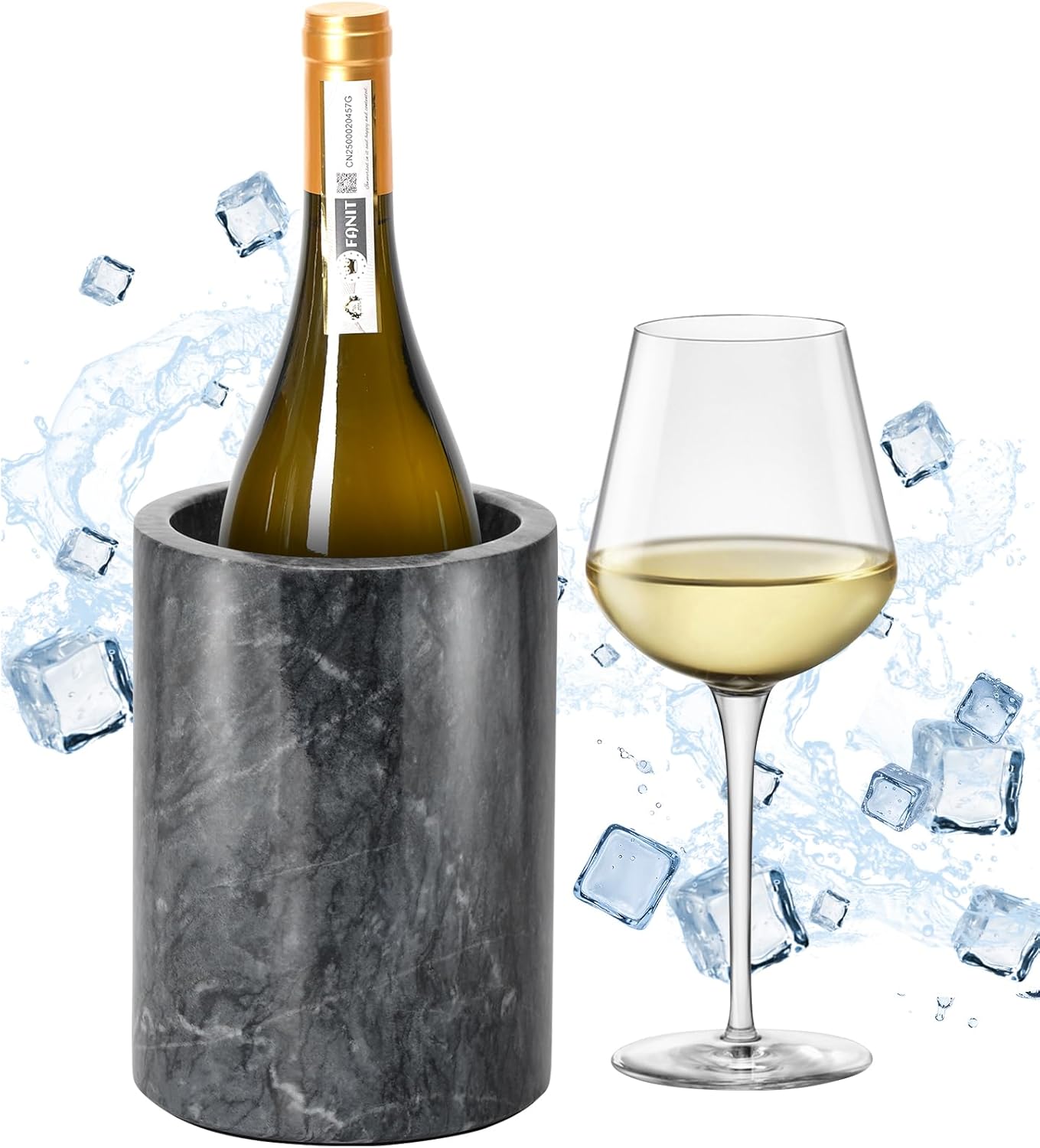
Classic Choice: Natural Marble Wine Cooler
Heavy, stable, and naturally cool. A timeless centerpiece.
Check Price on Amazon