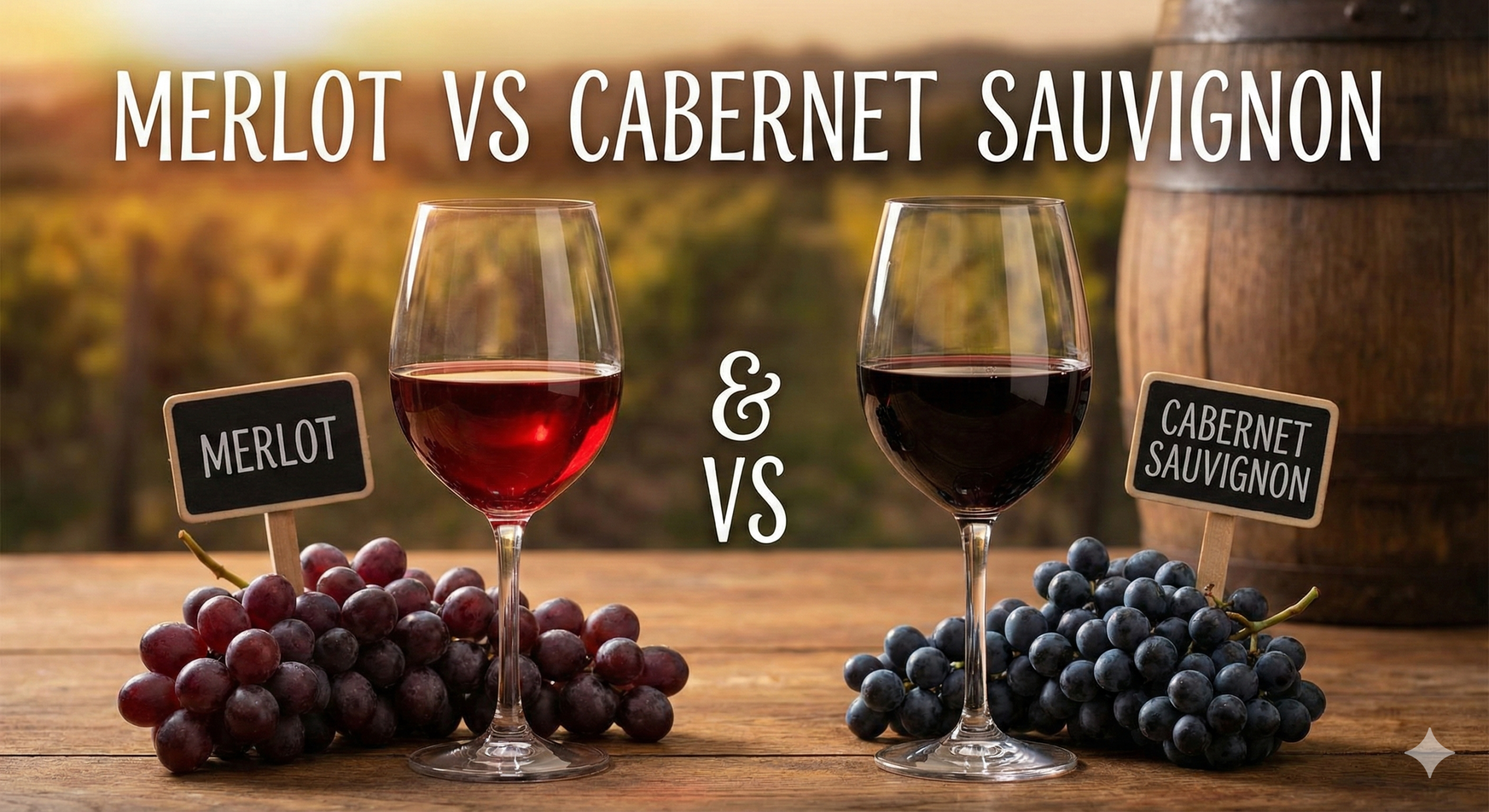
Walk into any wine shop, and you will see two names dominating the red wine shelf: Merlot and Cabernet Sauvignon. They are the two most popular red grapes in the world, often growing side-by-side in Bordeaux. Yet they could not be more different in the glass.
If Cabernet is the loud, assertive guest at the party, Merlot is the smooth, approachable conversationalist. Choosing between them is not just about taste — it is about what you are eating, how long you plan to age the bottle, and which expression of a grape’s personality speaks to you on a given evening.
The Quick Comparison
Do not have time to read the full breakdown? Here is the cheat sheet to help you decide which bottle to open tonight.
| Feature | Merlot | Cabernet Sauvignon |
|---|---|---|
| Body | Medium to Full | Full Boldest |
| Tannins | Soft & Velvety | High & Grippy |
| Acidity | Medium | Medium-High Higher |
| ABV Range | 13–14.5% | 13.5–15% |
| Primary Fruit | Plum, Cherry, Raspberry | Black Currant, Blackberry |
| Secondary Notes | Chocolate, Mocha, Vanilla | Cedar, Tobacco, Green Pepper |
| Best With | Roast Chicken, Pasta, Pork | Steak, Lamb, Aged Cheese |
| Aging Potential | 5–15 years (most) | 10–30+ years (premium) |
| Approachability | Drink young Easier | Benefits from age |
Origins & DNA: The Same Family Tree
To understand why Merlot and Cabernet Sauvignon taste so different, you need to understand where they came from — because they share more genetic history than most drinkers realize. Both are products of the same parent grape, and their divergence in character tells the story of how soil, climate, and time shape a vine’s identity.
Cabernet Franc: The Parent of Both
In the mid-17th century in southwestern France, a natural crossing occurred between Cabernet Franc (a red grape cultivated in Bordeaux for centuries) and Sauvignon Blanc (a white grape from the Loire Valley). The result was Cabernet Sauvignon — a discovery confirmed by DNA profiling research in the late 1990s, which finally explained why a red wine grape could carry the distinctly herbaceous, green-pepper aromatics associated with a white grape parent. Cabernet Sauvignon’s pyrazine character — that signature green pepper and cassis note — is a direct genetic inheritance from Sauvignon Blanc.
Merlot shares the same Cabernet Franc parent. Its second parent is believed to be Magdeleine Noire des Charentes, a rare ancient grape variety from southwestern France. Merlot’s lineage therefore runs parallel to Cabernet Sauvignon rather than descending from it — they are, genetically, half-siblings, both children of Cabernet Franc.
The Etymology of “Merlot”
The name Merlot is derived from the French word merle, meaning blackbird. The most widely accepted theory is that the name was given because of the grape’s dark, glossy blue-black berries, which resemble a blackbird’s plumage, or because blackbirds were observed eating the ripe Merlot berries with particular enthusiasm. The earliest written record of the name “Merlot” dates to the early 19th century in the Libournais region of Bordeaux.
Phylloxera and the Modern Vineyard
Both varietals were dramatically shaped by the phylloxera crisis of the late 19th century, when a root-eating louse native to North America devastated virtually every vineyard in Europe. Both Merlot and Cabernet Sauvignon survived only through grafting onto American rootstock — a practice that continues universally today and which subtly influences both varietals’ character to this day. The post-phylloxera replanting of Bordeaux in the early 20th century cemented both varietals’ dominance in their respective banks of the Gironde estuary and established the regional hierarchy that persists today.
Cabernet Sauvignon is a natural hybrid of Cabernet Franc (red) and Sauvignon Blanc (white) — a genetic crossing that occurred spontaneously in the 17th century. Merlot shares the same Cabernet Franc parent. They are half-siblings, not parent and child — a fact that explains their shared structural backbone alongside their dramatically different aromatic and textural personalities.
Grape Anatomy: Why the Berry Determines the Wine
The physical characteristics of the grape berry itself — its size, skin thickness, and seed count — are among the most direct determinants of the wine’s structure, color, and flavor. Before the winemaker touches the fruit, the grape’s own anatomy has already determined much of what will end up in the glass.
Cabernet Sauvignon’s Thick-Skinned Intensity
Cabernet Sauvignon berries are notably small and densely structured, with thick skins and a high ratio of seeds to juice. This anatomy has profound consequences. The thick skins are rich in anthocyanins (color compounds) and tannins — the polyphenolic compounds responsible for the wine’s deep ruby-purple color and its characteristic grippy, astringent mouthfeel. A small berry also means a high skin-to-juice ratio: you are extracting more tannin and color per milliliter of juice than you would from a larger berry. The seeds contain their own tannins (seed tannins, which are harsher and greener than skin tannins) — and Cabernet Sauvignon’s high seed count per berry means seed tannin management during winemaking is a significant consideration.
Merlot’s Plush, Thin-Skinned Approachability
Merlot berries are larger and thinner-skinned than Cabernet Sauvignon. The larger berry means a lower skin-to-juice ratio — proportionally less tannin and color extraction per milliliter of juice. The thinner skins produce softer, more supple tannins that do not require years in the bottle to integrate. This is the fundamental physical explanation for Merlot’s famously approachable, plush character: it is literally built into the berry’s anatomy. Merlot’s larger, juicier berries also ripen to higher natural sugar levels at harvest more readily than Cabernet’s smaller berries — which is why Merlot frequently expresses richer, more fruit-forward flavors even in cooler conditions.
The Vineyard: Left Bank vs Right Bank Bordeaux
The most famous expression of both varietals’ geography is the division of Bordeaux along the Gironde estuary and Garonne River into its “Left Bank” and “Right Bank.” This divide is not merely administrative — it reflects genuine differences in soil composition, microclimate, and centuries of accumulated viticultural wisdom that positioned each grape on the terroir where it performs best.
Left Bank: Cabernet Country
The Left Bank of Bordeaux encompasses the Médoc peninsula and the Graves appellation, extending south from the city of Bordeaux. The defining soil here is deep gravel and sand deposited by the Garonne and Dordogne rivers over millennia. These well-drained, poor, gravelly soils force vine roots to dig deep — sometimes six or more meters — in search of water and nutrients. This stress produces small-berried, intensely flavored fruit with concentrated tannins and acidity. The Left Bank’s slightly warmer, drier microclimate (moderated by the Atlantic ocean to the west and the forests of the Landes further south) suits Cabernet Sauvignon’s late-ripening character, giving it the long, warm growing season it needs to fully ripen and develop its characteristic black fruit complexity.
The famous appellations of the Left Bank — Pauillac, Saint-Estèphe, Saint-Julien, Margaux — produce what many consider the world’s greatest Cabernet-dominant wines. These are wines of extraordinary aging potential, structured around Cabernet’s tannin backbone with Merlot added as a softening and fleshing-out component.
Right Bank: Merlot’s Kingdom
Across the Gironde estuary, the Right Bank — particularly the appellations of Saint-Émilion and Pomerol — has a fundamentally different soil composition: clay and limestone. Clay soils retain water and warmth, which suits Merlot’s roots perfectly. Merlot vines thrive in these moister, cooler conditions and ripen reliably even in challenging vintages when the Left Bank’s Cabernet Sauvignon might struggle. The result is wines of extraordinary plushness and weight — the iconic Pomerol estate Pétrus, for example, makes one of the world’s most expensive and sought-after wines from a soil that is almost pure clay, planted almost entirely to Merlot.
A simple shorthand: Left Bank = Cabernet dominant, Right Bank = Merlot dominant. When you see a Left Bank appellation (Pauillac, Saint-Julien, Margaux, Saint-Estèphe) on a label, the wine will be structured around Cabernet. When you see a Right Bank appellation (Saint-Émilion, Pomerol, Fronsac), the wine will be built around Merlot’s plush, fruit-forward character.
Ripening Cycles & Vintage Risk
One of the most practically important differences between Merlot and Cabernet Sauvignon is when they ripen — a difference that has significant consequences for vintage variation, the winemaker’s harvest decisions, and the style of wine produced in any given year.
Cabernet Sauvignon: The Late Ripener
Cabernet Sauvignon is a late-ripening variety. In Bordeaux, it typically ripens two to three weeks after Merlot, meaning harvest usually falls in October rather than September. This late ripening is both a strength and a vulnerability. The extended growing season allows Cabernet’s tannins and complex flavor compounds to develop fully, producing wines with greater structure, depth, and longevity. However, the late harvest also exposes the grapes to autumn rain and cold, which can dilute concentration or prevent full ripening in cooler years. This is why Bordeaux vintages vary so dramatically — a wet October can ruin a Left Bank Cabernet vintage while having minimal impact on the Right Bank’s already-harvested Merlot.
Merlot: The Early Ripener
Merlot is an early-ripening variety, typically harvested two to three weeks before Cabernet Sauvignon. This earlier ripening makes it more reliable in cooler regions and in years with difficult autumn weather. In warm climates, however, Merlot’s early ripening can work against it — if the winemaker waits too long for flavor complexity to develop, the acidity drops and the grape risks over-ripening into a jammy, flat wine. This is why some of the most criticized “fruit bomb” Merlots come from overripe harvests in warm California growing seasons. The skill in producing great Merlot lies in harvesting at precisely the right moment when phenolic ripeness and acidity are perfectly balanced.
Soil Science: How the Earth Shapes the Wine
The relationship between soil type and wine character is one of the most fascinating aspects of viticulture, and the Merlot versus Cabernet Sauvignon comparison provides one of the clearest demonstrations of how dramatically soil influences flavour.
Gravel and sand (Cabernet’s preferred soils) drain quickly, force vine stress, warm rapidly in the day and cool quickly at night — creating a daily temperature swing that preserves acidity in the grapes even as they accumulate sugar. Gravel-grown Cabernet Sauvignon retains a distinctive mineral quality — that pencil-lead, graphite note that connoisseurs of Left Bank Bordeaux and Napa Valley Cabernet associate with the finest examples of the grape.
Clay and limestone (Merlot’s preferred soils) retain moisture, creating a more even water supply for the vine throughout the growing season. Clay soils also retain heat, accelerating ripening and contributing to Merlot’s characteristic roundness and flesh. Limestone adds a chalky mineral quality that is particularly evident in the finest Saint-Émilion wines — a subtle earthy character beneath the fruit that distinguishes them from the plushly fruity Merlots produced on richer soils.
Outside Bordeaux, the soil story continues. Napa Valley’s volcanic and alluvial soils produce powerful, concentrated Cabernet Sauvignon with remarkable depth. Washington State’s basalt-based soils give its Merlot a distinctive firmness and structure that sets it apart from California’s softer expressions. Chile’s Maipo Valley combines Andean-influenced gravel soils with a dry, sunny climate that produces consistently excellent Cabernet Sauvignon with intense, focused dark fruit.
The Winemaking Process: How Each Grape Is Handled
The grape’s raw material sets the parameters, but the winemaker’s decisions shape the final wine. Cabernet Sauvignon and Merlot are handled differently at virtually every stage of production, and these differences compound the distinctions already established by the grape’s anatomy and growing conditions.
Fermentation and Maceration
Cabernet Sauvignon’s thick skins and high tannin potential mean winemakers can afford — and often want — extended maceration (skin contact time) during fermentation. This extended contact extracts more tannin, deeper color, and greater complexity from the skins. Top Napa and Bordeaux producers often macerate for three to four weeks for their premium Cabernet Sauvignons, building the structural framework that allows decades of aging. For young, affordable Cabernet, shorter maceration periods produce a more approachable style, but the grape’s natural tannin content means it will always have more grip than Merlot.
Merlot’s thinner skins require more careful maceration management. Extended maceration can easily over-extract harsh seed tannins that overwhelm the grape’s naturally plush, fruit-forward character. Most Merlot producers favor shorter maceration periods (10–14 days for premium examples) and gentle extraction techniques that preserve the soft, supple texture that defines the grape at its best.
Oak Aging: Duration and Impact
Both varietals are traditionally aged in French oak barrels, but the duration and the type of oak used differ meaningfully. Premium Cabernet Sauvignon typically receives 18–24 months of oak aging, sometimes longer. This extended oak contact contributes vanilla, cedar, smoke, and toast notes that complement Cabernet’s dark fruit and integrate with its firm tannins over time. New oak percentages in premier cru Bordeaux and top Napa Cabernet can reach 50–100% — a significant investment in both cost and character.
Merlot typically spends 12–18 months in oak, often with a lower percentage of new barrels. Too much new oak overwhelms Merlot’s more delicate fruit, replacing the grape’s natural plum and chocolate with barrel-derived vanilla that can make the wine seem generic. The trend among quality-conscious Merlot producers has shifted toward larger-format barrels (demi-muids and foudres) and older oak that imparts structure without dominating aroma.
Flavor & Tasting Notes: A Full Sensory Map
Cabernet Sauvignon is famous for its “green pepper” note (from pyrazines), which adds a savory complexity to its dark fruit core. It hits your palate with a drying sensation due to high tannins. If you love a wine that fights back a little, this is your pick. To understand the science behind that sensation, read our article on what is tannin in wine.
Merlot, by contrast, is often described as “fleshy.” It has lower tannins and higher natural sugar levels at harvest, creating a lush, chocolatey mouthfeel. It is the perfect entry point for those learning how to describe wine terminology.
Complete Aroma Wheel: Cabernet Sauvignon
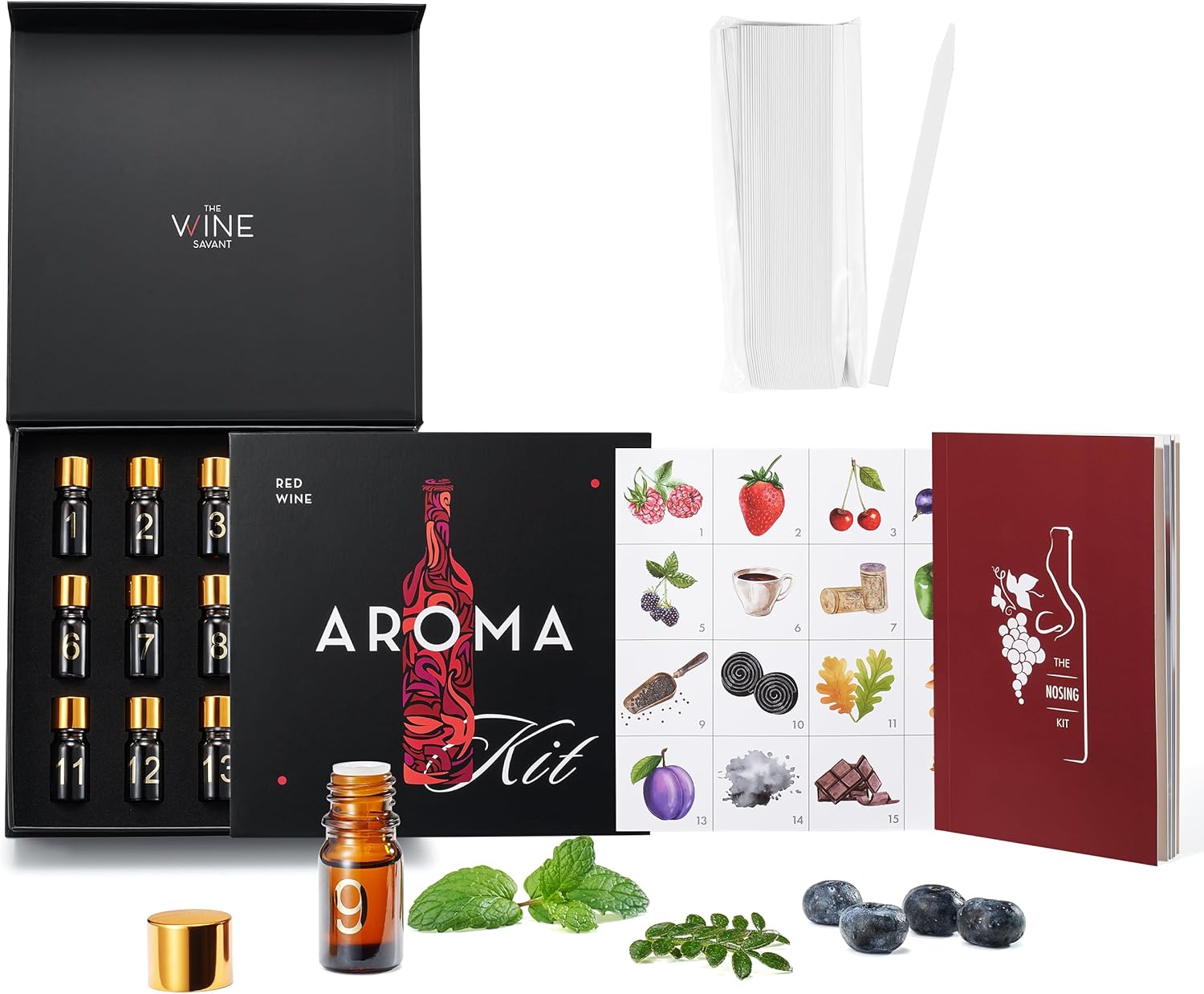
- Primary (fruit & floral): Blackcurrant (cassis), blackberry, black cherry, dark plum, blueberry
- Primary (other): Green bell pepper, fresh herbs, violets
- Secondary (winemaking): Vanilla, toast, smoke, clove, nutmeg (from oak); yeast notes in barrel-fermented examples
- Tertiary (age): Cedar, cigar box, pencil shavings, graphite, leather, tobacco, dark chocolate, dried herbs, eucalyptus (in Australian and some Chilean examples), truffle
Complete Aroma Wheel: Merlot
- Primary (fruit & floral): Plum, red cherry, black cherry, raspberry, blueberry, dried cranberry
- Primary (other): Rose petal, violet, dried herbs
- Secondary (winemaking): Vanilla, mocha, dark chocolate, coconut, caramel (from oak)
- Tertiary (age): Coffee grounds, espresso, truffle, game, dried figs, leather, tobacco, earthy minerality
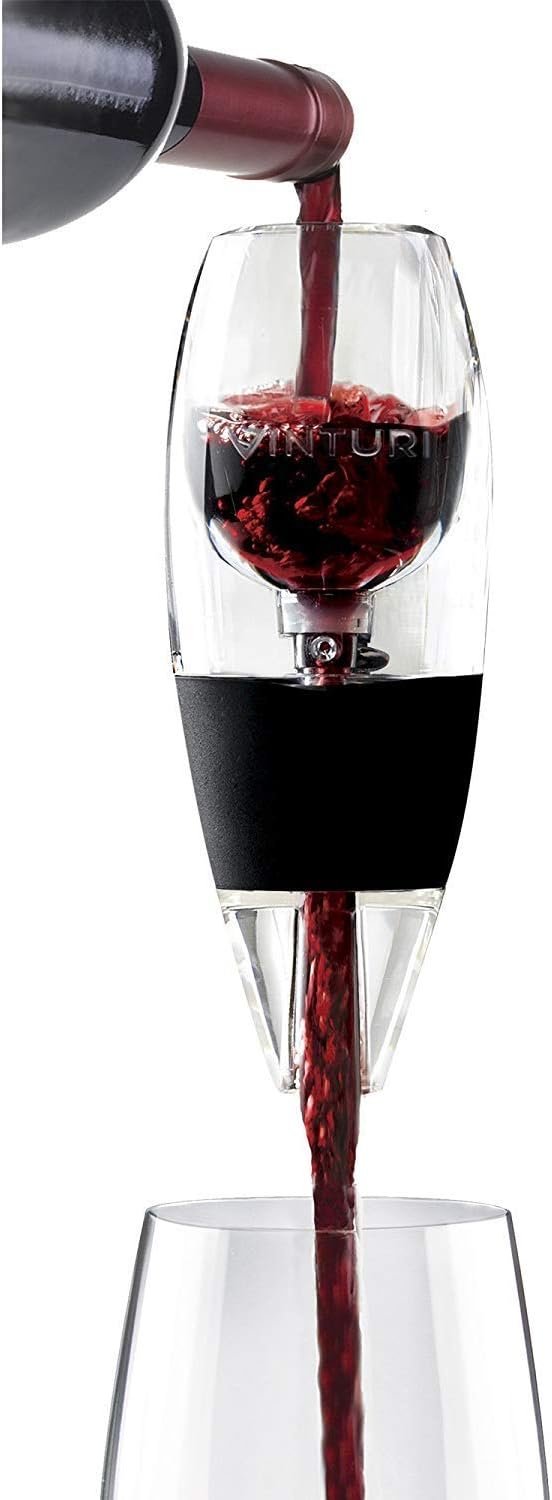
Vinturi Red Wine Aerator
Cabernet Sauvignon needs air to soften those harsh tannins. This device opens up the wine instantly as you pour, mimicking an hour of decanting in seconds.
Check Price on AmazonAcidity, Color & ABV: The Technical Differences
Beyond flavor and texture, three measurable technical parameters distinguish Merlot and Cabernet Sauvignon in ways that affect everything from how they pair with food to how they age in the bottle.
Acidity
Cabernet Sauvignon is a medium-to-high acidity wine. Its acidity — primarily tartaric and malic acid — gives it a lively freshness that cuts through fatty foods and contributes significantly to its aging potential. Acidity acts as a natural preservative in wine, slowing oxidation and maintaining the wine’s freshness over decades of cellar aging. The combination of high tannins and high acidity in premium Cabernet is precisely what allows it to age gracefully for 20 to 30 years or more.
Merlot has medium acidity — noticeably lower than Cabernet Sauvignon. This is part of why Merlot feels softer and rounder on the palate — there is less of that zippy, lively freshness that makes Cabernet feel energetic and structured. Merlot’s lower acidity also means it ages more quickly than Cabernet; the wine reaches its drinking window sooner but also declines sooner. For everyday drinking, this is a virtue. For long-term cellaring, it is a limitation.
Color
Color is one of the most reliable visual indicators of which grape you are looking at. Cabernet Sauvignon produces a wine of deep ruby to purple-black color — the thick, anthocyanin-rich skins extract an intense pigmentation that holds its color for many years. In the glass, a young Cabernet often has an almost opaque center with a purple-blue rim. As it ages, the color shifts toward garnet and eventually brick-red at the rim while remaining ruby in the center.
Merlot has a medium to deep ruby color — rich but less intensely saturated than Cabernet. The thinner skins extract less anthocyanin, producing a slightly lighter color that shifts more readily toward garnet and ruby with age. Looking at a glass of wine side by side can confirm this distinction reliably in wines from similar climates and with similar levels of age.
Alcohol Content (ABV)
Cabernet Sauvignon typically registers 13.5–15% ABV, with warm-climate examples from Napa Valley and parts of Australia regularly reaching 14.5–15.5%. The grape’s late ripening in warm years accumulates significant sugar, which ferments almost completely to produce a high-alcohol wine.
Merlot typically registers 13–14.5% ABV. While both wines sit in broadly similar ABV territory, Merlot’s lower ceiling means it rarely produces the very high-alcohol “big” wines that Cabernet Sauvignon can deliver in warmer vintages. This difference, though seemingly small numerically, is perceptible on the palate — very high-alcohol wines feel warmer and heavier, which is a characteristic of the biggest Napa Cabernets that Merlot rarely matches.
Cool Climate vs Warm Climate: How Environment Transforms Each Grape
One of the most illuminating aspects of both Merlot and Cabernet Sauvignon is how dramatically each grape transforms based on the climate in which it is grown. The same varietal produced in Bordeaux, Napa Valley, and Patagonia will produce three distinctly different wines — and understanding this helps explain the enormous range of styles labeled under each name.
Cabernet Sauvignon Across Climates
| Climate | Region Example | Style | Key Notes |
|---|---|---|---|
| Cool | Bordeaux Médoc, Margaret River (WA) | Leaner, more herbaceous | Cassis, cedar, graphite, green herb; high acidity |
| Moderate | Napa Valley (mountain), Coonawarra | Balanced, classic | Black cherry, tobacco, cedar; firm tannin, good acidity |
| Warm | Central Valley CA, Maipo Chile | Fruit-forward, generous | Ripe blackberry, jam, eucalyptus, vanilla; softer tannin |
| Hot | Napa Valley floor (warm years) | Rich, powerful | Dark fruit, chocolate, plum; high alcohol (14.5–15.5%) |
Merlot Across Climates
| Climate | Region Example | Style | Key Notes |
|---|---|---|---|
| Cool | Bordeaux Right Bank, Friuli (Italy) | Structured, earthy | Red cherry, raspberry, leather; higher acidity and tannin than expected |
| Moderate | Washington State, Colchagua Chile | Balanced, complex | Plum, black cherry, dark chocolate, tobacco; firm but supple structure |
| Warm | Napa Valley, Tuscany | Lush, velvety | Plum jam, mocha, vanilla; very soft tannin, low acidity |
| Hot | Overripe California, Australia | Flat, jammy | Stewed fruit, low acidity, hot finish; can lack structure and complexity |
A cool-climate Merlot from Bordeaux’s Right Bank can actually resemble a Cabernet Sauvignon in structure — firm tannins, good acidity, red rather than black fruit. Conversely, a very warm-climate Napa Cabernet can taste almost Merlot-like in its plushness and fruit-forwardness. Climate can blur the varietal line significantly in extreme expressions.
Global Regions Deep-Dive
Beyond Bordeaux, both varietals have established themselves in virtually every major wine-producing country. Each region adds its own expression, influenced by soil, climate, winemaking tradition, and the specific clonal selection planted.
Napa Valley, USA
Cabernet DominantThe world’s most commercially powerful Cabernet Sauvignon region. Mountain-grown Howell Mountain and Spring Mountain examples show the most elegance and longevity; valley floor Cabernet is richer and more immediately opulent. Prices range from $30 to $1,000+ for cult producers.
Washington State, USA
Both ExcelWashington is the world’s most compelling argument for Merlot’s quality potential. The Columbia and Yakima Valleys produce structured, complex Merlots with more backbone than California equivalents. Washington Cabernet Sauvignon is similarly impressive — precise and mineral.
Pomerol, Bordeaux
Merlot DominantHome to Pétrus — arguably the world’s most famous Merlot and certainly its most expensive. Pomerol’s clay-rich soils produce extraordinarily plush, powerful Merlots that age magnificently for decades. The appellation has no official classification system, yet produces some of Bordeaux’s highest-priced wines.
Maipo Valley, Chile
Cabernet DominantChile’s premier Cabernet Sauvignon region. The valley’s alluvial gravels and dry, sunny climate produce intensely flavored, well-structured Cabernets at a fraction of Napa’s prices. Almaviva and Don Melchor are among the region’s most celebrated examples.
Tuscany, Italy
Both PresentThe “Super Tuscan” movement from the 1970s onward embraced both Cabernet Sauvignon and Merlot as alternatives to native varieties. Sassicaia (Cabernet-dominant) and Masseto (Merlot-dominant) are Italy’s most celebrated international-varietal wines, commanding Bordeaux-level prices.
Coonawarra, Australia
Cabernet DominantAustralia’s most distinguished Cabernet Sauvignon region, famous for its “terra rossa” — a strip of red iron-rich soil over limestone. Coonawarra Cabernet has a distinctive minty/eucalyptus character alongside classic cassis and cedar notes.
Saint-Émilion, Bordeaux
Merlot DominantThe Right Bank’s premier classified appellation. Saint-Émilion’s mix of clay-limestone plateaus and sandy gravel slopes produces Merlots ranging from plush and immediately approachable to structured and age-worthy. Château Cheval Blanc and Château Ausone lead the classification.
Margaret River, Australia
Both ExcelWestern Australia’s cool-climate coastal region produces elegant, Bordeaux-styled Cabernet Sauvignon with more restraint and precision than warmer Australian regions. Merlot is commonly used as a blending component, adding softness to Margaret River’s firm, structured Cabernets.
Aging Potential: When to Open the Bottle
One of the most practically important differences between Merlot and Cabernet Sauvignon is their respective relationship with time. This affects not only when to drink a bottle but also whether it is worth investing in older vintages and how to plan your cellar.
Cabernet Sauvignon’s Extraordinary Longevity
Premium Cabernet Sauvignon — particularly from Bordeaux, Napa Valley, and Coonawarra — is among the world’s most age-worthy wines. The combination of high tannins, high acidity, and concentrated fruit compounds creates a wine that can develop beneficially in the bottle for decades. A classified growth Bordeaux from a great vintage may be barely approachable at five years but genuinely extraordinary at fifteen, transcendent at twenty-five, and still vital at forty. The tannins that feel harsh and grippy in youth gradually polymerize and soften, integrating into a silky, complex whole that cannot be replicated by any amount of decanting a young wine.
Entry-level Cabernet Sauvignon is designed to be drunk within three to five years of vintage, and these wines will not improve significantly in the bottle. It is the mid-range and premium tier that genuinely rewards patience.
Merlot’s Shorter but Rewarding Arc
Merlot generally reaches its drinking window earlier than Cabernet Sauvignon and declines sooner. Most mid-range Merlot is at its best between two and eight years after vintage. Premium Right Bank Bordeaux (Pomerol, Saint-Émilion grand cru) can age well for fifteen to twenty-five years, with the finest examples (Pétrus in great vintages) lasting considerably longer. However, Merlot’s lower acidity means it softens and rounds out earlier — a virtue for those who do not want to wait — but also means the window of peak drinking tends to be shorter than for equivalent-quality Cabernet.
| Wine Type | Drink From | Peak Window | Maximum Potential |
|---|---|---|---|
| Entry Merlot | On release | 1–4 years | 5 years |
| Mid-range Merlot | 2–3 years | 4–8 years | 10 years |
| Premium Merlot (Pomerol/Saint-Émilion) | 5–7 years | 8–18 years | 25+ years |
| Entry Cabernet Sauvignon | On release | 2–5 years | 7 years |
| Mid-range Cabernet | 3–5 years | 5–12 years | 15 years |
| Classified Bordeaux / Top Napa | 8–12 years | 15–30 years | 40–50+ years (great vintages) |
Decanting: Should You, and for How Long?
Decanting is one of the most impactful — and most debated — aspects of serving red wine. Both Merlot and Cabernet Sauvignon benefit from decanting, but in different ways and for different durations.
Decanting Cabernet Sauvignon
Young to mid-aged Cabernet Sauvignon (under twelve years old) benefits significantly from decanting. The high tannins in youth are softened by oxygen exposure — physically, decanting accelerates the oxidative processes that would otherwise happen over hours of slow breathing in a glass. A young Napa Cabernet or a recent Bordeaux vintage can transform dramatically after 1 to 2 hours in a decanter: the tannins soften, the dark fruit opens, the herbaceous notes integrate, and the wine becomes more expressive and harmonious.
For older, mature Cabernet Sauvignon (over fifteen years), approach decanting with care. These wines have already developed secondary and tertiary complexity that is fragile and volatile — aggressive aeration can cause their delicate evolved aromas to dissipate rather than develop. A brief decant of 20 to 30 minutes, or simply pouring the wine and allowing it to open in the glass, is often preferable.
Decanting Merlot
Most Merlot benefits from a shorter decant than Cabernet. Young mid-range Merlot softens and opens nicely with 30 to 60 minutes in a decanter. Premium Pomerol or aged Saint-Émilion needs similar care to aged Bordeaux Cabernet — a brief gentle decant primarily to separate any sediment, rather than extended aeration. Over-decanting Merlot can cause its fruit to fade and flatten — the lower acidity and tannin structure that makes it so approachable also makes it more vulnerable to rapid oxidation in a wide decanter bowl.
Young Cabernet Sauvignon: 1–2 hours. Young Merlot: 30–60 minutes. Aged Cabernet (15+ years): 20–30 minutes, or open in the glass. Aged Merlot (12+ years): decant only to remove sediment, serve quickly. When in doubt, pour a small taste first — if it already tastes integrated and soft, the wine does not need aggressive decanting.
Serving Temperature: Getting It Right
Serving temperature has an enormous and immediate impact on how both wines express themselves, and both Merlot and Cabernet Sauvignon are frequently served too warm — a common mistake that is easy to avoid once you know the optimal ranges.
Cabernet Sauvignon is best served at 60–65°F (16–18°C). At this temperature, the tannins are present but not harsh, the dark fruit is expressive, and the alcohol is integrated rather than prominent. Above 70°F (21°C) — typical room temperature in many centrally heated homes — Cabernet becomes flat, alcoholic, and one-dimensional. The heat pushes alcohol to the foreground and suppresses the fruit and aromatic complexity you are paying for.
Merlot is best served slightly cooler at 58–63°F (14–17°C). Its lower tannin structure means it can taste slightly better at cooler temperatures — the acidity appears fresher and the fruit more vibrant. At room temperature, Merlot can taste soft to the point of flabbiness. A brief 15 to 20 minutes in the refrigerator before opening will bring a room-temperature Merlot to its optimal serving temperature.
The traditional instruction to serve red wine at “room temperature” predates central heating — it referred to cool European cellar or stone-house temperatures of 60–65°F (16–18°C). Modern homes at 72–75°F are far too warm for either Merlot or Cabernet. Both wines benefit from a short chill before serving.
Food Pairing In Depth: Beyond Steak Night
The golden rule of pairing is match intensity with intensity. Cabernet Sauvignon is a high-intensity wine — its tannins act as a palate cleanser, scraping fat from the mouth and preparing you for the next bite. This makes it the undisputed king of steak night. For detailed advice, see our guide on pairing wine with steak.
Merlot is more versatile. Its softer tannins do not clash with lighter meats or tomato acidity. It pairs beautifully with roasted chicken, mushroom risotto, and Thanksgiving turkey dinner.
Cabernet Sauvignon Pairings: The Full List
- Ribeye, strip loin, and T-bone steak: The classic pairing. The fat in beef amplifies Cabernet’s fruit and softens its tannins, while the tannins in turn cleanse the fat from the palate — a perfect biochemical harmony.
- Rack of lamb: Lamb’s earthy, slightly gamey character harmonizes beautifully with Cabernet’s herbal, dark fruit, and cedar notes. A medium-rare rack of lamb with rosemary is one of the great pairings in the wine world.
- Aged hard cheeses: Aged cheddar, Manchego, Comté, and Parmigiano-Reggiano all have the fat content and intensity to handle Cabernet’s structure. Avoid soft, creamy cheeses — their delicate flavors disappear against Cabernet’s power.
- Dark chocolate (70%+): Cabernet’s bitter, tannic structure complements dark chocolate’s bittersweetness. Below 70% cocoa, the sweetness of the chocolate makes the wine taste sour by comparison.
- Venison and game: The bold, gamey character of venison, wild boar, and duck confit are natural partners for Cabernet’s intensity and structure.
- Hearty stews and braises: Beef bourguignon, osso buco (beef version), and lamb stew — slow-cooked, intensely flavored dishes that match Cabernet’s weight.
- Foods to avoid: Delicate fish, shellfish, light pasta dishes — these are overwhelmed by Cabernet’s tannins and dark fruit.
Merlot Pairings: The Full List
- Roast chicken and turkey: Merlot’s medium body and soft tannins complement poultry’s mild, savory character without overwhelming it.
- Tomato-based pasta: The acidity in tomato sauce calls for a wine with enough body to match it but not so much tannin that it clashes. Merlot is ideal — it bridges the gap between red-sauce pasta and heavier red wines.
- Mushroom risotto: The earthy, umami-rich character of mushrooms resonates strongly with Merlot’s plum, mocha, and earthy tertiary notes.
- Pork tenderloin and pork chops: Pork’s mild sweetness and tenderness are well-suited to Merlot’s fruit-forward, smooth profile.
- Pizza: A versatile, crowd-pleasing pairing. The combination of tomato, cheese, and herbs in pizza matches Merlot’s balanced profile without any one element dominating.
- Herb-roasted salmon: Premium, full-bodied Merlot can work surprisingly well with salmon — the omega-3 richness of the fish can handle Merlot’s gentle tannins, and the wine’s fruit complements herb preparations beautifully.
- Soft cheeses: Brie, Camembert, and chèvre pair beautifully with Merlot — the wine’s approachable fruit and low tannin do not overwhelm the delicate creaminess of these cheeses.
The Bordeaux Blend: Why They Are Better Together
One of the most important aspects of both varietals that is frequently overlooked in comparative discussions is their relationship as blending partners. In Bordeaux — and in the broader world of winemaking that Bordeaux has inspired — Merlot and Cabernet Sauvignon are not rivals but collaborators, each compensating for the other’s weaknesses and amplifying each other’s strengths.
What Each Adds to the Blend
Cabernet Sauvignon contributes the structural backbone: firm tannins that support long aging, high acidity that preserves freshness, dark fruit concentration, and the complex aromatic development (cedar, tobacco, graphite) that makes aged Bordeaux so compelling. Without a structural grape like Cabernet, a blend can be soft and immediately appealing but lack the architecture for long-term development.
Merlot contributes flesh, texture, and early approachability: the plum and chocolate richness that makes a wine enjoyable in its youth, the soft tannins that round out Cabernet’s grip, and the higher natural alcohol that adds body and warmth. In a blend, Merlot acts as the “filler” that adds volume and sensory richness to Cabernet’s frame.
The Supporting Cast: Other Bordeaux Blend Grapes
Classic Bordeaux blends also incorporate several other permitted varietals that add specific qualities:
- Cabernet Franc: The parent of both Merlot and Cabernet Sauvignon, Cabernet Franc adds a distinctive aromatic lift — pencil shavings, red fruit, violet, herbal freshness — and provides structural acidity. It is the primary variety in the Right Bank blend at Château Cheval Blanc and adds elegance to Left Bank blends.
- Petit Verdot: A small-production variety that contributes intense color, earthy spice (pepper, leather, violet), and firm tannins. Used in small percentages (typically 2–5%) as a “seasoning” grape that adds depth and complexity to the blend.
- Malbec: Better known today as Argentina’s signature variety, Malbec adds color depth, soft tannins, and dark plum richness to Bordeaux blends. It was historically more important in Left Bank blends before phylloxera and has diminished in significance in modern Bordeaux while thriving globally as a varietal wine.
Famous Châteaux: A Buyer’s Reference Guide
Bordeaux’s château system is one of the most codified wine hierarchies in the world. Understanding which châteaux produce predominantly Merlot-based versus Cabernet-based wines helps enormously when buying Bordeaux — since labels often do not list varietal composition.
Landmark Cabernet-Dominant Left Bank Châteaux
- Château Latour (Pauillac): One of only five First Growths in the 1855 classification. Produces massive, structured Cabernet Sauvignon-dominant wines that often need 15–20 years to truly reveal themselves.
- Château Mouton Rothschild (Pauillac): Another First Growth, known for extraordinary aromatics — cedar, cassis, pencil shavings. Elevated to First Growth in 1973, the only change to the 1855 classification.
- Château Margaux (Margaux): The most perfumed and elegant of the Left Bank First Growths, Margaux’s Cabernet Sauvignon-dominated wines are known for floral aromatic elegance alongside classic dark fruit structure.
- Château Léoville-Las Cases (Saint-Julien): Widely considered a “Super Second” — of First Growth quality in the best vintages but priced significantly below them. One of the most Cabernet-dominant wines in Bordeaux.
Landmark Merlot-Dominant Right Bank Châteaux
- Pétrus (Pomerol): The world’s most famous Merlot and one of its most expensive wines. Made from a plot of almost pure clay planted almost exclusively to Merlot; in great vintages, one of the longest-lived wines in Bordeaux’s Right Bank despite Merlot’s reputation for shorter aging potential.
- Le Pin (Pomerol): A tiny production “garage wine” that pioneered the concept of micro-scale, perfectionist winemaking in Bordeaux. Merlot-dominant, extraordinarily lush and concentrated.
- Château Pétrus (Pomerol): As above — note that “Pétrus” and “Château Pétrus” refer to the same estate.
- Château Cheval Blanc (Saint-Émilion): Unusual in the Right Bank for being Cabernet Franc-dominant (approximately 55%) with Merlot as the secondary component. Produces wines of extraordinary complexity and longevity that defy the typical Left Bank/Right Bank stylistic categories.
- Château Ausone (Saint-Émilion): The most prestigious estate in Saint-Émilion, planted on a south-facing limestone escarpment. Produces one of Bordeaux’s most complex and age-worthy wines from a Merlot/Cabernet Franc blend.
Price Guide: What to Expect at Every Budget
Both Merlot and Cabernet Sauvignon span an extraordinary price range — from under $10 for entry-level supermarket bottles to thousands of dollars for First Growth Bordeaux and Napa cult wines. Here is a realistic guide to what quality level you can expect at each price point.
| Price Range | Merlot Quality Level | Cabernet Sauvignon Quality Level |
|---|---|---|
| Under $15 | Soft, fruity, simple. Good everyday drinking but limited complexity. Best consumed within 2 years. | Light to medium body, mild tannins. Often blended. Drink on release. |
| $15–$35 | Genuine varietal character. Look for Washington State, Chile, and southern France for best value. Can show real complexity. | Good structure and dark fruit. Chilean Maipo and Californian blends at this level are excellent. Drink within 5 years. |
| $35–$80 | Premium regional Merlot — Washington’s best, Right Bank Bordeaux cru bourgeois, Italian super-Tuscans. Age-worthy (5–12 years). | Mid-range Napa Valley, Saint-Estèphe and Saint-Julien cru bourgeois, Margaret River. Genuine aging potential (8–15 years). |
| $80–$200 | Saint-Émilion grand cru classé, Pomerol crus, premium Duckhorn (Napa), Ornellaia Masseto (Italy). Outstanding quality, 15+ year aging. | Classified Bordeaux crus, mid-tier Napa Valley single-vineyard, Penfolds Bin 707. Serious aging potential (20+ years in great vintages). |
| $200+ | Pétrus, Le Pin, Château Lafleur, premium Masseto. The world’s finest Merlot-dominant wines. | First Growth Bordeaux, Screaming Eagle, Harlan Estate, Opus One. Trophy wines with extraordinary aging potential and investment value. |
Host a Blind Tasting: Find Your Preference Without the Labels
One of the most illuminating — and entertaining — wine experiences you can host is a Merlot versus Cabernet Sauvignon blind tasting. Removing the label strips away any preconceptions about which varietal you “should” prefer and lets your palate make the decision.
Setting Up the Tasting
- Select comparable bottles. Choose wines from the same region and at a similar price point so you are comparing like with like. Three Merlots and three Cabernets from Washington State, for example, or three from each bank of Bordeaux at similar cru levels.
- Cover the labels. Paper bags numbered 1 through 6 work perfectly — the host knows which is which but the tasters do not. Record your assessments before anyone reveals the labels.
- Pour in a neutral sequence. Alternate between varietals rather than pouring all Merlots first — this prevents the tasters from calibrating to one style before encountering the other.
- Assess blind. Ask each taster to assess body (medium/full), tannin level (low/medium/high), fruit character (red/dark), and whether they perceive green herb or spice notes. Then ask them to guess the varietal. The accuracy rate of even experienced tasters is often surprisingly modest — which is itself a valuable lesson about wine preconceptions.
- Reveal and discuss. Once assessments are recorded, reveal the labels and taste through the wines again with the identity known. Note how the knowledge changes (or does not change) the perception.
Most blind tastings reveal that tasters’ stated varietal preferences often diverge from their actual preferences when tasting blind. Many self-proclaimed “Cabernet drinkers” find themselves scoring Merlot highest when the label is hidden — and vice versa. It is a compelling reminder that wine preference is profoundly shaped by expectations as much as by actual sensory experience.
The Sideways Effect: How a Film Changed Merlot’s Fate
No discussion of Merlot versus Cabernet Sauvignon is complete without acknowledging one of the most extraordinary examples of cultural influence on wine consumption in modern history — the impact of the film Sideways (2004).
The film’s protagonist, Miles Raymond, delivers what became the most quoted wine line in cinema history: “If anyone orders Merlot, I’m leaving. I am NOT drinking any f***ing Merlot!” His passionate rejection of Merlot in favor of Pinot Noir — combined with his equally passionate defense of Pinot Noir — became a cultural touchstone that measurably shifted American wine buying behavior in the years following the film’s release. Nielsen market data showed Merlot sales growth declining significantly in the United States in the period immediately following the film’s release, while Pinot Noir sales surged.
The irony, widely noted by wine critics at the time, is that Miles’s favorite wine — Château Pétrus — is almost entirely Merlot. The character who most vocally despised Merlot was drinking the world’s most celebrated Merlot as his benchmark of vinous perfection.
The Sideways effect has largely faded with time. Quality-conscious wine producers in Washington State, Bordeaux’s Right Bank, and Italian super-Tuscan estates continued to demonstrate that Merlot at its finest is as complex and age-worthy as any Cabernet Sauvignon. The market has recognized this — Washington State Merlot in particular has gained significant critical prestige in the years since the film’s cultural impact waned.
Do You Need Different Glasses?
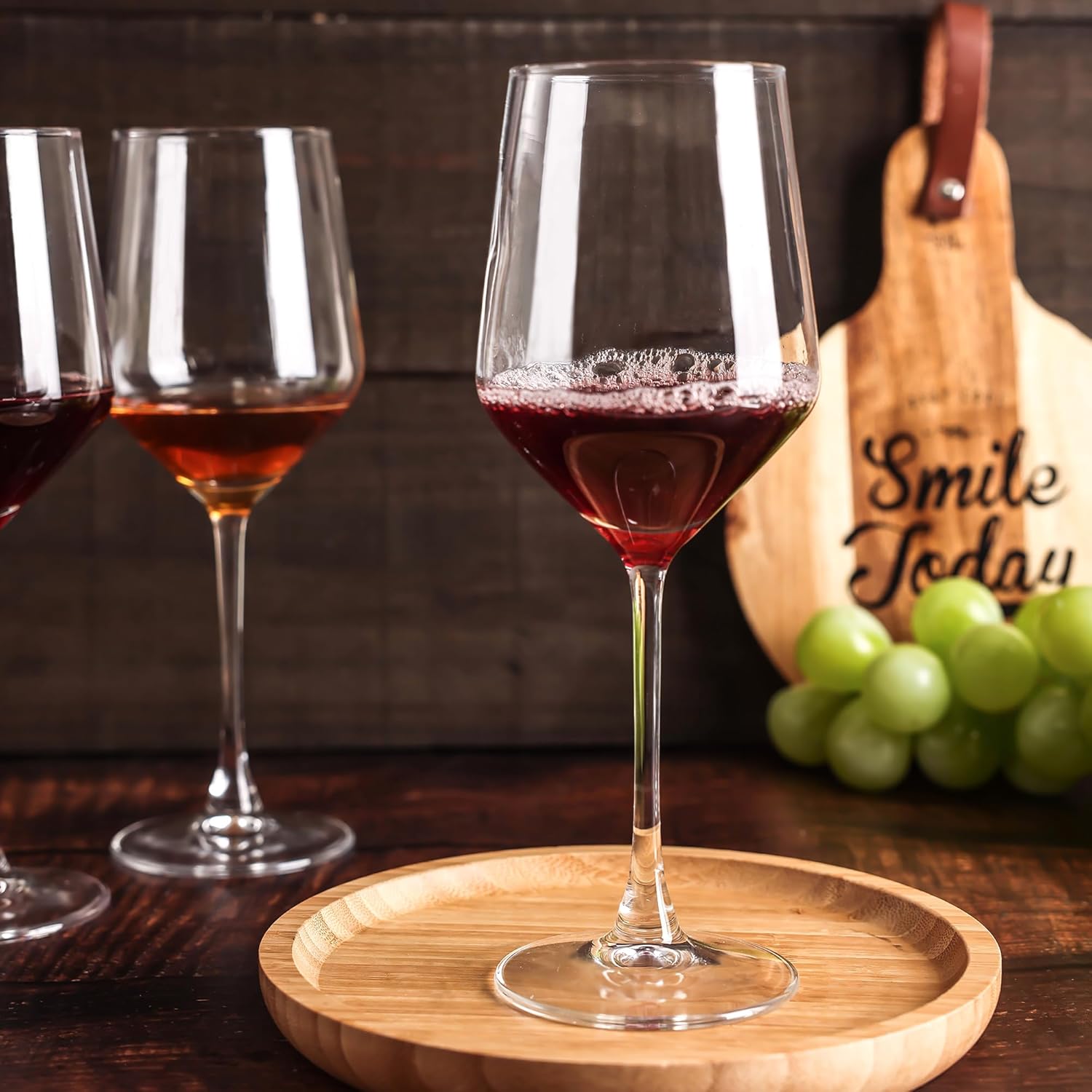
Surprisingly, yes. A “Bordeaux Glass” is designed specifically for Cabernet Sauvignon: it is tall with a broad bowl to direct wine to the back of the mouth, allowing ethanol vapors to partially dissipate before reaching the nose — critical for Cabernet’s higher ABV — and directing the tannic wine to the rear palate where astringency is perceived less acutely.
A standard red wine glass often suits Merlot better — the slightly wider bowl relative to height allows Merlot’s more aromatic, fruit-forward character to express itself without the tall chimney muting the delicate plum and cherry notes. If you are serious about maximizing each wine’s potential, check out our breakdown of Bordeaux vs. Burgundy glasses to see why shape matters as much as the wine itself.

Riedel Veritas Cabernet/Merlot Glass (Set of 2)
The industry standard. These glasses are specifically shaped to smooth out rough tannins and highlight the fruit in Bordeaux varietals — suitable for both Merlot and Cabernet Sauvignon.
See Best SellerFrequently Asked Questions
Technically, both are dry wines with no residual sugar. However, Merlot tastes fruitier and less bitter because it has fewer tannins, which many people perceive as “sweetness.” The absence of tannin’s drying astringency allows the fruit to come forward, creating a perception of sweetness that is actually about texture and fruit intensity rather than sugar content.
Merlot is generally the better entry-level red wine. Its softer tannins, plush fruit, and approachable structure do not overwhelm newcomers to red wine, and it pairs well with a broader range of everyday foods. Cabernet Sauvignon’s firm tannins can feel harsh and austere to those not yet accustomed to red wine’s textural complexity.
Yes — and most “Bordeaux Blends” are exactly that. Cabernet provides the structure and backbone while Merlot adds fleshiness and fruit. The blend produces wines that are more complex and complete than either varietal alone. California’s iconic Opus One and Bordeaux’s classified châteaux all use variations of this blend.
At the highest level, Cabernet Sauvignon generally commands higher prices due to demand, production costs, and aging potential. Screaming Eagle, Harlan Estate, and First Growth Bordeaux (all Cabernet-dominant) are among the world’s most expensive wines. However, Pétrus — Merlot-dominant — rivals and often exceeds the prices of any Cabernet Sauvignon. At mid-range price points, both varietals offer comparable quality per dollar across different regions.
Generally, no — Cabernet Sauvignon’s higher tannins and acidity give it significantly greater aging potential. Most Merlot is best within ten years of vintage. However, premium Pomerol and Saint-Émilion Merlot can age magnificently for twenty-five or more years in great vintages, and Pétrus from exceptional vintages is age-worthy for forty or more years. The gap between the varietals is narrowest at the very top of the quality hierarchy.
Young Cabernet Sauvignon tannins can be astringent and bitter, particularly in wines under three to five years of age. This is normal. The best solutions: decant for one to two hours before serving; pair it with protein-rich food (the fat and protein bind to tannins and soften them); wait a few more years for the wine to integrate; or serve at the correct temperature (60–65°F, not warmer). Above all, avoid drinking young Cabernet without food — tannins are always more pronounced on an empty palate.
Left Bank Bordeaux (Médoc, Graves, Pessac-Léognan) is dominated by Cabernet Sauvignon, grown on well-drained gravel soils. These wines are typically firmer, more structured, and require longer aging. Right Bank Bordeaux (Saint-Émilion, Pomerol, Fronsac) is dominated by Merlot, grown on clay and limestone soils. Right Bank wines are typically plushier, more immediately approachable, and fruit-forward. The distinction is one of the most fundamental in all of wine geography.
Most mid-range Merlot benefits from 30 to 60 minutes in a decanter. Young Merlot softens and opens significantly with a brief decant. Premium aged Merlot (Pomerol, Saint-Émilion grand cru) should be decanted gently and briefly — primarily to remove sediment — rather than aerated aggressively, as older wines’ fragile aromatics can dissipate with extended air exposure.
Delicate seafood (sole, halibut, oysters, scallops), light pasta dishes, goat cheese, and anything sweet will clash with Cabernet’s firm tannins and dark fruit. The tannins in Cabernet react with the proteins in fish in a way that creates a metallic, bitter taste — the “fish and red wine” problem. Pair Cabernet exclusively with foods that can match its intensity: beef, lamb, game, aged cheese, dark chocolate.