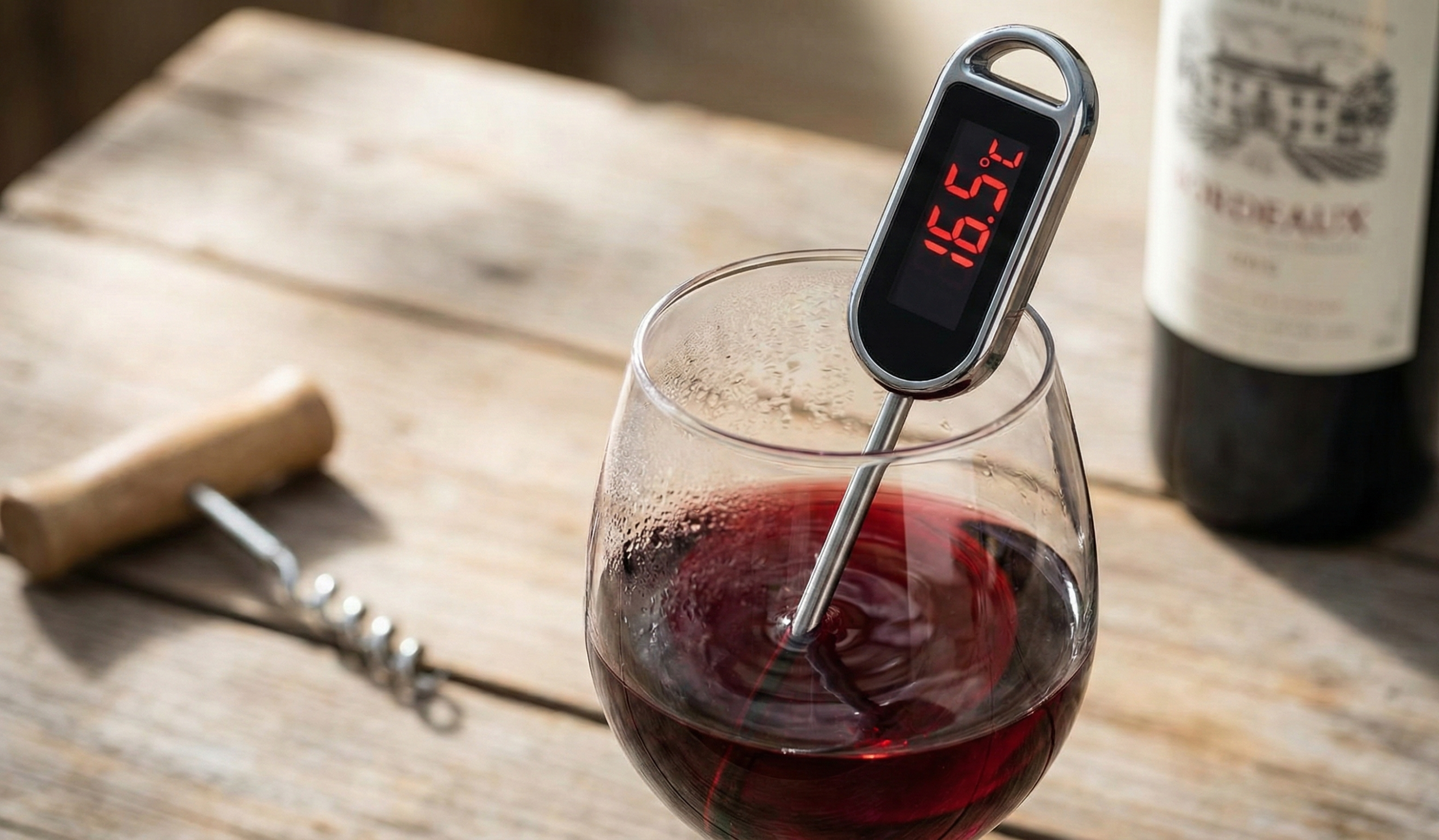
1. Beyond Guesswork: The Science of Serving Temperature
Pouring a wine at the wrong temperature is the single most common mistake that robs a bottle of its intended character. A robust Cabernet Sauvignon served directly from a 72°F kitchen counter will taste overly alcoholic and flabby, its complex tannins masking the fruit. That same bottle, allowed to settle at its ideal 63–65°F, reveals layers of dark fruit, cedar, and a structured, elegant finish. Conversely, a crisp Sauvignon Blanc served too warm tastes flat and lifeless, while at 48°F, its vibrant acidity and citrus notes sing.
Temperature directly controls the volatility of aroma compounds and the perception of structural elements in wine. Cold temperatures suppress aromatics and emphasize acidity and tannin, making reds seem harsh. Warm temperatures amplify alcohol and volatile acidity while softening tannins, which can make whites seem “blown out” and flabby. The goal is to find the sweet spot for each wine style — a balance where aromas are expressive, acidity is refreshing, alcohol is integrated, and tannins are smooth. This isn’t merely personal preference; it is chemistry. Serving at the right temperature is the final, crucial step of proper wine storage and care that unlocks the winemaker’s vision.
The Cost of Getting It Wrong
Think of temperature as a volume knob for different parts of the wine’s profile. Serving a delicate Pinot Noir too cold (below 55°F) turns the volume down on its beautiful red fruit and floral aromas, while cranking the volume up on its sometimes-grippy tannins. Serving a rich Chardonnay too warm (above 60°F) makes the alcohol sensation loud and hot, overwhelming the subtle notes of oak and baked apple. A thermometer gives you precise control to set every element at its perfect level.
2. Instant-Read, Infrared, or Smart Sensor? A Technology Breakdown
Not all thermometers are created equal for the specialized task of reading wine temperature. The right choice depends on whether you prioritize speed, convenience, precision, or the ability to monitor remotely.
| Technology | How It Works | Best For | Speed | Precision |
|---|---|---|---|---|
| Instant-Read Probe | Metal probe inserted into liquid; sensor at tip reads temperature. | Checking a poured glass or bottle in an ice bucket. Ultimate accuracy. | 3–5 seconds | ±0.5°F (High) |
| Infrared (IR) Gun | Measures infrared radiation emitted from a surface without contact. | Quickly scanning bottles in a rack or fridge. Hygiene-focused. | Instant | ±2°F (Surface only) |
| Smart Bluetooth/WiFi | Probe or strip connects to an app, providing real-time graphs and alerts. | Aging wine cellars, long-term monitoring, multiple bottles at parties. | Continuous | ±1°F |
| Analog Dial Thermometer | Bimetallic coil expands/contracts with heat, moving a needle on a dial. | Permanent fixture in a serving bucket or decanter. No batteries needed. | 30–60 seconds | ±3°F (Lower) |
| Collar / Sleeve | Liquid crystal strips or sensors that wrap around the bottle exterior. | Passive monitoring on the bottle during service. No insertion needed. | 30–60 seconds | ±2–3°F |
Key Insight: For most enthusiasts, a high-quality instant-read probe offers the best balance of speed, price, and direct-liquid accuracy. Infrared is fantastic for non-invasive checks but reads the bottle’s glass temperature, not the liquid inside. Smart sensors are the premium choice for the tech-savvy collector, integrating seamlessly with other essential wine accessories in a modern home.
3. The 2026 Buyer’s Guide: Features That Truly Matter
With a crowded market, it’s easy to get distracted by gimmicks. Focus on these four non-negotiable features.
1. Speed & Precision
Look for read time under 5 seconds and accuracy of at least ±1°F (±0.5°C). A slow thermometer is useless when dialing in the perfect chill for guests.
2. Probe Length & Shape
A thin, tapered, stainless steel probe at least 4 inches long is ideal. It should easily slip into a wine glass or bottle neck. Avoid thick, blunt probes.
3. Display & Readability
A backlit LCD screen is essential for dim dining rooms or cellars. Large, high-contrast digits prevent squinting. Some models offer a magnetic back for fridge mounting.
4. Build Quality & Water Resistance
It will get wet. A sealed, water-resistant body (IP65 rating or higher) protects electronics from condensation and accidental ice bucket dunks.
4. The 5 Best Wine Thermometers of 2026: At a Glance
| Model | Type | Key Feature | Best For | Price Tier |
|---|---|---|---|---|
| ThermoWorks Thermapen ONE | Instant-Read Probe | Laboratory-grade speed & accuracy | The Perfectionist & Serious Host | Premium |
| Etekcity Lasergrip 1080 | Infrared Gun | Non-contact, instant surface reads | Quick Cellar Checks & Hygiene Focus | Mid-Range |
| Wine Enthusiast Smart Sensor | Bluetooth Smart | App-based monitoring & alerts | Tech-Savvy Collectors | Premium |
| CDN ProAccurate | Analog Dial | No batteries, classic aesthetic | Traditionalists & Budget Buyers | Budget |
| ChefAlarm by ThermoWorks | Dual-Probe | Monitor two temps simultaneously | Large Gatherings & Comparative Tastings | Mid-Range |
5. ThermoWorks Thermapen ONE: The Gold Standard
When absolute, unwavering precision is non-negotiable, the Thermapen ONE stands alone. Adopted by chefs, scientists, and now discerning sommeliers, its claim to fame is a lightning-fast read in under one second with an accuracy of ±0.5°F — a level of performance that transforms wine service from approximation to exact science.
Why It Dominates
The patented “motion-sensing” technology automatically wakes and begins reading the moment you open it, and goes to sleep when closed. The needle-thin, tapered probe slips discreetly into a wine glass without displacing liquid. The large auto-rotating display is instantly readable from any angle. For the host who views food and wine pairing as a serious craft, this tool provides the foundational control to execute perfectly.
Unmatched Advantages
- Blazing fast 1-second readings
- Laboratory-grade ±0.5°F accuracy
- Superb, splash-proof build quality
- Excellent battery life (1500+ hours)
- Auto-rotating, backlit display
Considerations
- Premium price point
- Overkill for very casual users
- No remote monitoring capability

Experience professional-grade precision. The tool trusted by chefs and masters of wine.
Check Price on Amazon6. Etekcity Lasergrip 1080: The Master Scanner
For the enthusiast who wants to check an entire wine rack or fridge in 30 seconds without touching a single bottle, an infrared thermometer is a revelation. The Etekcity Lasergrip 1080 offers a wide temperature range (−58°F to 1022°F) and a highly intuitive point-and-shoot operation perfect for quick cellar audits.
The Non-Invasive Advantage
You can scan the surface of a bottle in your wine storage unit without opening the door. The laser dot provides precise targeting. The important caveat: it measures glass temperature, which can be 2–5°F different from the liquid inside — especially if the bottle has just been moved. Best for relative checks and catching major temperature problems.
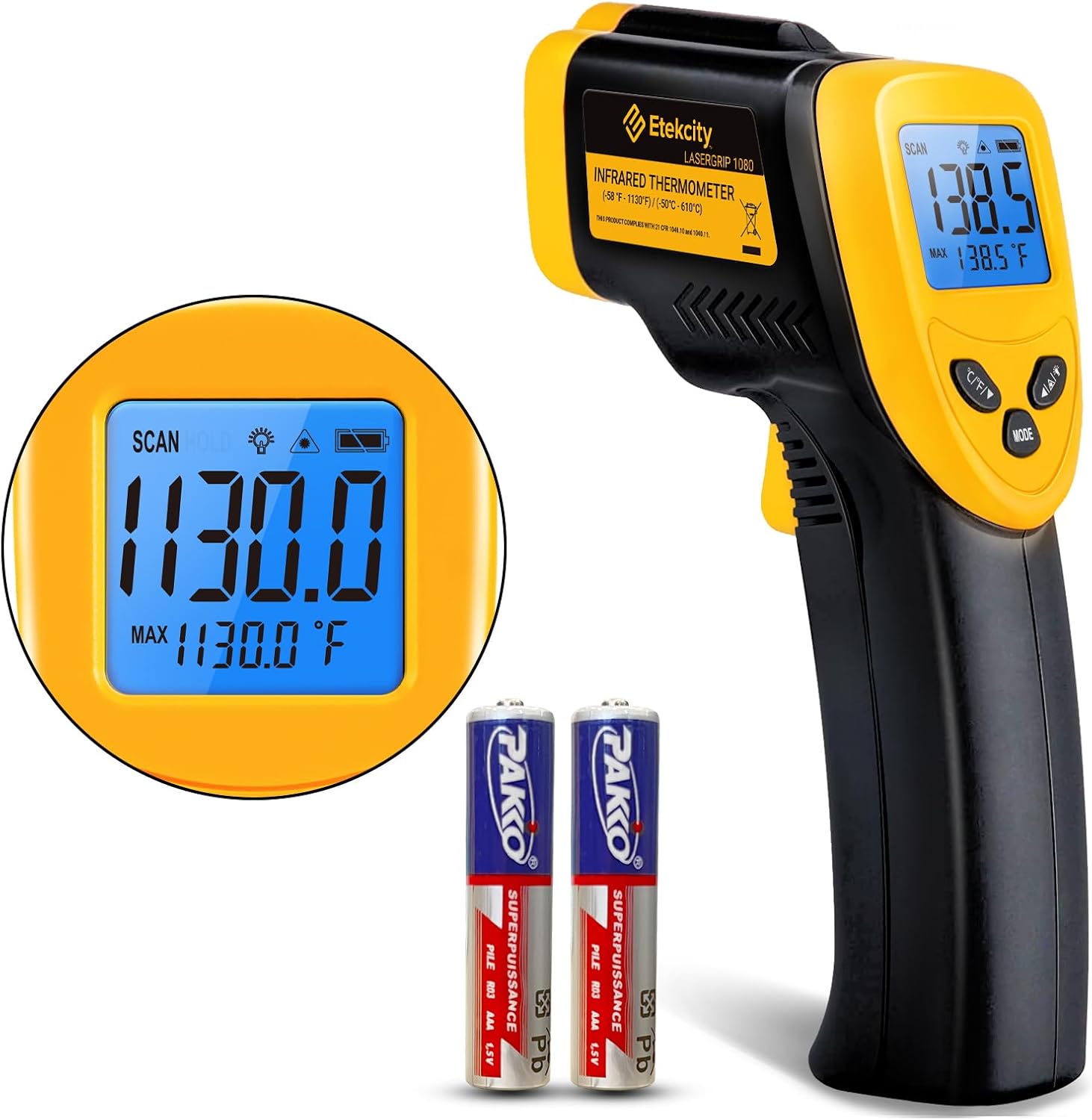
Scan your collection in seconds. The ultimate tool for fast, non-contact temperature audits.
Check Price on Amazon7. Wine Enthusiast Bluetooth Smart Sensor: The Connected Cellar
This system moves beyond spot-checks to offer continuous, remote monitoring. A small, waterproof sensor probe connected to a Bluetooth hub sends data to your smartphone — real-time graphs of temperature and humidity from anywhere.
Peace of Mind, Digitally
Set custom high/low temperature alerts, and receive a notification if your cellar compressor fails or a heatwave spikes room temperature. For insurance or resale purposes, the logged data proves your wines have been kept in impeccable condition.

8. CDN ProAccurate Dual-Read Thermometer: The Classic Workhorse
For those who prefer a hands-off, always-on display or want a dedicated thermometer for a champagne bucket, the CDN ProAccurate features a clear dial with both Fahrenheit and Celsius scales. Simply place it in your decanter or ice bucket, and at a glance, see the temperature.
Simplicity and Reliability
No batteries. Always ready. Not as precise or fast as a digital probe, but adequate for most serving situations. An excellent “first thermometer” or spare to keep in your wine travel bag.

Elegant, battery-free simplicity. The perfect constant monitor for your serving vessel.
Check Price on Amazon9. ChefAlarm by ThermoWorks: The Dual-Zone Maestro
Hosting a party with multiple wines? Conducting a comparative tasting? The ChefAlarm connects to two independent probe thermometers, allowing you to monitor two different wines simultaneously on one large, backlit display.
Multitasking Made Easy
Imagine one probe in a Sauvignon Blanc ice bath and the other in a Cabernet decanter — both perfectly on target with a glance. High/low alarms for each probe. It bridges the gap between simple spot-checking and full smart systems.

Master two temperatures at once. The ultimate tool for parties and comparative tastings.
Check Price on Amazon10. Collar & Sleeve Thermometers: The Passive Option
One product category entirely absent from most wine thermometer reviews is the collar or sleeve thermometer — a flat, flexible band that wraps around the outside of a bottle and provides a continuous temperature readout without any insertion, contact with the wine, or battery requirement. Understanding what these tools do well (and where they fall short) completes the picture of your options.
How Collar Thermometers Work
Most collar thermometers use liquid crystal display (LCD) technology embedded in a flexible strip. Different temperature-sensitive crystals in the strip reflect different colors at different temperatures, creating a color-coded readout visible through the band’s clear window. More advanced models use digital sensors embedded in a silicone band that wraps around the bottle neck, transmitting a reading to a small display clip.
The primary limitation of collar thermometers is the same as infrared guns: they measure the glass surface temperature, not the liquid inside. For bottles that have been stable in storage for hours, the glass surface temperature is a reliable proxy for the liquid temperature. For bottles that have recently been moved — taken from a fridge and placed on a counter, or put in an ice bucket — the glass responds to temperature changes faster than the liquid, creating a lag of 2–5°F between what the collar reads and what the wine actually is.
✅ Best Uses for Collar Thermometers
- Monitoring a bottle during the full duration of a dinner party as it sits on the table
- Verifying a bottle has reached its target temperature after extended storage
- As a permanent fixture on a bottle being served from an ice bucket over 2+ hours
- Educational tool for guests to see the wine’s temperature evolving in real time
❌ Where Collar Thermometers Fall Short
- Inaccurate immediately after moving a bottle between environments
- Not useful for checking a just-opened bottle’s temperature quickly
- LCD strips lose accuracy over time as crystals degrade
- Not suitable for cellar monitoring (no logging, no alerts)
💡 The Best Collar Thermometer Use Case
Keep a collar thermometer permanently on your most frequently served bottle style — a Champagne bottle in the ice bucket at a celebration, for example. While you use a probe for initial confirmation, the collar lets guests and hosts monitor temperature drift throughout the evening without interrupting service. Think of the probe as the precision instrument and the collar as the dashboard.
11. Varietal Temperature Deep Dive: The Specifics Most Guides Skip
Generic ranges like “50–65°F for reds” are useful starting points but miss the critical nuance that different grape varieties — even within the same category — have dramatically different ideal serving temperatures based on their specific aromatic compound profiles, structural characteristics, and the winemaking approach applied to them. Here is a varietal-by-varietal precision guide.
🍷 Nebbiolo (Barolo / Barbaresco)
61–64°FHigh natural tannin and acidity. Slightly warmer than most reds integrates the tannins. Below 58°F the grippy tannin structure dominates unpleasantly.
🍷 Pinot Noir
55–60°FDelicate red fruit and floral aromas are volatile and fragile. The cooler end of the red range preserves its ethereal character. At 65°F+ it loses definition.
🍷 Cabernet Sauvignon
62–66°FFull body needs warmth to express. Below 58°F tannins become harsh. Above 68°F alcohol dominates. The cellar temperature sweet spot rewards precision.
🍷 Gamay (Beaujolais)
52–58°FThe “chill your red” exception. Gamay’s primary appeal is vivid, fresh red fruit — cool temperatures enhance this character dramatically. Many sommeliers serve it at 54°F.
🥂 Riesling
44–50°FThe most temperature-sensitive white. Floral terpenes and citrus volatilize beautifully at 46–48°F. Too warm and the petrol/mineral complexity disappears behind flabby sweetness.
🥂 Oaked Chardonnay
52–58°FWarmer than most whites. The oak integration, buttery texture, and complexity need warmth to express. Cold suppresses everything that distinguishes a good Chardonnay from a cheap one.
🥂 Sauvignon Blanc
46–50°FThiol compounds responsible for grapefruit and passion fruit are more volatile than most aromatic compounds — they express beautifully cold. Avoid serving above 54°F.
🥂 Viognier
54–58°FViognier’s primary appeal — peach, apricot, jasmine — needs more warmth than Sauvignon Blanc to fully express. Its high natural alcohol also benefits from slightly warmer service.
🥂 Champagne (Non-Vintage)
44–48°FCold maintains bubble integrity and emphasizes freshness. Vintage Champagne is best served slightly warmer (48–50°F) to allow its complexity to unfold alongside the effervescence.
🍯 Tawny Port (10-yr)
57–61°FSlightly chilled brings out the caramel and dried fruit notes. Too cold suppresses the nutty oxidative complexity that defines aged Tawny. Serve in smaller glasses to manage warming rate.
🍯 Sauternes / Botrytized
50–55°FSweeter than most wines but cold enough to prevent it from feeling cloying. The acidity that balances Sauternes is more perceptible at cooler temperatures, keeping it from tasting heavy.
🍺 Beer (Context)
38–55°FLager: 38–42°F. IPA: 45–50°F. Stout: 50–55°F. Same principles apply — cold suppresses aroma and sweetness, warmth amplifies both. Your wine thermometer works equally well here.
12. Temperature Creep in the Glass: The Science of Wine Warming
One of the most underappreciated dynamics in wine service is the fact that wine temperature in the glass is never static. From the moment you pour, the wine begins absorbing heat from three primary sources: the ambient room temperature, the glass itself, and your hand. Understanding this “temperature creep” explains why precise thermometer measurement at the point of pouring matters, and why you should typically aim to serve wine 3–5°F below its ideal range if the glass will sit for more than 10 minutes before being consumed.
🔬 The Physics of Temperature Creep
Heat transfer from room air to wine is governed by thermal conductivity, surface area, and the temperature differential between the wine and its environment. A typical 5oz pour in a Burgundy glass exposes approximately 12–15 square centimeters of wine surface to the air. In a room at 70°F, a wine poured at 55°F will warm approximately 1–2°F per 5 minutes at the beginning (when the differential is greatest) and slow as it approaches room temperature equilibrium. After 15 minutes, a wine poured at 55°F is typically sitting at 60–62°F — still in range for most reds, but over the ideal maximum for a delicate Pinot Noir.
Glass Shape’s Effect on Warming Rate
A wide-bowled Burgundy glass with a large surface area warms wine approximately 40% faster than a narrow tulip glass of the same fill volume. This is by design — the wide bowl is intended to allow aromatic evolution in the first 5–10 minutes — but it also means that by the fourth or fifth sip, the wine is warmer than when you first poured it. For wines served near the top of their ideal range (a Cabernet at 65°F, for example), the slow warming in a Bordeaux glass actually improves the experience over 20 minutes.
For wines that are best served cold and where temperature creep is undesirable (a delicate Riesling, a Champagne), use a narrower glass and keep the bottle in an ice bucket between pours. Your thermometer will confirm the pour temperature matches target even as bottle temperature fluctuates with repeated openings.
💡 The “3°F Below” Strategy
If you know guests will hold glasses for 10–15 minutes before finishing, serve wine 3–5°F below the midpoint of its ideal range. A Sauvignon Blanc with an ideal range of 46–50°F should be poured at 46°F if glasses will sit; at 49°F if guests are drinking actively. Your thermometer makes this calculation effortless — no guesswork, no disappointment by the third sip.
13. Precision Chilling: How to Hit Exact Temperatures Every Time
The thermometer is only half of the equation — the other half is the chilling method you use to reach your target temperature precisely. Different methods offer vastly different levels of control and speed. Without a thermometer to confirm results, even the best chilling technique is still guesswork.
The Ice Bath Method (Fastest Passive)
- Fill a bucket 50/50 with ice and water — never ice alone. Water conducts heat 25x more efficiently than air. The liquid medium ensures full contact with the bottle glass surface.
- Add salt for maximum speed — two handfuls of table salt depress the freezing point of the water, creating a brine that stays liquid below 32°F. This super-chilled brine cools a bottle in 10–15 minutes rather than 25–30 minutes.
- Insert your probe thermometer into the glass immediately after pouring the first test measure. The glass reading will be within 1°F of the bottle contents if the bottle has been in the bath for more than 10 minutes.
- Set a pull temperature 3°F above target — the wine will continue cooling briefly after removal from the bath and will drop another degree or two as you pour. Pulling at 48°F when targeting 45°F delivers 45°F in the glass.
The Freezer Method (Controlled Speed)
The freezer is a viable 20–25 minute chilling solution when monitored with a thermometer. The wet paper towel wrap technique — wrapping the bottle in 2–3 layers of saturated paper towel before placing in the freezer — accelerates cooling by 30–40% through evaporative cooling and improved thermal contact. Always set a timer at 15 minutes and use your thermometer to check. A forgotten bottle in the freezer will freeze at approximately 23°F — the probe thermometer saves expensive mistakes.
Warming a Red Wine (Temperature Up, Not Down)
Warming a wine that was stored too cold requires the same thermometer-guided precision but with different methods. Short of using a microwave (never — the heating is uneven and damages the wine), the three viable options are: cupping the glass in your hands (body heat at 98°F warms 5oz of wine approximately 1°F per 2 minutes); swirling vigorously in a large-bowled glass (surface evaporation and increased air contact accelerates warming); or a brief 30-second warm water bath on the outside of the bottle (not inside the bottle — run warm tap water over the glass surface). In all cases, check with your probe every 2 minutes to avoid overshooting.
⚠️ Why Ice Buckets Don’t Always Work Without a Thermometer
The most common ice bucket failure is entirely invisible without a thermometer: a bucket with 80% melted water and 20% floating ice provides water at 36–40°F — adequate for whites — but a bucket with only ice and no water (the air gaps between cubes) cools through air contact alone, at roughly the same rate as a refrigerator. One check with an infrared gun pointed at the bottle in the bucket reveals immediately whether you have effective cooling or just the appearance of it. Many dinner party guests have received a “chilled” wine that was actually 58°F simply because the host couldn’t see the water level had dropped.
14. Calibration & Accuracy Over Time: Is Your Thermometer Still Right?
A thermometer you trust is only trustworthy if it is accurate. Digital probe thermometers can drift from their factory calibration over time, particularly if subjected to temperature shocks, physical impact, or battery degradation. Analog bimetallic thermometers drift gradually as the coil ages. Understanding how to test and recalibrate your instrument ensures your precision measurements remain meaningful.
The Accuracy Hierarchy
ThermoWorks Thermapen class. Factory-calibrated to lab standards. Recertification services available for professional use.
Adequate for all wine service applications. The difference between 64°F and 65°F is imperceptible; the difference between 60°F and 65°F is significant.
Useful for approximate monitoring and trend-watching. Not suitable for precise single-degree adjustments to serving temperature.
How to Calibrate Your Thermometer at Home
Two reference points allow simple home calibration verification: the ice-water slurry (should read 32°F/0°C for a perfect ice-water mixture) and boiling water (should read 212°F/100°C at sea level, adjusting for altitude — subtract approximately 1°F per 500 feet of elevation).
- Prepare an ice-water slurry — fill a glass with crushed ice and add just enough cold water to make the ice float. This mixture equilibrates at exactly 32°F (0°C) regardless of how much ice you use. The key is that the ice and water are both present and well-mixed.
- Insert the probe tip fully into the slurry — not touching the sides or bottom of the glass. Wait 30 seconds for the reading to stabilize. If the reading is 32°F ±0.5°F, your thermometer is accurate. If it reads 33–34°F or 30–31°F consistently, it has drifted.
- For adjustable thermometers — most premium digital probes have an offset calibration function accessible via the settings. Adjust the offset to bring the ice-water reading back to 32°F. Note the original offset in your records.
- For non-adjustable units — record the deviation as a mental offset. A thermometer that consistently reads 1°F high should have 1°F subtracted from every reading. If the deviation exceeds 2°F, replace the unit.
- Test frequency — verify calibration every 3–6 months for regular use, and immediately after any physical impact or exposure to temperatures outside the unit’s rated range (dropping the probe on a hard surface, for example, can shock the sensor).
15. Cellar vs Service: Two Different Tools for Two Different Goals
A critical distinction that most wine thermometer guides conflate: the thermometer you use to monitor your storage environment and the thermometer you use to verify serving temperature are different tools optimized for different tasks. Using a service probe for cellar monitoring — or a cellar sensor for service precision — produces inferior results from both.
Cellar and Storage Monitoring
For cellars, wine fridges, and long-term storage environments, what you need is continuous monitoring with data logging and alerts. The temperature stability over weeks and months matters more than any single reading’s precision. A Bluetooth smart sensor (like the Wine Enthusiast Smart Sensor reviewed above) or a dedicated digital hygrometer/thermometer combination placed inside the storage unit provides this. Key specifications for cellar monitoring: data logging capability (at minimum daily averages), high/low alert thresholds that notify you immediately of anomalies, and combined temperature/humidity readout (because humidity management is as critical as temperature for long-term aging).
For wine fridges specifically, place the sensor at the mid-shelf position — not at the back (coldest) or near the door (warmest). The mid-shelf reading reflects the average experience of your wine collection most accurately.
Service and Pouring Precision
For service, what you need is instant, direct liquid temperature measurement. A fast instant-read probe thermometer (Thermapen ONE or equivalent) checks the wine at the moment of pouring — the only moment that truly matters. The cellar sensor cannot tell you whether a bottle that has been sitting on the kitchen counter for 20 minutes has warmed from 55°F to 63°F. Only a direct probe measurement can confirm that.
The Ideal Two-Thermometer Setup
The complete serious wine enthusiast’s toolkit uses two thermometers for two specific jobs: a Bluetooth smart sensor (permanently placed inside the wine fridge or cellar) for 24/7 storage monitoring and alert capability; and a fast digital probe thermometer (Thermapen or equivalent) for confirming serving temperature at the point of pouring. The total investment is under $100 for mid-range products in both categories — a trivial cost against the value of a well-maintained collection served at its absolute best.
16. The Multi-Wine Host Workflow: Serving Five Wines Perfectly
Serving a single wine at the right temperature is straightforward. Serving five different wines at five different temperatures simultaneously — while also managing food service, guests, and conversation — is genuinely challenging without a system. This is the workflow used by professional sommeliers and wine educators at multi-course tastings.
The Preparation Timeline (2 Hours Before)
- Identify target temperatures for every wine on the list — write them down on a card or note on your phone. Five minutes of advance planning prevents the common mistake of “approximately right” temperatures for half the wines.
- Pull wines from cellar temperature (55°F) to their service positions — reds that need to be warmer go to a spot at room temperature; whites and sparkling that need cooling go to the refrigerator or ice baths. Do this 60–90 minutes before service.
- Check temperatures at the 45-minute mark — use your probe to verify each wine is tracking toward its target. Adjust ice bath, counter position, or refrigeration if any wine is ahead or behind schedule.
- Final check 10 minutes before service — every bottle gets a probe reading. This is the confirmation step. A wine at 67°F targeting 63°F still has time for a 5-minute ice bath. A wine at 60°F targeting 65°F needs 10 minutes on the counter.
- Use the ChefAlarm dual-probe for critical pairs — if two wines need to hit their targets simultaneously (white for the first course, red for the third), set one probe in each and monitor without interrupting guest service.
17. Wine Temperature Myths Debunked
Myth 1: “Room temperature is fine for red wine”
This phrase refers to 18th-century stone chateau rooms averaging 60–65°F — not modern heated homes at 70–75°F. Serving most reds at modern room temperature makes them taste hot, alcoholic, and flat. Your thermometer will confirm that the average living room is 5–10°F too warm for full-bodied reds.
Myth 2: “Ice buckets always chill wine effectively”
Only if they contain water. Ice cubes alone create air gaps that cool at the same rate as a refrigerator — 2–3 hours for a full chill. The moment the ice-water slurry drains and you’re left with only ice, the effective cooling stops. A 30-second infrared scan of the bottle in the bucket reveals the actual surface temperature immediately.
Myth 3: “White wine should be served as cold as possible”
Over-chilling white wine is almost as damaging as serving red wine too warm. A Chardonnay at 38°F from a very cold fridge suppresses virtually all of its aromatics — you taste cold, acid, and alcohol but nothing that distinguishes it. Full-bodied whites need 52–58°F to express their defining characteristics. Only light, aromatic whites benefit from the colder end of the 44–50°F range.
Myth 4: “The temperature on my wine fridge display is accurate”
Wine fridge displays show the set temperature, not the actual measured temperature at the mid-shelf. Cold spots near the back can run 3–5°F colder than the display; warm spots near the door can run 3–5°F warmer. An independent sensor placed at mid-shelf is the only way to know what your wines are actually experiencing. This matters enormously for long-term aging.
Myth 5: “Champagne should always be served ice-cold from the fridge”
Standard non-vintage Champagne is best at 44–48°F — colder than most whites. But high-quality vintage Champagne (and prestige cuvées) are best served at 48–52°F, where their complexity can express alongside the effervescence. The same cold that preserves bubbles in a budget Prosecco suppresses the tertiary complexity in a 10-year-old vintage.
18. Winter vs Summer Serving Challenges
The ambient environment your wines are served in changes dramatically with season, and these changes create predictable serving challenges that are invisible without a thermometer but easy to solve once identified.
Summer Challenges: Everything Gets Warm Too Fast
In summer, the primary challenge is temperature creep acceleration. A wine that holds ideal temperature for 20 minutes at a 68°F dinner party in March will warm past its ideal range in 10 minutes at an 82°F outdoor barbecue in July. The ambient-to-wine differential is larger, so heat transfers faster. Your serving strategy in warm weather should: start wines 5°F colder than the target; use insulating sleeves or ice buckets for whites throughout the meal; check temperature every 15 minutes rather than every 30; and fill glasses in smaller pours so each glass is consumed before significant warming.
Winter Challenges: Reds Come Out Too Cold
In winter, the opposite problem dominates: cellar-stored reds at 55°F feel harsh and closed when poured directly. The typical advice — “leave the red out an hour before serving” — produces wildly variable results depending on room temperature. In a 62°F dining room on a cold winter evening, an hour only brings the bottle to 58°F. In a warm kitchen near the oven, the same hour brings it to 68°F — overshot. The thermometer is the only way to achieve consistent results across seasons.
💡 The Warm-Water Shortcut for Winter Reds
Fill a tall pitcher or container with 68°F water (check with your thermometer). Stand the red wine bottle in this warm bath for 10–12 minutes. The water transfers heat to the glass bottle far more efficiently than air, warming the wine from 55°F to 62–64°F in a controlled, gentle, and consistent way. Check with your probe at the 8-minute mark and again at 12. This technique produces restaurant-quality serving temperature precision at home, regardless of ambient conditions.
19. Finding Your Personal Ideal Temperature: The Experimental Method
The ideal serving temperatures in every guide — including this one — are starting points, not absolute rules. Your palate, your specific bottle, the food you are eating, and the ambient environment all interact to create the experience in your glass. The wine thermometer’s greatest underutilized value is as an educational tool that helps you discover and document your personal preferences.
The Tasting Journal Protocol
For any wine you drink more than twice per year, try this approach: over three separate tastings of the same wine, serve it at the lower bound of its recommended range (say, 55°F for a Beaujolais), then at the midpoint (57°F), then at the upper bound (59°F). Record your impressions with your thermometer’s exact reading: which temperature made the fruit more vivid? At which temperature were the tannins most comfortable? Which temperature produced the longest finish?
After five or six wines documented this way, your personal temperature preferences begin to emerge. You may discover you consistently prefer full-bodied reds at 64°F rather than 62°F, or that you always enjoy white Burgundy better at 56°F than at the commonly recommended 52°F. These personal benchmarks — only discoverable through thermometer-precise experimentation — make every future bottle of that style more enjoyable.
20. The Master Temperature Chart: Your Quick-Reference Guide
Print this, save it, or commit it to memory. Fuller-bodied wines can be served at the higher end of their range; lighter-bodied at the cooler end.
Sparkling Wines
Champagne, Prosecco, Cava. Colder preserves bubbles and acidity. Vintage Champagne at the warmer end.
Light-Bodied Whites
Sauvignon Blanc, Pinot Grigio, Riesling, Vinho Verde. Crisp and refreshing.
Full-Bodied Whites & Rosé
Oaked Chardonnay, White Burgundy, Viognier, Rosé. Warmer reveals complexity.
Light–Medium Reds
Pinot Noir, Beaujolais, Grenache, Barbera. Cooler preserves delicate aromas.
Full-Bodied Reds
Cabernet Sauvignon, Syrah, Bordeaux, Barolo. Cellar temperature. Never above 68°F.
Dessert & Fortified
Port, Sauternes, Sherry. Style-dependent. Fino Sherry at the colder end; Tawny Port warmer.
21. Pro Tips: From Chilling to Serving with Confidence
The 15-Minute Rule: For a red wine that’s too warm (e.g., a Cabernet at 72°F), place it in an ice water bath for 12–15 minutes, using your thermometer to pull it out once it hits 65°F. This is far faster and more controlled than an air-chill fridge.
Decanter Dynamics: Pouring wine into a decanter will immediately warm it 2–4°F due to increased surface area. If decanting a red, start with it at the lower end of its ideal range (60°F) so it warms to perfection in the glass over 20 minutes.
The Glass Check: The most critical measurement is the temperature in the glass, not the bottle. Always take a final reading after pouring, especially if the glass itself was warm or chilled. This is the temperature your guest will actually experience.
Embrace Variation: Try a Chardonnay at 50°F and again at 58°F. Note how the flavors change. This experiential learning, guided by precise measurement, is how you deepen your understanding of wine varietals and their expressions.
22. Your Wine Thermometer Questions, Answered
You can use a good digital kitchen thermometer in a pinch, as the technology is similar. However, dedicated wine thermometers often have features tailored to the task: a finer, longer probe for reaching into wine glasses, temperature ranges focused on the 40–80°F zone, and sometimes a “wine mode.” A meat thermometer with a short, thick probe will be clumsy and imprecise for wine.
For a sealed bottle, an infrared thermometer pointed at the bottle’s shoulder gives a close surface reading. For true liquid temperature, you must open the bottle. The most practical method: pour a small amount into your glass and immediately measure that. The wine in the glass will be within one degree of the wine in the bottle if the pour is immediate.
Cupping the bowl of the glass with your hands is perfectly acceptable and traditional. Your body heat transfers to the glass and the wine. For more rapid warming, swirl vigorously in the glass — increased surface area speeds temperature change. A thermometer lets you track progress to avoid over-warming, which is the more common mistake.
Absolutely. A wine left on the counter at 70°F will oxidize much faster than one re-corked and put in the fridge at 40°F. Cold dramatically slows chemical reactions. For optimal preservation, always refrigerate opened bottles, red or white, and consider using a wine preservation system for longer-term storage.
Consistency is arguably more important for the average drinker. If you always serve your Pinot Noir at 58°F, you and your guests will come to recognize and appreciate its profile at that temperature. Use the thermometer to achieve repeatable consistency first; then, experiment with finer adjustments within the recommended range.
Yes, significantly. A large, wide-bowled Burgundy glass exposes more surface area to the air, warming approximately 40% faster than a narrow tulip glass of the same fill volume. This is by design. Be aware that the wine’s temperature in your glass is not static — it will climb 1–2°F every 5 minutes in a warm room. Factor this into your initial serving temperature.
For probe thermometers, wipe the stem clean with a damp cloth after each use. If it’s been in red wine, a cloth dampened with a mild sanitizer or white vinegar solution prevents staining. Never submerge the body unless it’s rated waterproof. For infrared thermometers, wipe the lens gently with a soft dry cloth. Store all thermometers in a dry place and recalibrate every 3–6 months using an ice-water slurry (should read 32°F).
The classic advice originates from 18th-century French stone chateaus, where room temperature was 60–65°F. Modern centrally-heated homes average 70–75°F — too warm for most reds. Forget the phrase “room temperature.” Instead, remember “cellar temperature” (55–65°F) and use your thermometer to hit the right point for the specific wine.
Absolutely. It’s excellent for beer (lagers at 38–42°F, IPAs at 45–50°F, stouts at 50–55°F), coffee, tea, cocktail ingredients, or baby bottles. Any situation where liquid temperature impacts flavor and experience is a perfect use case for a precise thermometer.
Small fluctuations (a degree or two) are normal if the probe is moving between slightly different parts of the liquid or if the wine itself isn’t uniform temperature (common if just poured). Ensure the probe tip is fully submerged and still for 5 seconds. If you’re seeing wild swings or error codes, check the battery — low power is the most common cause of erratic behavior in digital thermometers.
Humidity itself does not affect the temperature of the wine — temperature and humidity are independent physical properties. However, high humidity (above 80% RH) can cause condensation on the outside of cold bottles and on your thermometer probe, which may temporarily affect surface thermometer readings. Probe thermometers inserted into the liquid are completely unaffected by ambient humidity. If your cellar is highly humid, a combined temperature/hygrometer sensor positioned inside the storage environment tracks both variables for optimal long-term wine care.