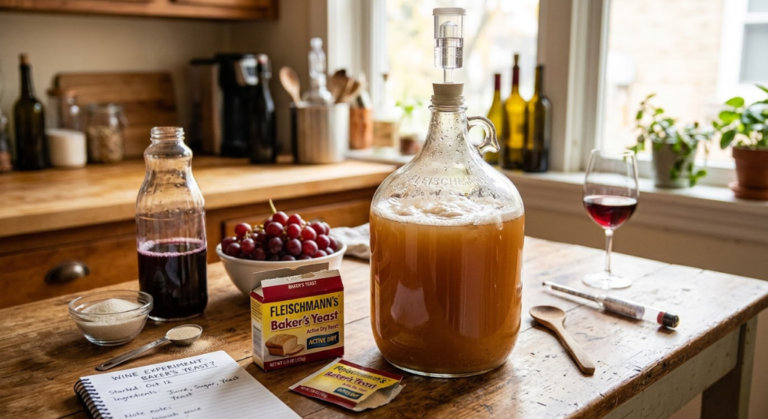
Can You Use Baker’s Yeast to Make Wine? The Complete Homebrew Science Guide
You want to make wine at home. You have grape juice, a vessel, some sugar — and in the cupboard, a packet of bread yeast left over from last week’s baking. The question seems obvious: yeast is yeast, right? It ferments things. Can you just use baker’s yeast to make wine?
The answer is yes — technically, you can. Baker’s yeast will ferment grape juice and produce alcohol. The question is not whether it works, but whether the result is anything worth drinking. And that answer is more nuanced than most online sources suggest.
This guide covers the full science: what baker’s yeast actually is and how it differs from wine yeast at a cellular and metabolic level, what happens to your wine’s flavour when you use it, why the alcohol tolerance difference is a serious practical problem, and what to do if you’ve already started a batch. It also gives you the best alternatives — from proper wine yeast to wild fermentation — for making wine that is actually good.
1. The Short Answer: Yes, But the Results Are Disappointing
Baker’s yeast (Saccharomyces cerevisiae) will ferment grape juice into a mildly alcoholic beverage. The fermentation biology works. However, the result will almost certainly be inferior to wine made with proper wine yeast in several meaningful ways:
- It will likely stop fermenting at 5–8% ABV rather than the 11–14% typical of finished wine
- It will produce excessive amounts of fusel alcohols and off-flavour compounds
- It will have a pronounced bready, yeasty aroma that does not belong in wine
- It may leave more residual sugar, making the wine taste flat and unpleasant
- It is likely to produce a cloudier, less stable final product
That said, baker’s yeast wine is not dangerous, and it is a perfectly reasonable starting point if you have no other option — provided you understand what to expect and how to optimise the process. Wine has been made with whatever yeast was available for thousands of years; the insistence on specific wine yeast strains is a relatively modern development in winemaking history.
🍇 The Key Question
The question is not “will baker’s yeast ferment grape juice?” (it will). The question is “will the result taste like wine?” (probably not). Understanding why these are different questions is the foundation of understanding yeast selection in winemaking. Our wine glossary for beginners covers fermentation terminology that helps frame this discussion.
2. What Is Baker’s Yeast — and What Is It Actually Designed To Do?
Baker’s yeast is a domesticated strain of the fungus Saccharomyces cerevisiae that has been selectively bred over centuries for one purpose: producing carbon dioxide rapidly and reliably in bread dough. The CO₂ it generates creates the gas bubbles that make bread rise. The ethanol it produces as a co-product evaporates during baking, leaving behind only the leavened structure.
The Breeding Goal: Speed, Not Quality
The characteristics that make baker’s yeast excellent for bread are almost entirely the wrong characteristics for winemaking. Baker’s yeast is selected for: rapid fermentation onset (getting CO₂ production started quickly), high fermentation rate under aerobic or semi-aerobic conditions (plenty of oxygen present in dough), tolerance for dense, sugary, protein-rich dough environments, and production of bready, wheaty aroma compounds that are desirable in baked goods.
None of these characteristics are what you want in a winemaking yeast. In wine, you need: slow, controlled fermentation that allows complex aromatic compound development, tolerance for anaerobic (oxygen-poor) conditions, high alcohol tolerance (to ferment to 12%+ ABV), production of aromatic compounds that enhance fruit character, and minimal production of off-flavour compounds like higher alcohols.
Baker’s Yeast Varieties
Baker’s yeast comes in three main forms: active dry yeast (granulated, dormant, must be activated in warm water before use), instant/rapid-rise yeast (finer granules, can be added directly to dough), and fresh/cake yeast (compressed, highly active, shorter shelf life). All three are strains of Saccharomyces cerevisiae and will ferment grape juice. The active dry and instant varieties are the most commonly available forms home winemakers might attempt to use. Fresh yeast ferments the most vigorously and would theoretically perform best in a wine context among the three, though still far below purpose-bred wine yeast.
3. What Is Wine Yeast — and Why Was It Bred Differently?
Wine yeast is a collection of Saccharomyces cerevisiae strains (and some strains of related species like Saccharomyces bayanus and Torulaspora delbrueckii) that have been selected specifically for their performance in grape-juice fermentation environments. Wine yeast selection has been driven by very different criteria than bread yeast selection.
What Wine Yeast Was Bred For
- High alcohol tolerance — surviving and continuing to ferment at 13–16% ABV
- Low production of volatile acidity — minimising acetic acid (the compound responsible for “vinegar” off-flavours)
- Low production of fusel alcohols — minimising the harsh, solvent-like compounds that create headaches and rough mouthfeel
- High production of desirable esters — the fruit-forward, floral aromatic compounds that make wine smell like wine
- Nutrient efficiency — performing well in the relatively nutrient-poor environment of grape juice
- Temperature tolerance — performing well across the 15–28°C range used in wine fermentation
- Competitive dominance — reliably out-competing wild yeasts and bacteria that might cause spoilage
Strain Specialisation
Within wine yeast, there is further specialisation by grape variety and wine style. Some strains are specifically optimised for Chardonnay — enhancing the tropical and buttery notes characteristic of the variety. Others are bred for Cabernet Sauvignon — emphasising dark fruit and structural tannin management. This level of metabolic precision is completely absent from baker’s yeast, which was bred for an entirely different environment. Understanding how different varieties express different flavour compounds — which we explore in our guide to wine varietals — requires a yeast that can bring out those varietal characteristics rather than masking them with off-flavours.
4. Baker’s Yeast vs. Wine Yeast: The Full Technical Comparison
| Characteristic | Baker’s Yeast | Wine Yeast | Impact on Wine Quality |
|---|---|---|---|
| Alcohol tolerance | 5–8% ABV (typical) | 12–16% ABV (strain dependent) | Critical — baker’s yeast stops fermenting early, leaving sweet, unfinished wine |
| Fermentation rate | Very fast — can be too aggressive | Controlled — optimised for wine conditions | Fast fermentation generates heat and off-flavours; controlled is better |
| Fusel alcohol production | High | Low (strain dependent) | Fusels = harsh, solvent flavours; headaches; rough finish |
| Ester production | Low (bready esters) | High (fruity, floral esters) | Esters are primary fruit and floral aromatic compounds in wine |
| Volatile acidity | Higher | Lower (strain dependent) | Volatile acidity = vinegar; even moderate levels are unpleasant |
| Nutrient requirements | Higher (optimised for nutrient-rich dough) | Lower (optimised for nutrient-poor grape juice) | Baker’s yeast may stall in nutrient-poor grape juice |
| Clarity / flocculence | Low flocculence — stays suspended | Higher flocculence — drops out of solution | Baker’s yeast produces cloudier wine that is harder to clear |
| Temperature range | Optimised for ~35–40°C (bread proofing) | Optimised for 15–25°C (wine fermentation) | At wine fermentation temperatures, baker’s yeast is less efficient |
| Sulphite tolerance | Low | High | Wine grapes/juice often contains natural or added sulphites that slow baker’s yeast |
| Cost | Very cheap — widely available | Inexpensive — a few dollars for enough to ferment 5 gallons | Cost is not a meaningful differentiator |
Saccharomyces cerevisiae (bread strain)
Alcohol tolerance: 5–8% ABV
Best for: Bread, pizza dough, pretzels
Wine result: Stops early, bready off-flavours, cloudy, rough
Verdict for wine: Works but disappoints
Saccharomyces cerevisiae (wine strain)
Alcohol tolerance: 12–16% ABV
Best for: All wine styles, cider, mead
Wine result: Ferments fully, clean flavour, proper aroma, clear
Verdict for wine: The right tool for the job
Mixed Saccharomyces + non-Saccharomyces
Alcohol tolerance: Variable — unpredictable
Best for: Natural wine, experimental ferments
Wine result: Highly variable — can be excellent or disastrous
Verdict for wine: Interesting but risky for beginners

Lalvin EC-1118 — the most popular and widely available wine yeast for home winemakers. Tolerates up to 18% ABV, neutral flavour profile, highly reliable
👉 Shop Lalvin EC-1118 on Amazon As an Amazon Associate, WineArmy may earn from qualifying purchases5. What Actually Happens When You Use Baker’s Yeast in Wine
Let’s walk through a realistic baker’s yeast wine fermentation from start to finish — what you observe, what is happening biologically, and where the problems emerge.
Days 1–3: Vigorous Activity
Baker’s yeast starts fermenting very aggressively, often within 2–6 hours of pitching (adding yeast to juice). You will see significant CO₂ production — lots of bubbling — and the must will foam noticeably. This vigour looks promising but is actually a warning sign: the rapid fermentation is generating heat, which encourages the production of fusel alcohols (higher alcohols like propanol, butanol, and isoamyl alcohol) that create harsh, solvent-like off-flavours in the finished wine.
Days 4–7: Activity Begins to Slow
As alcohol concentration in the fermenting juice rises toward 5–6%, baker’s yeast begins to experience genuine stress. It was not bred to survive in alcoholic environments, and its enzymatic machinery starts to shut down. Fermentation slows noticeably. CO₂ production drops. The yeast, now stressed, begins producing significantly more volatile acidity (acetic acid — the compound in vinegar) as a metabolic stress response.
Day 7–14: Fermentation Stalls
Most baker’s yeast strains will stall between 5–8% ABV. The sugar in the juice has not been fully fermented — a typical grape juice with 22–24 Brix (sugar content) would need to ferment to approximately 12–13% ABV to become properly dry. Baker’s yeast achieves less than half of that. The result is a sweet, low-alcohol liquid that tastes something between grape juice and rough wine — with a pronounced bready, yeasty smell and a harsh alcoholic edge from fusel production.
What You End Up With
After fermentation is complete (or has stalled), your baker’s yeast “wine” will typically have: 5–8% ABV (vs 11–14% for real wine), residual sweetness from unconsumed sugar, elevated volatile acidity (vinegar notes), a bready, yeasty aroma, cloudiness (baker’s yeast does not compact well), and fusel alcohol warmth that feels rough rather than smooth.
6. Alcohol Tolerance: The Most Critical Practical Difference
Of all the differences between baker’s yeast and wine yeast, alcohol tolerance is the most practically significant. It determines whether your fermentation completes at all — or stalls halfway through, leaving you with a sweet, unstable, bacteria-prone liquid that bears little resemblance to wine.
Why Alcohol Tolerance Matters
Grape juice typically contains 18–26 Brix (degrees of sugar) depending on the grape variety and ripeness. To ferment this to complete dryness requires yeast that can survive to approximately 10.5–15% ABV. Baker’s yeast dies — or more accurately, goes into reproductive and metabolic shutdown — at 5–8% ABV. This means baker’s yeast will only consume roughly 30–50% of the available sugar before stopping.
What Happens to the Remaining Sugar
The residual sugar that baker’s yeast leaves unconsumed creates two problems. First, the wine tastes unpleasantly sweet and flat — it lacks the dry, clean finish of properly fermented wine. Second, and more seriously, that residual sugar is an ideal growth medium for bacteria and wild yeasts that were out-competed during the initial fermentation. Your partially-fermented wine can easily become infected with lactic acid bacteria (creating sourness), acetic acid bacteria (creating vinegar), or spoilage organisms that make the wine undrinkable.
The Workarounds (and Why They Don’t Really Work)
Some home winemakers try to address the alcohol tolerance problem by adding yeast in stages — adding fresh baker’s yeast once the first pitch dies. This can extend fermentation slightly but does not fundamentally solve the problem, because the fresh yeast is still intolerant of alcohol and will also stall. Others try adding yeast nutrients to keep the baker’s yeast healthier for longer — this helps slightly but cannot overcome the fundamental genetic limitation of the strain’s alcohol tolerance.
⚠️ The Stuck Fermentation Risk
A fermentation that stalls with significant residual sugar is called a “stuck fermentation.” A stuck baker’s yeast wine fermentation is not just disappointing — it can become genuinely unpleasant or undrinkable if bacteria colonise the remaining sugar. If you suspect your fermentation has stuck, the best solution is to add a proper wine yeast to take over and complete the job.
7. The Flavour Problems with Baker’s Yeast Wine
Beyond the alcohol tolerance problem, baker’s yeast creates a range of off-flavour compounds that significantly degrade wine quality. Understanding these helps you recognise them in a finished batch and understand what to do.
Fusel Alcohols (Higher Alcohols)
Fusel alcohols are higher-molecular-weight alcohols produced as byproducts of amino acid metabolism during fermentation. They include isoamyl alcohol, n-propanol, n-butanol, and isobutanol. In small quantities they contribute to flavour complexity, but baker’s yeast produces them in significantly higher amounts than wine yeast — particularly under the temperature and nutrient conditions of a typical home winemaking setup.
High fusel content produces wine with a hot, harsh, solvent-like character — the kind of roughness that causes headaches even from moderate consumption. It is the dominant flavour problem with baker’s yeast wine and is the reason the finished product tastes like a rough fermented drink rather than wine.
Volatile Acidity (Acetic Acid)
All fermentation produces some acetic acid (the primary compound in vinegar). Wine yeast strains are specifically selected for low volatile acidity production. Baker’s yeast, particularly under stress from alcohol accumulation, produces acetic acid at significantly higher rates. The sensory threshold for volatile acidity in wine is around 0.4–0.6 g/L — above that level, wines smell and taste noticeably of vinegar. Baker’s yeast wine commonly exceeds this threshold.
Acetaldehyde
Acetaldehyde is an intermediate compound in alcohol fermentation. Properly functioning wine yeast efficiently converts acetaldehyde to ethanol and quickly reduces it to trace levels. Baker’s yeast, which is less well-adapted to anaerobic wine fermentation conditions, may accumulate higher acetaldehyde levels. High acetaldehyde gives wine a green apple or paint-like aroma and contributes to next-day headaches from wine consumption.
Hydrogen Sulphide (H₂S)
When yeast is under nutrient stress — particularly sulphur amino acid deficiency — it can produce hydrogen sulphide (H₂S), the compound responsible for the smell of rotten eggs. Baker’s yeast, optimised for nutrient-rich bread environments, is more likely to experience nutrient stress in the relatively nutrient-poor environment of grape juice, particularly if the winemaker has not added yeast nutrients. Even small amounts of H₂S can ruin the aroma of a wine batch.
8. Why Baker’s Yeast Wine Tastes “Bready” — The Biochemistry
One of the most consistent complaints about baker’s yeast wine is the pronounced bready, yeasty aroma that dominates the finished product. This is not imagination — it has a specific biochemical explanation.
The Responsible Compounds
Baker’s yeast strains have been specifically selected for high production of certain carbonyl compounds — particularly diacetyl (buttery), acetoin, and 2,3-butanediol — that contribute to baked bread aroma. These compounds are present in baked goods at low levels after most evaporate during baking, creating pleasant background notes. In wine, where there is no baking stage to drive them off, they accumulate and dominate the aroma profile.
Additionally, the autolysis (self-digestion) of dead baker’s yeast cells releases a range of compounds — including glutamates and nucleotides — that create a strong yeasty, “nutritional yeast”-like character. This is desirable in bread and beer but unpleasant in wine, where it competes with and masks fruit character.
The Ester Deficit
Wine’s most appealing aromatic characteristics come from esters — particularly ethyl acetate (in low amounts — pleasant, fruity), isoamyl acetate (banana, pear), and ethyl hexanoate (apple, anise). Wine yeast strains are selected for high ester production in grape juice environments. Baker’s yeast, when fermenting grape juice, produces a less favourable ester profile and significantly more of the bready carbonyl compounds described above. The result is wine that smells like neither bread nor wine — an awkward middle ground.
9. How to Make Wine With Baker’s Yeast (Optimised Method)
If you are committed to using baker’s yeast — perhaps because it’s all you have, or as an intentional experiment — here is the method that gives you the best possible result from a fundamentally limited starting point. This is not the same as instructions for making proper wine; it is how to minimise the damage from using the wrong yeast.
- Start with quality grape juice or crushed grapes The juice quality matters more than the yeast choice, relatively speaking. Use fresh-pressed grape juice (not pasteurised concentrate if possible), pressed from fully ripe fruit. Avoid commercially pasteurised juice with added preservatives — the sulphites and potassium sorbate in commercial juice will slow or kill even baker’s yeast.
- Test and adjust sugar levels (chaptalisation) Measure the Brix (sugar content) with a hydrometer or refractometer. For baker’s yeast, you want a starting sugar level of about 18–20 Brix rather than the typical 22–24 — lower starting sugar means baker’s yeast can ferment closer to completion before its alcohol tolerance is exceeded. If starting Brix is higher, dilute with a small amount of water.
- Add yeast nutrients Baker’s yeast in grape juice will be nutrient-stressed. Add a proprietary yeast nutrient (diammonium phosphate — DAP — is the most basic) at a rate of about 1 gram per litre of must. This reduces the risk of H₂S production and helps baker’s yeast survive longer in the alcoholic environment.
- Rehydrate and pitch the yeast at the right temperature Rehydrate active dry baker’s yeast in warm water (around 38°C) for 10 minutes before adding to the juice. Pitch into must that is at around 20–22°C. Too cold and baker’s yeast will be very sluggish; too warm and you will accelerate fusel alcohol production.
- Ferment at the cooler end of the range Keep fermentation temperature between 18–22°C. Baker’s yeast is optimised for higher temperatures (bread proofing at 35–40°C) but cooler fermentation significantly reduces fusel alcohol production and gives better flavour results. This is the single most impactful process adjustment you can make.
- Fit an airlock and monitor activity Use a proper fermentation vessel with an airlock to allow CO₂ to escape without allowing oxygen in. Oxygenation after the initial aerobic phase causes oxidation and acetic acid production. Monitor daily — if activity stops completely and the wine still tastes noticeably sweet, fermentation has stuck.
- Rack off the lees promptly Baker’s yeast does not compact as cleanly as wine yeast. Once fermentation activity stops, rack (siphon) the wine off the lees (sediment) promptly — within 1–2 days of fermentation completing or stalling. Extended contact with dead baker’s yeast lees accelerates autolysis and the bready, yeasty off-flavours described in the previous section.
- Consider rescuing with wine yeast if fermentation stalls If your baker’s yeast fermentation stalls at 5–7% ABV with significant residual sweetness, you can rescue the batch by adding a packet of proper wine yeast (Lalvin EC-1118 is the most robust choice). This wine yeast will pick up where the baker’s yeast left off, fermenting the remaining sugar and achieving a more complete result — though the fusel and off-flavour compounds already produced cannot be removed.
- Allow adequate clearing time before drinking Baker’s yeast wine will be cloudier than wine yeast wine. Allow at least 4–6 weeks in a cool, stable location after fermentation for the wine to clarify. Fining agents like bentonite or isinglass can accelerate clarity but are not essential for a basic batch.

Complete Home Winemaking Starter Kit — includes proper wine yeast, hydrometer, airlock, and all the basic equipment to make your first proper batch
👉 Shop Winemaking Kits on Amazon As an Amazon Associate, WineArmy may earn from qualifying purchases10. Wild Yeast: The Natural Alternative Worth Considering
Before discussing commercial wine yeast alternatives, it is worth addressing the option that existed before either baker’s or wine yeast was commercially available: wild fermentation using the yeast naturally present on grape skins and in the winery environment.
What Is Wild Yeast Fermentation?
Grape skins carry a diverse community of wild yeast species, including various Saccharomyces and non-Saccharomyces genera. When freshly crushed grapes or fresh grape juice is left at room temperature, these wild yeasts begin fermenting spontaneously within 24–48 hours without any added yeast. This is how wine was made for thousands of years, and it is the method still used by natural wine producers worldwide — including the Can Sumoi estate we discuss in our guide to organic and natural wines.
Wild Yeast vs. Baker’s Yeast — Which Is Better for Home Wine?
For a home winemaker without access to commercial wine yeast, wild fermentation from fresh grapes is actually a better option than using baker’s yeast. Fresh grapes carry native Saccharomyces cerevisiae strains that, while not as predictable as commercial wine yeast, are far better adapted to wine fermentation conditions than baker’s yeast. They have evolved alongside grapes, in environments with grape sugar concentrations and organic acid profiles, and they naturally tolerate higher alcohol levels than bread yeast strains.
The catch: wild fermentation only works with fresh, high-quality grapes (not pasteurised juice). Pasteurisation kills the native yeasts. And wild fermentation is inherently unpredictable — the microbial community varies by grape source, harvest year, and environment. The results can be extraordinary (many great natural wines are wild-fermented) or can go wrong in ways that are difficult to diagnose and fix.
The Hybrid Approach
A practical middle ground is to allow one to two days of wild fermentation from fresh grapes before adding a commercial wine yeast to take over. This gives the wild yeasts time to contribute their complexity-adding, early-stage fermentation work (non-Saccharomyces wild yeasts often produce particularly interesting aromatic compounds in the first 24–48 hours) before the commercial wine yeast establishes dominance and ensures complete, clean fermentation.
11. Best Wine Yeasts for Home Winemakers: A Practical Guide
If this article has convinced you to use proper wine yeast — which it should — here are the most useful strains for a home winemaker starting out. These are all widely available online and at homebrew shops, cost just a few dollars per packet, and will produce dramatically better results than baker’s yeast.
| Yeast Strain | Alcohol Tolerance | Flavour Profile | Best For | Beginner Friendly? |
|---|---|---|---|---|
| Lalvin EC-1118 (Champagne) | Up to 18% ABV | Very neutral — lets fruit speak | All wines, especially whites; rescuing stuck fermentations | ✅ Yes — most forgiving and reliable |
| Lalvin 71B | Up to 14% ABV | Fruity, aromatic, emphasises floral notes | Rosé, fruity reds, fruit wines, Nouveau styles | ✅ Yes — great for beginners wanting fruit-forward wine |
| Lalvin D47 | Up to 14% ABV | Rich, full body, creamy texture | White wines, Chardonnay, mead, fruit wines | ✅ Yes — but keep fermentation cool (below 15°C to avoid fusel production) |
| Red Star Côte des Blancs | Up to 14% ABV | Delicate, fruity, enhances floral aromatics | White wines, sweet wines, rosé | ✅ Yes — excellent for aromatic whites |
| Red Star Premier Rouge | Up to 15% ABV | Robust, emphasises tannin structure and body | Full-bodied red wines — Cabernet, Merlot, Shiraz | ✅ Yes — reliable for classic red styles |
| Mangrove Jack’s MA33 | Up to 15% ABV | Rich mouthfeel, tropical fruit esters | White wines, especially tropical fruit styles | ✅ Yes — particularly good for Sauvignon Blanc styles |
💡 For Absolute Beginners: Start With EC-1118
Lalvin EC-1118 is the most widely recommended starter wine yeast for good reasons: it tolerates up to 18% ABV (will always ferment to completion), has an extremely neutral flavour profile that doesn’t mask fruit character, is highly resistant to stuck fermentations, works well across a wide temperature range, and is forgiving of beginner mistakes in nutrient and temperature management. It is the yeast equivalent of a reliable workhorse — not the most exciting option, but the most likely to give a successful first batch.
12. Troubleshooting Baker’s Yeast Wine Fermentation
If you have already started a batch with baker’s yeast and are experiencing problems, here is how to diagnose and address the most common issues.
Problem: Fermentation Has Stalled
Symptoms: Bubbling has stopped but the wine still tastes very sweet. Hydrometer reading shows high specific gravity (still above 1.010).
Cause: Baker’s yeast has reached its alcohol tolerance limit (typically 5–8% ABV) and gone dormant or died.
Solution: Add a packet of Lalvin EC-1118 wine yeast (rehydrated as per packet instructions). EC-1118 is specifically designed to restart stuck fermentations due to its high alcohol tolerance. It will take over and ferment the remaining sugar.
Problem: Wine Smells Like Rotten Eggs
Symptoms: Distinctive hydrogen sulphide (H₂S) aroma — “rotten egg,” sulphurous smell.
Cause: Baker’s yeast under nutrient stress, particularly sulphur amino acid deficiency.
Solution: Add yeast nutrients (DAP — diammonium phosphate) immediately. Splash rack the wine (pour it vigorously to expose it to air temporarily) to help drive off H₂S. If the smell persists, add a small amount of copper sulphate solution (available at homebrew shops) — copper binds H₂S and removes it from the wine.
Problem: Wine Tastes Like Vinegar
Symptoms: Sharp, acidic, vinegar-like flavour that was not there initially.
Cause: Acetic acid bacteria (Acetobacter) have infected the wine, or volatile acidity from stressed baker’s yeast fermentation has built to unpleasant levels.
Solution: If the infection is mild and fermentation is still active, sulfite the wine (add potassium metabisulphite) and ensure the fermentation vessel is fully sealed. If vinegar flavour is pronounced, the wine cannot be rescued — the acetic acid contamination is irreversible. Use it as a cooking wine or wine vinegar.
Problem: Wine Tastes Harsh and “Hot”
Symptoms: Rough, burning sensation that seems excessive for the alcohol content. Harsh finish.
Cause: High fusel alcohol production from baker’s yeast fermentation, especially if it ran warm.
Solution: Time is the only partial remedy — fusel alcohols integrate somewhat with extended ageing. Allow the wine to rest for 3–6 months in a sealed container. Oak chips (available at homebrew shops) can help mask fusel harshness. Blending with a small amount of clean, well-made wine reduces the impact. This is the one off-flavour from baker’s yeast that cannot be fully eliminated.
Problem: Wine Is Very Cloudy
Symptoms: Dense, persistent cloudiness that does not clear with time.
Cause: Baker’s yeast’s low flocculence — cells stay suspended rather than settling. May also indicate pectin haze from the fruit.
Solution: Cold crash the wine (move it to a cold environment — near 0°C — for 1–2 weeks). Add bentonite fining agent if cold crashing doesn’t resolve it. Pectin enzyme can help with pectin-based haze from fruit wines.
13. The Science of Wine Fermentation: Why Yeast Selection Matters
For those who want to understand the deeper science behind why yeast selection has such a dramatic impact on wine quality, this section provides the biochemical context.
The Fermentation Equation — Simplified
The core fermentation reaction converts glucose to ethanol and CO₂:
C₆H₁₂O₆ → 2 C₂H₅OH + 2 CO₂
(Glucose → Ethanol + Carbon Dioxide)
This central reaction is the same regardless of whether baker’s or wine yeast performs it. The dramatic differences in wine quality come from the side reactions and metabolic byproducts that different yeast strains generate alongside the main fermentation pathway.
The Ester Pathway
Esters are formed when organic acids react with alcohols during fermentation. The ester isoamyl acetate (formed from isoamyl alcohol and acetic acid) smells like banana; ethyl hexanoate smells like apple. Wine yeast strains are selected for high activity of the enzyme alcohol acetyltransferase (ATF1), which catalyses ester formation. Baker’s yeast strains have lower ATF1 activity in the conditions of grape juice fermentation, producing fewer and less desirable esters.
The Fusel Pathway
Fusel alcohols are formed through the Ehrlich pathway when yeast metabolises amino acids. The rate of fusel production is influenced by temperature, nitrogen availability, and yeast genetics. Baker’s yeast, which is optimised for high-temperature, amino-acid-rich bread environments, has high-activity versions of the enzymes in this pathway. At wine fermentation temperatures and in the amino-acid-limited environment of grape juice, baker’s yeast continues producing fusels at a rate that wine yeast strains have been bred to suppress.
Sulphite Tolerance and Wine Chemistry
Grapes naturally contain sulphur dioxide (SO₂) in small amounts, and winemakers commonly add it as a preservative and antioxidant. Wine yeast strains have been selected for high sulphite tolerance — they can proceed through fermentation in the presence of SO₂ levels that would inhibit or kill baker’s yeast. This is why commercial grape juice with even small amounts of added sulphites can significantly impair baker’s yeast fermentation, while a proper wine yeast would proceed unaffected.
Understanding these flavour compounds — how they arise and what they contribute to wine’s aromatic profile — connects directly to the tasting vocabulary we explore in our wine terminology and tasting vocabulary guide.

After making your first batch, compare it to a great commercial wine to calibrate your palate. Ariel dealcoholized Cabernet shows how professional fermentation translates to flavour
👉 Browse Reference Wines on Amazon As an Amazon Associate, WineArmy may earn from qualifying purchases14. Pros & Cons: Using Baker’s Yeast to Make Wine
✅ Arguments For Using Baker’s Yeast
- Available in every kitchen — no special trip required
- Will technically produce an alcoholic beverage
- Useful for emergency or experimental batches
- Very cheap — already in your cupboard
- Can be rescued mid-fermentation by adding wine yeast
- Historically valid — wine was made this way for millennia
- Good for understanding fermentation basics as a learning exercise
- Results improve significantly with process optimisation (cool temp, nutrients)
❌ Arguments Against Using Baker’s Yeast
- Low alcohol tolerance — fermentation stalls at 5–8% ABV
- Bready, yeasty off-flavours that don’t belong in wine
- High fusel alcohol production — harsh, rough mouthfeel
- More volatile acidity — vinegar notes
- Cloudier, harder to clear final product
- Higher risk of stuck fermentation and bacterial infection
- Poor sulphite tolerance — impaired by juice preservatives
- Proper wine yeast costs only ~$2–4 per batch — the savings are negligible
- Will not reflect varietal character of grapes used
Frequently Asked Questions
Yes — baker’s yeast will ferment grape juice and produce alcohol. The question is whether the result is worth drinking. Baker’s yeast will typically stall at 5–8% ABV rather than fermenting to the 11–14% of proper wine. It produces bready off-flavours, elevated fusel alcohols (harsh, rough mouthfeel), and more volatile acidity (vinegar notes) than wine yeast. The result is technically a fermented grape beverage but is significantly inferior to wine made with proper wine yeast. If you have no other option, baker’s yeast works — but a packet of Lalvin EC-1118 wine yeast costs about $2 and produces dramatically better results.
Both are strains of Saccharomyces cerevisiae — the same fungal species. The difference is in thousands of generations of selective breeding for different purposes. Baker’s yeast was bred for: rapid CO₂ production in bread dough, performance at high temperatures (35–40°C), and production of bready aroma compounds. Wine yeast was bred for: high alcohol tolerance (12–16% ABV), production of fruity ester compounds, low production of off-flavour fusels and volatile acidity, and performance at cooler wine fermentation temperatures (15–25°C). The metabolic profiles of these two types of yeast are dramatically different even though they are the same species.
Most baker’s yeast strains will produce between 5–8% ABV before stalling due to alcohol toxicity. Typical grape juice contains enough sugar for 12–14% ABV if fully fermented. This means baker’s yeast will only consume 40–60% of the available sugar before stopping, leaving a wine that is sweet, low-alcohol, and unstable. Some baker’s yeast strains in optimal conditions may push to 9–10% ABV, but this is unusual and not reliable. For reference, most table wines are 11–14% ABV.
Probably not — at least not like proper wine. Baker’s yeast wine will have a pronounced bready, yeasty aroma, a harsh edge from fusel alcohol production, possible vinegar notes from elevated volatile acidity, residual sweetness from incomplete fermentation, and cloudiness. The result may be drinkable as a rough fermented beverage but will not taste like wine as most people understand it. Process optimisation — fermenting cool, adding nutrients, racking promptly — can significantly improve the result, but cannot fully compensate for the fundamental mismatch between baker’s yeast and wine fermentation conditions.
For beginners making their first homemade wine, Lalvin EC-1118 (also called Champagne yeast or Premier Cuvée) is the most recommended choice. It tolerates up to 18% ABV, has an extremely neutral flavour profile that lets fruit character come through, is highly resistant to stuck fermentations, works well across a wide temperature range, and is very forgiving of beginner mistakes. For fruit-forward wines, Lalvin 71B is an excellent alternative that enhances floral and fruity notes. For full-bodied reds, Red Star Premier Rouge is a popular option. All of these cost $2–4 per packet at homebrew shops or online.
Yes — active dry yeast and instant/rapid-rise yeast are both baker’s yeast strains and will ferment grape juice. Rapid-rise yeast is simply a finer-ground version of active dry yeast that doesn’t require pre-activation. Both will produce the same results as baker’s yeast: stalling at low alcohol, off-flavours, bready aroma, and cloudy wine. The differences between active dry and rapid-rise yeast matter a lot in bread making but are largely irrelevant for wine fermentation. Neither is a good choice; both are workable in the absence of proper wine yeast.
A stuck baker’s yeast fermentation is most easily rescued by adding Lalvin EC-1118 wine yeast. Rehydrate a packet of EC-1118 in warm water (38°C) for 15 minutes, then add it directly to your stuck wine. EC-1118 is specifically designed for this purpose — it has an 18% alcohol tolerance and is very aggressive at taking over stuck fermentations. Stir gently and refit the airlock. Within 24–48 hours you should see renewed activity. EC-1118 will ferment the remaining sugar that baker’s yeast could not handle. The final wine will still have the fusel and off-flavour characteristics from the initial baker’s yeast fermentation, but it will be drier and more stable.
Yes — baker’s yeast wine is not toxic or dangerous to drink, provided the fermentation has not become contaminated with harmful organisms (which is rare but possible if sanitation is poor). The compounds produced in excess by baker’s yeast — fusel alcohols and volatile acidity — cause inferior flavour and may contribute to worse next-day headaches at equivalent alcohol consumption compared to clean wine yeast fermentations, but they are not harmful at the levels found in home wine. The primary concern with baker’s yeast wine is quality, not safety.
Baker’s yeast ferments very aggressively for the first 3–5 days, then slows dramatically as alcohol accumulates. Most baker’s yeast fermentations are effectively complete (or stalled) within 7–14 days. This is actually faster than proper wine yeast fermentations, which typically run 2–4 weeks for a more complete, controlled ferment. The speed of baker’s yeast fermentation is not an advantage in wine — it contributes to the production of off-flavour compounds that slower, cooler fermentations minimise.
Brewer’s yeast (also Saccharomyces cerevisiae strains, plus some Saccharomyces pastorianus strains for lager) is a better option than baker’s yeast for wine making, but still inferior to proper wine yeast. Brewer’s yeast has been bred for alcoholic fermentation rather than CO₂ production, so it tolerates higher alcohol levels than baker’s yeast (typically 8–12% ABV). However, it produces beer-specific compounds — hop tolerance adaptations, beer ester profiles — that are not desirable in wine. Brewer’s yeast wine will taste beer-like rather than bready, but it will still lack the fruit-forward aromatic profile that proper wine yeast creates. It is a better emergency substitute than baker’s yeast but not a real alternative to wine yeast.
Conclusion: Baker’s Yeast Can Make Wine — Just Not Good Wine
The answer to “can you use baker’s yeast to make wine?” is unambiguously yes — if by “wine” you mean “a fermented grape beverage.” The fermentation biology works. Baker’s yeast will convert grape sugar into alcohol. What you end up with will be cloudy, low-alcohol (5–8% ABV), bready in aroma, rough in texture from fusel alcohol, and potentially sweet from incomplete fermentation. It is drinkable. It is not wine as the word is generally understood.
The reason proper wine yeast exists — and why it costs just a few dollars from any homebrew shop — is that thousands of years of accumulated knowledge, and decades of modern selective breeding, have produced yeast strains that do this job correctly. Wine yeast tolerates 12–16% ABV. It produces aromatic esters that smell like fruit rather than bread. It minimises the harsh fusel alcohols that make cheap wine feel rough. It clears cleanly from the finished wine. For the price of a cup of coffee, you can buy a packet of Lalvin EC-1118 and make wine that tastes like wine.
If you are in a genuine pinch — no homebrew shop nearby, no online delivery available — use baker’s yeast, keep fermentation cool, add nutrients, rack promptly, and manage your expectations. If you want to make wine that actually tastes like wine, spend the $2 on proper yeast. The difference in result is far greater than the difference in cost.
Ready to Make Proper Wine at Home?
Find wine yeast, home winemaking kits, hydrometers, airlocks, and everything else you need to brew your first real batch — from $2 packets of wine yeast to complete starter kits.
🛒 Shop Wine Yeast & Winemaking Supplies on Amazon As an Amazon Associate, WineArmy may earn from qualifying purchases