Do I Need a Wine Fridge? The Honest Answer for Every Type of Wine Lover
If you love wine, you’ve probably wondered at some point whether you need a wine fridge. Maybe you’ve accumulated a few bottles you want to keep in good condition. Maybe someone just gave you a case as a gift. Maybe you’ve started buying wines you want to age. Or maybe you’ve just seen a wine fridge on display and thought it looks good in a kitchen.
The answer — genuinely — depends on who you are as a wine drinker. A wine fridge is an excellent investment for some people and a completely unnecessary expense for others. This guide cuts through the marketing and gives you the honest framework to decide whether a wine fridge makes sense for your situation, what it actually protects your wine from, what the alternatives are, and if you do decide to buy one, exactly what to look for.
1. The Honest Answer: It Depends on One Thing
The most important question for determining whether you need a wine fridge is not how much wine you drink, not how much you spend on it, and not how serious a wine lover you are. It is this:
How long do you keep wine before drinking it?
If the answer is less than a week — you buy wine and drink it within days — then you almost certainly do not need a wine fridge. Short-term storage does not require temperature-controlled conditions. The enemy of wine is not a few days at room temperature; it is months and years of improper conditions.
If the answer is weeks to months — you accumulate a small collection and drink from it gradually — then a wine fridge becomes worth considering, especially if your home gets warm in summer.
If the answer is years — you buy wines specifically to age them, you buy more than you drink — then a wine fridge is close to essential for protecting your investment.
✅ You Probably Need One If…
You keep wine for months or years, you buy wine to age or invest in, your home gets above 25°C in summer, you have more than 20–30 bottles at any time, or you want to serve wine at the correct temperature effortlessly.
❌ You Probably Don’t Need One If…
You buy wine and drink it within a week or two, you rarely keep more than 6–12 bottles at once, your home stays cool year-round, or your wines are all under $20 and meant for near-term drinking.
2. What Actually Ruins Wine During Storage
To understand whether a wine fridge is worth it, you need to understand what specifically damages wine when stored improperly. There are five main enemies of wine in storage — and each one is addressed (or not) by a wine fridge in different ways.
Enemy 1: Heat
Heat is wine’s single greatest enemy in home storage. At temperatures above 25°C, the chemical reactions within wine accelerate dramatically — tannins polymerise too quickly, aromatic compounds break down, and the wine “cooks.” A bottle exposed to 30°C for a few hours is stressed; one stored at 30°C consistently for weeks is damaged. Repeated heat exposure is cumulative and irreversible. A wine stored at 18°C for 10 years will age gracefully; the same wine stored at 28°C for 10 years will be oxidised, flat, and jammy long before it reaches its peak.
Wine fridges specifically solve the heat problem by maintaining a consistent, cool temperature regardless of ambient room conditions. This is their primary and most important function.
Enemy 2: Temperature Fluctuation
Even more damaging than consistently warm temperatures is dramatic temperature fluctuation. Wine expands and contracts as temperature rises and falls. If a bottle stored horizontally cycles through large temperature swings repeatedly, the cork is pushed in and out microscopically by the expanding and contracting wine — eventually allowing air to penetrate. Even bottles with screw caps are affected because the liquid itself cycles through expansion and contraction that stresses the wine’s chemical structure.
A cool basement might be at 14°C, but if it cycles between 14°C in winter and 24°C in summer, that 10-degree annual fluctuation is more damaging than a consistent 18°C would be.
Enemy 3: Light (UV Exposure)
UV light triggers photochemical reactions in wine that produce sulphur compounds responsible for the “light strike” fault — a musty, wet cardboard smell that is particularly common in white and sparkling wines. This is why wine bottles are often made from dark-coloured glass (green or brown). Even brief UV exposure from fluorescent lights (which emit UV) can light-strike a bottle. Sunlight is far more damaging still.
Wine fridges with solid or UV-filtering glass doors protect against light exposure. Storing wine in a dark cupboard or box achieves the same protection more simply.
Enemy 4: Vibration
Chronic vibration disturbs the sediment that naturally forms in ageing wines (particularly red wines and vintage port), preventing it from settling and potentially interfering with the slow chemical processes that constitute wine ageing. This is why wine cellars are traditionally located below ground — away from foot traffic, road vibration, and mechanical equipment. Vibration is the least damaging of the five enemies for typical home storage timescales, but it matters for serious long-term ageing.
Enemy 5: Humidity (Too Low)
Humidity matters primarily for wines sealed with natural cork. If relative humidity drops below 50%, corks can dry out, shrink slightly, and allow air infiltration that oxidises the wine. Traditional wine cellars maintain 60–80% relative humidity for this reason. For screw-cap wines, humidity is essentially irrelevant. For corked wines stored for years, maintaining humidity matters. Many wine fridges include humidity control features for this reason.
🌡️ The Core Insight
A wine fridge is fundamentally a solution to the heat and temperature-fluctuation problems. Everything else — light, vibration, humidity — can be managed through simpler and cheaper methods. If heat is not a significant problem in your home, a wine fridge provides less marginal benefit. Our detailed guide on how to store wine at home covers all five enemies and their solutions in depth.
3. Ideal Wine Storage Conditions — The Numbers
Understanding the target conditions for wine storage makes it easier to assess whether your current situation requires a dedicated appliance.
Long-Term Storage Temperature: 12–14°C
The traditional benchmark for long-term wine cellaring is 12–14°C (54–57°F). At this range, wine ages slowly and gracefully — the chemical reactions that constitute ageing (ester development, tannin polymerisation, colour evolution) proceed at the right pace. Higher temperatures accelerate ageing; lower temperatures slow it. Neither extreme is ideal. Most wine fridges set for long-term storage target this range.
Short-Term / Serving Temperature: Varies by Style
Serving temperature is a separate consideration from storage temperature. Red wines are best served at 14–18°C, not at room temperature as the old rule suggested (that rule predates central heating and refers to a cooler European room temperature). White wines are best served at 8–12°C. Sparkling wines at 6–10°C. A dual-zone wine fridge can maintain reds at serving temperature in one zone and whites at serving temperature in another — a genuine convenience for regular entertainers.
| Wine Type | Ideal Serving Temp | Ideal Storage Temp | Most Damaged By |
|---|---|---|---|
| Full-bodied reds | 16–18°C | 12–14°C | Heat above 25°C, UV light |
| Light reds & Pinot Noir | 14–16°C | 12–14°C | Temperature fluctuation |
| Full-bodied whites | 10–13°C | 10–12°C | Heat, light strike |
| Light/crisp whites | 7–10°C | 8–10°C | Light strike especially |
| Sparkling / Champagne | 6–9°C | 8–10°C | Heat, vibration, UV light |
| Rosé | 8–12°C | 10–12°C | Heat, light exposure |
| Dessert wines | 6–10°C | 10–13°C | Heat, oxidation after opening |
Understanding these temperature ranges is part of the broader knowledge of how different wine styles behave — something covered in detail in our guide to wine varietals and their characteristics.
4. Do YOU Need a Wine Fridge? A Practical Decision Guide
Rather than a blanket answer, here is a framework that maps different wine drinker profiles to honest recommendations.
Profile 1: The Casual Drinker (Buy and Drink Within Days)
You pick up a bottle or two when you need one, drink it within a few days, and rarely have more than 4–6 bottles in the house at once. Your bottles don’t sit around long enough for storage conditions to matter significantly.
Verdict: No wine fridge needed. Keep bottles in a cool, dark place — a kitchen cupboard away from the cooker, a corner of a wardrobe, or the coolest room in the house. Put whites in the regular fridge about 30–60 minutes before serving. This is all you need.
Profile 2: The Regular Enthusiast (Accumulates 12–24 Bottles)
You buy wine regularly, often have a rotating collection of 12–24 bottles, and may keep some for several weeks before drinking. You live somewhere that gets warm in summer (above 23–25°C indoors).
Verdict: A wine fridge is worth considering. If your home gets significantly warm in summer, a small countertop or freestanding unit (12–18 bottle capacity) would meaningfully protect your collection. If your home stays reasonably cool year-round, a dark cupboard works fine.
Profile 3: The Collector / Ager (Buys to Cellar)
You specifically buy wines with the intention of ageing them — perhaps 3, 5, or 10+ years. You accumulate a collection and selectively drink from it. You may spend $30–$100+ per bottle on wines you want to cellar properly.
Verdict: A wine fridge is close to essential. The investment value of your collection justifies the appliance cost. You need consistent temperature control, and a standard domestic wine fridge delivering 12–14°C year-round is far better than any ambient storage in a typical home.
Profile 4: The Entertainer (Needs Wine Ready at Serving Temperature)
You frequently host dinners, you keep a variety of red and white wines ready to serve, and being able to pour at the correct temperature matters to you. You don’t necessarily collect to age — you want convenience and serving quality.
Verdict: A dual-zone wine fridge is genuinely useful. Having whites chilled and reds at cellar temperature, ready to serve, is a meaningful quality-of-life improvement for regular entertainers. This is less about preservation and more about serving optimally.
Profile 5: The Wine Investor
You buy wine as an investment — en primeur Bordeaux, allocated Burgundy, sought-after Napa Cabernet — and intend to hold for many years before drinking or reselling.
Verdict: A proper wine fridge (or professional storage) is non-negotiable. The financial value at stake justifies professional-grade storage. For serious investment quantities, consider professional off-site wine storage services which offer guaranteed conditions, insurance, and provenance documentation.

Ivation 18-Bottle Wine Cooler — a popular entry-level thermoelectric wine fridge with consistent temperature, UV-filtering glass door and quiet operation
👉 Shop Wine Fridges on Amazon As an Amazon Associate, WineArmy may earn from qualifying purchases5. Why Your Kitchen Fridge Is Not a Wine Fridge
The most common improvised wine storage solution is the regular kitchen fridge. For chilling a bottle before serving, this is perfectly fine. As a long-term storage solution, it has several meaningful drawbacks that a dedicated wine fridge addresses.
Too Cold for Long-Term Storage
Kitchen fridges operate at 2–4°C — well below the ideal 12–14°C for wine ageing. At these temperatures, the chemical reactions that constitute ageing essentially stop entirely. A wine stored at 3°C for a year barely ages at all; useful for preserving the current state of a young wine, but not for allowing it to develop complexity over time. More importantly, wines removed from a very cold fridge to room temperature experience a large, rapid temperature swing — exactly the kind of fluctuation that stresses wine.
Too Dry
Kitchen fridges typically operate at 30–50% relative humidity — lower than the 60–80% ideal for wine. Over months, this dries out corks, potentially allowing air infiltration and oxidation.
Too Much Vibration
The compressor in a kitchen fridge cycles on and off repeatedly throughout the day, creating ongoing vibration. For wines being aged for extended periods, this chronic vibration can disturb sediment and interfere with the slow ageing process.
Food Odours
Corks are permeable — they breathe, which is partly the point. Storing corked wine in a kitchen fridge alongside strong-smelling foods (cheese, leftovers, herbs) can allow fridge odours to slowly penetrate the cork and affect the wine’s aroma over time. This is a slow process and not significant for short periods, but it is a real concern for multi-month storage.
Door Opening Frequency
Kitchen fridges are opened many times daily, creating temperature fluctuations each time the door opens. A dedicated wine fridge is opened far less frequently, maintaining more stable conditions.
⚠️ The Kitchen Fridge Rule
Use the kitchen fridge for: chilling wine before serving (up to 1–2 hours for most whites, 20–30 minutes for reds that are too warm). Do not use it for: storing wine for more than 1–2 weeks, storing corked wines that you intend to age, or keeping sparkling wines with corks for more than a few days (the fizz fades faster under repeated temperature changes).
6. How Long Are You Keeping Your Wine? The Critical Variable
Wine storage risk scales dramatically with time. Understanding this helps you make a rational decision about storage investment relative to your actual habits.
| Storage Duration | Risk at Room Temp (18–22°C) | Risk in Warm Home (25–30°C) | Wine Fridge Impact |
|---|---|---|---|
| 1–3 days | Negligible | Negligible | Minimal — not worth the cost |
| 1–4 weeks | Low | Low–moderate | Minor benefit in very hot climates |
| 1–6 months | Low–moderate | Moderate–high | Meaningful benefit, especially for quality wines |
| 6 months–2 years | Moderate | High — noticeable degradation | Significant benefit for wines over $25–30/bottle |
| 2–5 years | High — wine will be affected | Very high — wine likely ruined | Essential for protecting any serious wine |
| 5+ years | Very high | Catastrophic | Non-negotiable — proper temperature control required |
The key insight from this table: wine stored for under a month at normal room temperature in a cool home faces minimal risk. The risk curve rises steeply beyond three to six months, and becomes critical beyond one to two years. If your honest self-assessment places you in the “1–4 weeks” category, the wine fridge investment is not justified by the protection benefit alone.
7. Types of Wine Fridges: What’s Available
If you’ve decided a wine fridge makes sense for your situation, here is an overview of the main types and what each is suited for.
Countertop / Compact Wine Fridges (6–18 Bottles)
These small units sit on a kitchen counter or shelf. They are ideal for casual wine enthusiasts who want a dedicated space to keep a small rotating collection at serving temperature. They are primarily thermoelectric, quiet, and energy-efficient. Limitations: not designed for long-term ageing (they don’t have the temperature stability of larger units), limited capacity, and the compressor-free design means they struggle to cool below ambient temperature by more than 10–15°C in very warm environments.
Freestanding Wine Fridges (20–75 Bottles)
The most common category for home use. These floor-standing units offer meaningful storage capacity, either single-zone (one temperature throughout) or dual-zone (separate compartments for reds and whites). Good freestanding units provide stable temperatures suitable for both medium-term storage (months) and active cellaring (years). They require ventilation at the front or sides — not the rear — to be placed under a counter or in a cabinet.
Built-In / Under-Counter Wine Fridges
Designed with front ventilation to be installed under kitchen counters or in custom cabinetry. These look far more integrated in a kitchen but cost more than freestanding equivalents. The front-venting design is essential — never install a rear-venting wine fridge in an enclosed cabinet, as it will overheat and fail.
Dual-Zone Wine Fridges
These maintain two separate temperature zones — typically reds in the upper/warmer zone and whites in the lower/cooler zone. For regular entertainers who want both reds and whites ready to serve at their correct temperatures, dual-zone units are genuinely useful. For pure long-term cellaring, a single-zone unit at 12–14°C is more appropriate (both reds and whites store well at this temperature).
Large Wine Cabinets (75–300+ Bottles)
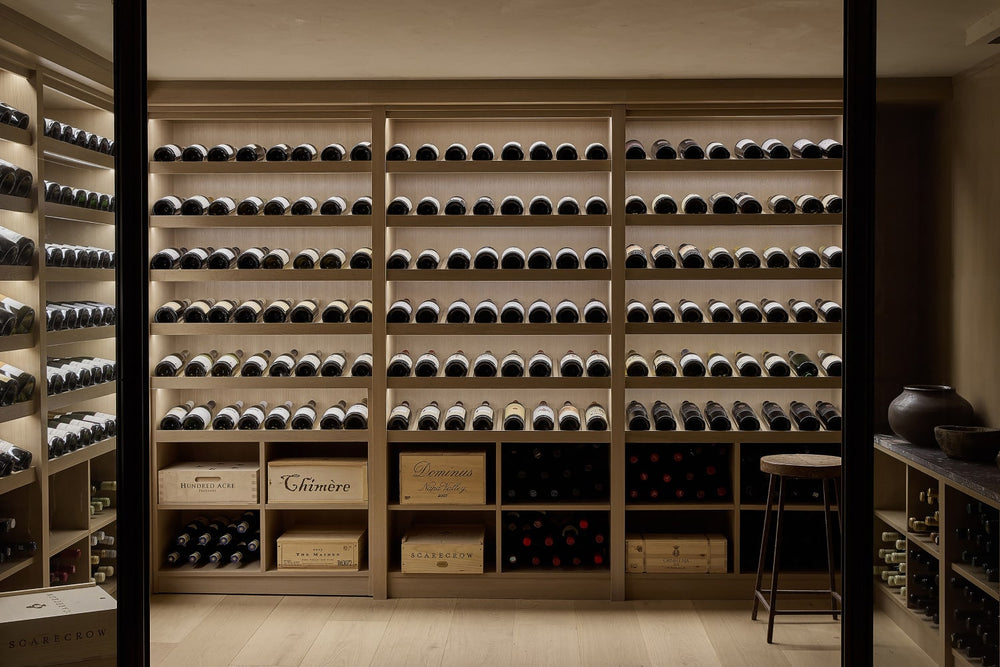
For serious collectors, large capacity wine cabinets function as fully climate-controlled wine rooms in a compact form. These are typically compressor-based for strong cooling performance, with precision temperature control and proper humidity management. They represent the home storage option closest to a professional cellar.
8. Thermoelectric vs. Compressor Wine Fridges: Which Is Right for You?
This is one of the most common questions when buying a wine fridge, and the right answer depends on your specific situation. Our detailed guide to thermoelectric vs. compressor wine cooling covers the full technical comparison — here is the practical summary.
| Factor | Thermoelectric | Compressor |
|---|---|---|
| How it works | Peltier effect — electrical current across two materials creates temperature differential | Same as a fridge — refrigerant gas circulated by a compressor |
| Noise level | Near-silent — no moving parts | Audible — compressor cycles on/off |
| Vibration | Virtually none | Moderate — compressor creates vibration |
| Cooling power | Limited — can only cool 10–15°C below ambient room temp | Strong — can reach target temperature regardless of room temp |
| Temperature stability | Good in stable environments; struggles in hot rooms/summers | Excellent — maintains set temperature reliably |
| Energy efficiency | Lower energy use for small units | Higher energy use but more efficient per bottle for large units |
| Best for | Cool rooms, small collections, quiet living spaces, short-term storage | Warm climates, larger collections, long-term ageing, summer performance |
| Typical price | Lower — $80–$200 for 12–18 bottle units | Higher — $150–$500+ for equivalent capacity |
The Practical Decision
If you live in a climate where your kitchen never gets above 24°C (75°F) in summer, a thermoelectric unit will serve you well and has the advantage of silence and low vibration — particularly good for sparkling wines and for placement in living spaces. If you live somewhere hot — your kitchen reaches 28–35°C in summer — only a compressor-based unit will reliably cool to wine storage temperatures. A thermoelectric unit in a hot kitchen becomes useless precisely when you need it most.
9. How Many Bottles Do You Actually Need to Store?
Accurately sizing your wine fridge is important — both undersizing (frustrating, you immediately run out of space) and oversizing (wasting money and kitchen space) are common mistakes.
Counting Your Real Usage
The best way to size a wine fridge is to think about your peak collection — the most bottles you are likely to have at any one time. Add 20–30% to that figure for growth. Most people significantly underestimate their peak collection because they think about current stock rather than aspirational stock.
- Occasional drinker, buy and drink quickly: 12–18 bottle unit
- Regular wine lover, rotating stock of 20–40 bottles: 24–36 bottle unit
- Enthusiast with growing collection: 46–75 bottle unit
- Collector, buys cases and ages: 100+ bottle unit or multiple units
The Bottle Count Myth
Published bottle counts on wine fridges are almost always based on standard Bordeaux-shaped bottles. Burgundy bottles (wider shoulders), Champagne bottles (heavier, wider), and magnum bottles all take up more space. If you regularly buy Burgundy or Champagne, a 24-bottle rated fridge may actually hold only 18–20 of your bottles. Factor this in when sizing.
Modular Expansion
Some wine storage solutions — particularly rack-based systems — allow for modular expansion without replacing the entire unit. Our guide to modular wine rack and expandable storage options covers these alternatives, which can be more cost-effective for larger collections than buying progressively larger appliances.

NewAir 28-Bottle Dual Zone Wine Fridge — separate zones for reds and whites, compressor-based for reliable cooling in any room temperature
👉 Shop Dual-Zone Wine Fridges on Amazon As an Amazon Associate, WineArmy may earn from qualifying purchases10. What to Look for When Buying a Wine Fridge
If you’ve decided to buy, here are the key features to evaluate — ranked by importance for most buyers.
1. Temperature Range and Stability
The most important specification. For long-term storage, look for a unit that can maintain 12–14°C reliably. Check customer reviews for reports of temperature fluctuation — some budget units cannot hold their set temperature accurately. Look for digital temperature control with at least ±1°C accuracy. Analogue dial controls are less precise.
2. Compressor vs. Thermoelectric
As covered above — choose based on your climate and whether silence or cooling power is the priority.
3. UV-Filtering Glass Door
A must-have. Clear glass without UV filtering defeats one of the main purposes of a wine fridge. Look for “UV-resistant” or “UV-filtering” door glass. Tinted or smoked glass doors provide this protection and tend to look more premium.
4. Vibration Isolation
For compressor units, look for mention of anti-vibration technology or compressor mounting design. This matters more for long-term ageing than for short-term storage.
5. Humidity Control
Some units include active humidity control or water reservoirs. This matters most for wines sealed with natural cork that will be stored for years. For screw-cap wines or short-to-medium-term storage, humidity is less critical.
6. Shelving and Bottle Orientation
Quality wine fridges store bottles horizontally — keeping the cork moist. Avoid units that store bottles vertically for long-term storage of corked wines. Look for wooden or coated metal shelving rather than plain wire (which can scratch labels and destabilise bottles). Removable shelves add flexibility for non-standard bottle sizes.
7. Interior Lighting
LED lighting is standard and preferred — it produces minimal heat and no UV. Avoid incandescent or fluorescent interior lighting.
8. Noise Rating
If the unit will be in a living space or near a bedroom, check the decibel (dB) rating. Thermoelectric units are nearly silent; compressor units typically run at 35–45 dB. For context, 35 dB is quiet library level; 45 dB is a quiet conversation.
9. Energy Consumption
Check the annual kWh consumption. A well-insulated, efficient unit can cost under $20/year to run; poorly insulated budget units can cost significantly more. Energy Star certification is a useful indicator for US buyers.
11. The Best Wine Fridge Alternatives (If You Decide You Don’t Need One)
If a wine fridge isn’t the right call for your situation, here are genuinely effective alternatives at different budget levels.
Option 1: The Dark, Cool Cupboard (Free)
Any interior cupboard away from heat sources (ovens, radiators, sunny windows) in the coolest room of the house provides surprisingly good short-to-medium-term storage. Under the stairs, in a ground-floor utility room, in a large wardrobe — all of these work reasonably well if ambient temperature stays below 22°C year-round. Store bottles on their sides to keep corks moist. This is the most cost-effective solution and is appropriate for collections that turn over within a few months.
Option 2: A Basement or Cellar (Free to Low Cost)
A basement or below-ground space naturally maintains cool, stable temperatures without any equipment. If you are fortunate enough to have a basement — even an unfinished one — it is often the best wine storage solution available. A basic wine rack in a clean basement corner can store hundreds of bottles at close-to-ideal conditions year-round. Our guide to wine cellar essentials including racks, climate, and lighting covers how to set up a proper home cellar space.
Option 3: Wine Rack in an Interior Room ($30–$150)
A floor-standing or wall-mounted wine rack in an interior room that doesn’t get too warm provides horizontal storage, organisation, and better conditions than keeping bottles in a carrier bag or box. This is the right solution for people who want to organise their collection without investing in a dedicated appliance. Our guide to modular wine racks and expandable storage covers the best rack options for different spaces and collection sizes.
Option 4: Professional Wine Storage (Variable Cost)
For serious collectors who either can’t accommodate a large wine fridge or want professional-grade conditions with insurance and provenance documentation, off-site wine storage with a specialist company is worth considering. Costs typically range from $15–$40 per case per year depending on location and provider. For valuable collections, this is often better value than purchasing a large domestic wine fridge.
Option 5: Wine Storage Without a Fridge Guide
For a comprehensive overview of all the ways to store wine properly without a dedicated appliance, our article on how to store wine without a wine fridge covers every technique and scenario in detail.
12. Cost Breakdown: Is a Wine Fridge Worth the Investment?
Let’s run the actual numbers on wine fridge ownership to see when the investment genuinely makes financial sense.
| Wine Fridge Type | Purchase Price | Annual Energy Cost (approx.) | Lifespan | Total 5-Year Cost |
|---|---|---|---|---|
| Budget thermoelectric (12–18 bottle) | $80–$130 | ~$15–$25 | 3–5 years | ~$175–$255 |
| Mid-range single zone (24–36 bottle) | $150–$250 | ~$25–$40 | 5–8 years | ~$275–$450 |
| Good dual-zone (28–46 bottle) | $250–$450 | ~$30–$50 | 6–10 years | ~$400–$700 |
| Premium large unit (75–150 bottle) | $600–$1,500 | ~$50–$80 | 8–12 years | ~$850–$1,900 |
The Value Calculation
A mid-range wine fridge costing $200 and running for 7 years at $35/year total running costs represents about $445 total. To justify that cost through wine protection, you would need to prevent about $445 worth of wine from being damaged by poor storage over those 7 years. If your collection is typically worth $1,000–$2,000 at any given time (20–40 bottles at $25–$50 each), even preventing a 20–30% degradation in wine quality over that period provides clear value. If your collection is worth $200 at any given time, the maths doesn’t work as well.
The Convenience Value
Beyond pure wine protection, wine fridges provide convenience value: always having white and rosé ready to serve chilled, having reds at serving temperature rather than uncomfortably warm room temperature, being able to see your collection clearly and reach bottles easily. For regular drinkers and entertainers, this convenience value may justify the cost independently of any protection benefit.
13. Red and White Wine at Different Temperatures — Do You Need Dual-Zone?
One of the most marketed features of wine fridges is dual-zone temperature control. Here is an honest assessment of when it matters and when it’s an unnecessary premium.
The Case For Dual-Zone
Red and white wines genuinely have different ideal serving temperatures — reds at 14–18°C and whites at 7–12°C. A dual-zone fridge keeps whites cold and reds at a cooler-than-room-temperature but warmer-than-fridge temperature. This means every wine you pull from the fridge is already at or near its correct serving temperature with no additional chilling or warming required. For regular entertainers who serve both styles frequently, this is a genuine quality-of-life improvement.
The Case Against Dual-Zone
For long-term cellaring, dual-zone is largely unnecessary. Both red and white wines store well at 12–14°C — the storage temperature and the serving temperature are different things. You can store everything at 12–14°C and then allow reds to come up to serving temperature for 20–30 minutes on the counter before serving, and cool whites slightly further if needed.
Additionally, dual-zone units are generally more complex mechanically, more expensive, and — since one zone often has a compressor and one has a thermoelectric element — may provide inferior performance in one zone compared to a dedicated single-zone unit of equivalent price. Our in-depth look at specific brand performance, including our Wine Enthusiast cooler review and NewAir wine cooler review, can help you see how specific models perform in practice.
The Honest Recommendation
Buy dual-zone if you are primarily using the fridge for serving convenience — keeping both reds and whites ready to serve at the right temperature at all times. Buy single-zone if your primary purpose is long-term storage and ageing — set it to 12–14°C and use the counter for temperature adjustment before serving.
14. Pros & Cons: Should You Buy a Wine Fridge?
✅ Good Reasons to Buy a Wine Fridge
- You keep wine for months or years
- Your home gets above 24°C in summer
- You buy wines specifically to age ($30+ per bottle)
- You frequently entertain and want perfect serving temperatures
- You have a growing collection that needs organisation
- You want to invest in wines and protect their value
- You have no cool, dark storage space at home
- You regularly keep Champagne or sparkling wines for weeks
❌ Reasons You Probably Don’t Need One
- You drink wine within days of buying it
- Your home stays cool year-round (below 22°C)
- Most of your wine is under $20 and meant for near-term drinking
- You rarely have more than 6–12 bottles at one time
- You have a cool, dark cupboard or basement already
- Budget is tight — alternative solutions are nearly as good for casual use
- You have limited kitchen or living space
Frequently Asked Questions
It depends on how you drink wine. If you buy wine and drink it within a week or two, keep under 12 bottles at once, and your home doesn’t get very warm in summer — you almost certainly don’t need one. A cool, dark cupboard serves perfectly well for short-term storage. If you keep wine for months, accumulate a growing collection, live somewhere hot, or buy wines specifically to age, a wine fridge becomes a worthwhile investment. The key variable is storage duration, not how much you love wine or how much you spend per bottle.
Your kitchen fridge is fine for chilling wine for a few hours before serving, or keeping an open bottle for a few days. For storage beyond 1–2 weeks, it is not ideal: it runs at 2–4°C (too cold for ageing), has low humidity (can dry out corks), vibrates from the compressor, and may allow food odours to penetrate corks over time. For short-term chilling before drinking — absolutely fine. For storing a collection — not a good long-term solution.
For long-term storage and ageing, set your wine fridge to 12–14°C (54–57°F). This is the traditional cellar temperature that allows wine to age slowly and gracefully. For serving convenience, whites should be served at 7–12°C and reds at 14–18°C — so if you’re using the fridge primarily for ready-to-serve wine, set whites lower (8–10°C) and reds higher (14–16°C) in a dual-zone unit. Single-zone at 12–14°C is the all-purpose storage setting that works for all wine types.
Think about your peak collection size — the most bottles you are likely to have at any one time — then add 20–30% for growth. General guidance: casual drinkers (12–18 bottle unit), regular enthusiasts (24–36 bottle unit), serious collectors (46–75+ bottle unit). Note that bottle counts are based on standard Bordeaux-shaped bottles — Burgundy, Champagne, and magnum bottles take up significantly more space, so if you regularly buy these formats, size up accordingly.
Thermoelectric is better for: quiet environments, small collections, rooms that stay cool year-round, sparkling wines (less vibration). Compressor is better for: warm climates (can cool reliably regardless of ambient temperature), larger collections, long-term ageing, consistent performance in summer. The most important practical consideration: if your room reaches 28°C or above in summer, a thermoelectric unit cannot cool adequately — you need a compressor unit. In a cool, stable room, thermoelectric’s silence and low vibration are genuine advantages.
Yes, but the timeframe depends heavily on conditions and wine type. Wine stored correctly in a cool, dark, vibration-free environment without a dedicated fridge will keep well for months to years. Wine stored at consistently warm temperatures (above 25°C), in direct light, or subject to dramatic temperature swings will deteriorate in quality over weeks to months. The damage is cumulative and irreversible — heat-damaged wine tastes cooked, flat, and jammy. Under $20 wines drunk within a month are generally unaffected by normal room storage. Wines over $30 stored for a year or more are genuinely at meaningful risk without proper conditions.
Dual-zone is genuinely useful if you regularly serve both red and white wine and want both ready at their correct serving temperatures without any additional chilling or warming. It adds real convenience for regular entertainers. If you are primarily using the fridge for long-term cellaring, dual-zone is not necessary — both reds and whites store well at 12–14°C, and you can warm reds on the counter before serving. Single-zone units at equivalent price points often have better build quality and performance than dual-zone units of the same price because they have fewer mechanical components.
Away from direct sunlight, away from heat sources (ovens, radiators, dishwashers), and in a location with adequate ventilation. Freestanding units need clearance at the sides and rear for ventilation — never push them flush against a wall without ventilation space. Built-in/under-counter units require front ventilation and are specifically designed for enclosed spaces. Avoid garages (temperature extremes), next to the oven (obvious heat source), or anywhere that receives direct sunlight through a window. The ideal location is an interior wall position in a room that stays relatively cool.
Running costs vary significantly by unit size and type. A small thermoelectric unit (12–18 bottles) typically costs $15–$25 per year in electricity. A mid-size compressor unit (24–46 bottles) runs about $25–$50 per year. Large units (75–150 bottles) can cost $50–$80 per year. These figures are rough estimates based on average US electricity prices — actual costs depend on local electricity rates, how often the door is opened, ambient room temperature, and the unit’s efficiency rating. Look for Energy Star certified models for the most efficient options.
For long-term storage, both reds and whites keep well at the same temperature — 12–14°C. The different temperature recommendations you’ll see (reds at 16–18°C, whites at 8–12°C) refer to serving temperatures, not storage temperatures. So for a single-zone wine fridge, setting everything to 12–14°C works perfectly for storage of all wine types. Before serving, allow reds to warm slightly on the counter for 20–30 minutes, and whites can be served straight from the fridge or cooled slightly further if needed. Dual-zone refrigerators are useful when you want wine ready at serving temperature without any additional adjustment.
Conclusion: Match the Solution to Your Actual Situation
The wine fridge industry would have you believe that any serious wine lover needs one. The honest answer is more nuanced: a wine fridge is a genuinely excellent investment for the right person, and a completely unnecessary expense for many others.
If you drink wine casually, buy it close to when you’ll drink it, and don’t accumulate more than a case at a time, you almost certainly do not need a wine fridge. A cool, dark, stable space in your home provides perfectly adequate storage for the timescales you’re dealing with. Save the money.
If you are building a collection, buying wines specifically to age, spending $30–$100+ per bottle on wines you want to drink at their best in three to ten years, or regularly hosting and wanting perfect serving temperatures — a wine fridge is not just useful but genuinely valuable. The protection it provides on even a modest collection of quality wines pays back its cost many times over.
The middle ground — regular enthusiasts who accumulate 20–40 bottles, live in a warm climate, and keep wine for weeks to months — is where the decision requires the most thought. For these drinkers, a mid-range unit ($150–$250) typically represents good value, particularly in climates where summer indoor temperatures regularly exceed 24°C.
Whatever you decide, the principles of good wine storage remain the same: cool, consistent, dark, still, and humid enough for corks. Whether you achieve those conditions with a $200 appliance or a cool cupboard under the stairs depends entirely on your situation — not on how serious a wine lover you are.
Ready to Find the Right Wine Fridge?
Browse countertop coolers, freestanding units, dual-zone fridges, and large wine cabinets — from starter units to serious collector storage.
🛒 Shop Wine Fridges on Amazon As an Amazon Associate, WineArmy may earn from qualifying purchases