What’s the Difference Between Mead and Wine? History, Taste, Production & the Great Ancient Rivalry
Mead and wine are both ancient fermented beverages, both alcoholic, and both made by converting sugar into ethanol with yeast. Yet they are fundamentally different products — different raw materials, different flavour profiles, different histories, different cultural associations, and increasingly, different market trajectories as mead undergoes a striking global renaissance.
If you’ve encountered mead at a craft beverage fair, seen it on a restaurant menu, or simply wondered what the drink of Norse gods and medieval banquets actually tastes like compared to wine, this guide gives you the complete picture. We cover the defining difference (honey vs. grapes), the ancient rivalry between them, how each is made, how they taste, how their styles compare, and how to think about them as complementary rather than competing pleasures.
1. At a Glance: The Key Differences
| Feature | Mead | Wine |
|---|---|---|
| Primary ingredient | Honey | Grapes (or occasionally other fruits) |
| Sugar source | Fructose and glucose from honey | Fructose and glucose from grape juice |
| Fermented liquid | Honey dissolved in water (must) | Grape juice (must) |
| Colour | Pale gold to amber (or varies with additions) | White, rosé, red, orange |
| Alcohol range | 3.5–20% ABV (wide range) | 7–22% ABV (including fortified) |
| Typical ABV | 8–14% ABV | 11–15% ABV |
| Flavour base | Honey character: floral, sweet, waxy | Grape character: fruity, tannic, acidic |
| Tannin content | Very low (unless fruit or bark additions) | Low (white) to high (red) |
| Acidity | Lower than wine (unless acidified) | Higher — natural grape acids |
| Historical origin | Oldest fermented beverage (~20,000 years) | ~8,000–9,000 years old |
| Regulatory category | Often classified as “honey wine” or in its own category | Strictly defined by country/DO regulations |
| Home production | Easier — no pressing equipment needed | Requires grapes or juice and more equipment |
🍯 The One-Sentence Difference
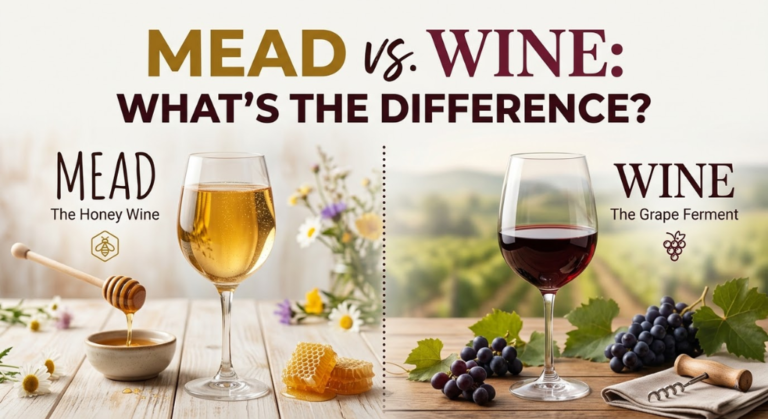
Mead is fermented honey water. Wine is fermented grape juice. Both use yeast to convert sugar to alcohol, but the sugar source — honey vs. grapes — gives them completely different flavour profiles, histories, and cultural identities.
2. What Is Mead?
Mead is an alcoholic beverage made by fermenting honey dissolved in water. In its most basic form, it requires only three ingredients: honey, water, and yeast. The honey provides all the fermentable sugar; the water creates the liquid medium; the yeast converts the sugar to ethanol and carbon dioxide. The result — after fermentation and some conditioning — is a beverage that can range from bone-dry and crisp to lusciously sweet and complex, from 3.5% ABV to 20% or more.
The word “mead” is one of the oldest words in the English language, derived from Proto-Indo-European *medhu — meaning honey or sweet drink. Cognates exist across virtually every Indo-European language family: Sanskrit madhu, Greek methy, Welsh medd, Lithuanian medus, and many others — suggesting that mead was a common beverage across the entire ancient Indo-European world.
What Defines Mead Legally
In the United States, mead is regulated by the Alcohol and Tobacco Tax and Trade Bureau (TTB), which classifies it under “honey wine” with its own category. In the EU and UK, mead has specific definitions — it must be made primarily from honey, water, and yeast. Many countries have their own traditional mead names: hydromel in French, Met in German, Medovukha in Russian, Tej in Ethiopian tradition (where it is made with fermented honey and gesho — a hop-like plant).
3. What Is Wine?
Wine is an alcoholic beverage made by fermenting grape juice. The grapes — pressed to extract their juice — are fermented by yeast (either naturally present on the grape skins or added as a commercial culture), which converts the grape sugars to ethanol, carbon dioxide, and a complex array of flavour and aroma compounds.
The word “wine” comes from Proto-Indo-European *woino, and like mead, its ancient linguistic roots suggest a beverage that spread across the ancient world alongside the Indo-European language family — though wine’s specific origin is tied to the domestication of Vitis vinifera in the Caucasus region.
What Makes Wine Wine
In most regulatory contexts, wine must be made from grapes (or occasionally other fruits with qualifying prefixes — “apple wine,” “plum wine”). The grape variety, the origin of the grapes, the production method, and the style all fall under extensive regulatory frameworks in most wine-producing countries. This regulatory complexity — appellations, designations, protected names — reflects wine’s extraordinary cultural and economic importance across human history. Our wine glossary for beginners covers the essential terminology that frames this regulatory and descriptive landscape.
4. The Ancient History of Mead: Humanity’s Oldest Fermented Drink
Mead holds a strong claim to the title of the world’s oldest fermented alcoholic beverage. The evidence for this is partly linguistic — the widespread cognates of “mead” across Indo-European languages suggest a common, pre-dispersal origin — and partly archaeological.
The Earliest Evidence
Chemical analysis of pottery shards from Jiahu, China, dated to approximately 7000–6500 BCE, revealed traces of fermented honey along with rice and fruit — suggesting a mixed fermented beverage that included honey as a sugar source. In Northern Europe, evidence of dedicated honey fermentation appears in Bronze Age contexts, and the substance is mentioned in the earliest Sanskrit texts (the Rigveda, c. 1500 BCE) as a sacred and celebratory drink.
In ancient Greece, the historian Pliny the Elder described mead, and Homer’s Odyssey contains references to melikraton — honey wine. The Celts, Norse, Saxons, and virtually every Northern and Eastern European culture produced mead before grapes could be grown in their climate. In regions where grapes did not grow, mead was essentially the equivalent of wine — the premium fermented beverage for celebrations, religious ceremonies, and elite consumption.
Mead in Norse and Medieval Culture
In Norse mythology, mead holds a position of extraordinary significance. The Mead of Poetry — Kvasir’s blood mixed with honey — was the drink that could grant the gift of wisdom and poetic inspiration to anyone who consumed it. Warriors who died bravely were promised not just Valhalla but eternal supplies of mead served by the Valkyries. Mead halls were the centre of Viking social life — the great feasting halls where warriors, kings, and poets gathered. The Old English epic Beowulf opens in Heorot, a great mead-hall.
Through the early medieval period in Northern Europe, mead remained the beverage of prestige. Its decline relative to wine began as Christianity spread (wine having sacred significance in the Eucharist), trade routes expanded to bring wine northward, and agricultural changes made grain-based beer more economically practical for mass production.
The Modern Mead Revival
After centuries of marginalisation — kept alive primarily by home producers and a few specialist meaderies — mead has experienced a remarkable resurgence since the early 2000s. The number of commercial meaderies in the United States grew from approximately 30 in 2003 to over 500 by 2020. Modern craft meaderies are producing dry, complex, highly refined meads that bear little resemblance to the cloying sweet mead of historical imagination — wines, essentially, but made from honey.
5. The Ancient History of Wine: Civilisation’s Defining Drink
Wine’s documented history stretches back approximately 8,000–9,000 years, making it younger than honey fermentation but no less foundational to human civilisation. The earliest confirmed wine residues were found at Hajji Firuz Tepe in northwestern Iran, dated to approximately 5400–5000 BCE.
The Cradle of Wine
The South Caucasus region — modern-day Georgia, Armenia, and parts of Turkey — is considered the cradle of viticulture. Archaeological evidence from Georgia (particularly the discovery of the world’s oldest known wine cellar at the Gadachrili Gora site, dated to approximately 6000 BCE) suggests that the domestication of Vitis vinifera and the development of winemaking occurred in this region before spreading westward across the ancient world.
From the Caucasus, wine culture spread to Mesopotamia, Egypt, Greece, and Rome. Wine’s role in ancient Mediterranean civilisations was not merely culinary — it was religious, political, philosophical, and economic. The Greek symposium was literally a wine-drinking gathering. Roman trade was built partly on wine. The Christian Eucharist uses wine as a sacred symbol. These deep cultural roots are why wine carries a level of civilisational significance that no other beverage — including mead — quite matches.
The Modern Wine World
Today wine is produced in virtually every country on earth. The global wine market is worth over $350 billion annually. Over a thousand grape varieties are commercially cultivated. The culture of wine — its language, its rituals, its geography of appellations and terroirs — represents one of the most complex and rich areas of human cultural and gustatory knowledge. Understanding this world is a lifelong endeavour, and resources like our guide to Old World vs. New World wine and terroir provide useful frameworks for navigating it.

Lalvin EC-1118 — the most widely used yeast for both wine and mead production, tolerating up to 18% ABV with a clean, neutral flavour profile
👉 Shop Mead & Wine Yeast on Amazon As an Amazon Associate, WineArmy may earn from qualifying purchases6. Ingredients Compared: Honey vs. Grapes
The defining difference between mead and wine is their primary ingredient — honey for mead, grapes for wine. Understanding what each ingredient brings to the fermented beverage clarifies why the two drinks taste so distinctly different even when made by similar processes.
Honey as a Fermentation Substrate
Honey is approximately 80% sugar (roughly equal proportions of fructose and glucose, with some sucrose and other sugars). The remaining 20% is water, with trace amounts of proteins, minerals, organic acids, enzymes, pollen, and a wide range of volatile aromatic compounds. It is these aromatic compounds — floral, waxy, herbal, and fruity notes that vary enormously by floral source (varietal honey) — that give mead its distinctive character.
The sugar in honey is highly fermentable but nutrient-poor. Unlike grape juice, which contains nitrogen compounds that feed yeast, honey provides almost no yeast-assimilable nitrogen (YAN). This is why mead fermentation is more challenging than wine fermentation — the yeast is working in a nutrient-sparse environment and requires supplementation to produce clean, high-quality mead.
The floral source of the honey — clover, orange blossom, buckwheat, manuka, wildflower, heather, linden — has a dramatic effect on the character of the finished mead, much as grape variety affects wine. This is the mead equivalent of varietal wine — the source honey drives the flavour profile.
Grapes as a Fermentation Substrate
Grape juice contains 15–28% sugar (depending on ripeness), organic acids (primarily tartaric, malic, and citric), phenolic compounds (tannins, anthocyanins, flavonoids), proteins, minerals, and a complex array of varietal aroma precursors that are activated during fermentation. The sugar is similarly divided between glucose and fructose.
Unlike honey, grape juice is naturally rich in yeast-assimilable nitrogen and other nutrients — grapes evolved alongside the yeasts and bacteria that ferment them, and the nutritional environment is naturally suited to fermentation. This is why wild fermentation of grape juice (natural wine) works reliably; wild fermentation of honey is far more difficult to control.
The Acid Difference
One of the most important practical differences between mead and wine is acidity. Grapes naturally contain high levels of tartaric and malic acid — pH 3.0–3.9 for most grape juice. This natural acidity is a crucial feature of wine’s freshness, balance, and food-friendliness. Honey has very low natural acidity. Pure honey dissolved in water has a pH of approximately 3.9–4.5 — meaningfully less acidic than grape juice. The result is that mead tends to feel rounder and less crisp than wine, without the natural acidic “cut” that makes wine so food-friendly. Many meadmakers add acids (citric, tartaric, or malic) to their mead to improve balance — this is the mead equivalent of acidification in wine.
7. How Each Is Made: The Production Process Compared
Both mead and wine are made by fermenting sugar with yeast, but the production processes have significant differences driven by the different properties of honey and grapes.
| Production Stage | Wine | Mead |
|---|---|---|
| Raw ingredient preparation | Grapes crushed/pressed to extract juice (must) | Honey dissolved in warm water to create must |
| Skin contact (optional) | Red wines: extended maceration for colour/tannins. Whites: little or none | Fruit/herb additions macerated in; no grape skins involved |
| Sulphite additions | Common — added at crush to control wild microbes | Less common — honey has natural antimicrobial properties |
| Yeast pitching | Commercial or wild yeast added to must | Commercial wine/mead yeast added (wild fermentation very difficult) |
| Nutrient additions | Usually not necessary — grapes are nutrient-rich | Essential — honey is nutrient-poor; YAN additions critical for clean fermentation |
| Primary fermentation | 7–30 days typically | 2–8 weeks typically (slower due to nutrient scarcity) |
| Secondary fermentation / conditioning | Weeks to months in tank or barrel | Months to years — mead often benefits from longer conditioning |
| Malolactic fermentation | Common in reds and some whites (softens acidity) | Rarely used — mead already has lower acidity |
| Fining and filtering | Common in commercial production | Less common — craft mead often unfined, may show natural haziness |
| Oak ageing | Common for many red wines and some whites | Used by some meadmakers for complexity |
| Carbonation | Sparkling wine: traditional method or tank method | Carbonated (sparkling) mead common; also achieved naturally |
The Nutrient Problem in Meadmaking
The biggest practical challenge in mead production — one that has no equivalent in wine — is yeast nutrition management. Honey’s near-total absence of nitrogen and micronutrients means that yeast working in a honey-water must can easily become stressed, producing off-flavours including hydrogen sulphide (rotten egg smell), excessive fusel alcohols, and acetaldehyde. Professional meadmakers use a technique called “Staggered Nutrient Addition” (SNA) — adding yeast nutrients in multiple small doses over the first few days of fermentation rather than all at once — to keep yeast healthy and producing clean flavours throughout the ferment.
8. How They Taste: Mead vs. Wine Flavour Comparison
The flavour difference between mead and wine is fundamental — they are recognisably different categories of beverage, not slight variations on a theme. Here is how to understand each one’s flavour language.
How Mead Tastes
Traditional mead (made without fruit, spice, or other additions) has a distinctive honey character: floral, lightly sweet, waxy, and aromatic, with a smooth, round body that lacks wine’s sharp acidity. The dominant flavour notes depend entirely on the honey used — clover honey mead tastes of light vanilla and fresh flowers; orange blossom mead has citrus and jasmine notes; buckwheat mead is dark, earthy, and almost molasses-like; heather mead is herbal and slightly resinous.
Well-made dry mead achieves a delicate balance of residual honey sweetness (even dry mead retains a slight impression of honey character) with enough acidity and minerality to feel refreshing and complex. Poorly made mead — or mead from an early batch by a home meadmaker — often tastes unpleasantly sweet, flabby, and lacking in complexity: the result of residual sugar without acidity to balance it.
Where wine often has a defined attack-midpalate-finish structure driven by acidity and tannins, mead tends to have a softer progression — rounder entry, honeyed middle, and (in good examples) a clean, dry finish with lingering floral notes.
How Wine Tastes
Wine’s flavour is driven by the combination of fruit character (the specific aromatic compounds of the grape variety), structural elements (acidity and tannins), and winemaking influences (oak, yeast contact, fermentation conditions). Wine has a significantly wider established flavour vocabulary than mead — the language of fruit, earth, mineral, floral, spice, and oak that wine tasters use reflects thousands of years of descriptive tradition. Our guide to wine tasting vocabulary covers the full descriptive framework in depth.
The key structural difference experienced on the palate is acidity: wine’s natural acidity gives it a liveliness and cut that mead typically lacks. This is why wine is generally more food-friendly with a wider range of dishes — the acidity cuts through fat, refreshes the palate, and provides contrast to rich flavours in a way that softer, less acidic mead often cannot match as precisely.
Side-by-Side Tasting Notes
| Sensory Dimension | Traditional Dry Mead | Dry White Wine (Sauvignon Blanc) | Dry Red Wine (Cabernet Sauvignon) |
|---|---|---|---|
| Colour | Pale gold to amber | Pale yellow-green | Deep ruby to garnet |
| Aroma | Floral, honey, beeswax, light fruit | Citrus, green herbs, tropical fruit, minerality | Blackcurrant, cedar, tobacco, dark fruit, earth |
| Entry | Soft, round, slightly sweet impression | Crisp, bright, immediate acidity | Firm, structured, tannin presence |
| Midpalate | Honey, floral, medium body | Fresh fruit, mineral, clean | Dark fruit, spice, tannin drying sensation |
| Finish | Clean, slightly sweet, floral linger | Crisp, clean, citrus linger | Long, drying, dark fruit, sometimes oak |
| Texture | Round, smooth, low tannin | Light-medium body, clean | Full body, drying from tannins |
9. Alcohol Content Compared
Both mead and wine cover a wide ABV range — from very light styles to fortified or high-alcohol versions. Here is how they compare across the spectrum.
| Style Category | Mead ABV | Wine ABV |
|---|---|---|
| Session / light | 3.5–8% (hydromel / short mead) | 7–10% (German Riesling, some Vinho Verde) |
| Standard | 8–14% (traditional mead) | 11–14% (most table wines) |
| High alcohol | 14–18% (sack mead, great mead) | 14–17% (Amarone, Zinfandel, some Grenache blends) |
| Fortified / extreme | 18–20%+ (with spirit addition, or very high honey) | 17–22% (Port, Sherry, Madeira) |
The key difference in how ABV is achieved: wine’s alcohol is limited by the natural sugar content of grapes and yeast tolerance, while mead can theoretically achieve very high alcohol by simply adding more honey to the must. “Sack mead” — a historical term for very strong, sweet mead — was a premium beverage in medieval and Renaissance Europe, associated with prestige and excess (Falstaff’s preferred drink in Shakespeare is sack).
10. The Many Types of Mead: A Complete Guide
Mead has one of the most diverse and internally varied style maps of any fermented beverage. When fruit, spices, grains, hops, or other ingredients are added, the resulting beverage gets a specific name — the mead world has developed a rich nomenclature that rivals wine in its categorisation.
Traditional Mead
Ingredients: Honey, water, yeast only
Pure expression of the honey variety. Dry to sweet depending on fermentation completion and honey quantity. Can be still or sparkling. The most direct equivalent to a varietal wine — the honey source is everything.
Melomel
Ingredients: Honey + any fruit
Fruit adds colour, acidity, tannins (if berries), and flavour complexity. Raspberry melomel, blackberry melomel, and blueberry melomel are among the most popular. Cyser (honey + apple) and pyment (honey + grape) are specific named subtypes.
Pyment
Ingredients: Honey + grape juice or grapes
The fascinating crossover between mead and wine. Pyment produces a drink that has the floral, honeyed character of mead alongside the fruit, acidity, and sometimes tannin of wine. Ancient Greeks made a version called oenomel.
Metheglin
Ingredients: Honey + spices/herbs
Traditional medicinal mead with herbs. Historical metheglins often included herbs like hops, ginger, thyme, rosemary, and elderflower. Modern versions range from complex herbal blends to single-spice expressions like vanilla or cinnamon metheglin.
Cyser
Ingredients: Honey + apple juice/cider
The crossover between mead and cider. Apple brings significant acidity and structure, creating a more food-friendly, wine-like balance. Often dry and crisp, or semi-sweet with autumnal spice notes from the apple. Very popular in craft meaderies.
Rhodomel
Ingredients: Honey + rose petals (or other flowers)
Floral meads are among the most distinctive — rose petals, lavender, elderflower, hibiscus, and other florals are added during or after fermentation. Pairs beautifully with lighter foods and desserts.
Braggot
Ingredients: Honey + malted grain (hops optional)
The hybrid between mead and beer. Malted barley adds body, biscuity flavour, and structure. Hops add bitterness. Braggot sits at the intersection of three ancient fermented beverage traditions and is experiencing a revival in craft breweries.
Hydromel / Short Mead
Ingredients: Honey + water (less honey ratio)
Low-alcohol mead (3.5–7.5% ABV) made with a lower honey-to-water ratio. Ferments quickly (days to weeks vs. months for traditional mead), is often lightly sparkling, and is designed for session drinking rather than sipping.
Tej
Ingredients: Honey + gesho (Rhamnus prinoides)
Ethiopian traditional mead made with gesho — a bitter plant similar to hops in function. Tej is the national drink of Ethiopia, traditionally served in distinctive flask-shaped vessels called berele. It has a distinctive bittersweet, herbal character unlike any European mead style.

A complete mead-making starter kit — everything you need to brew your first batch of honey wine at home
👉 Shop Mead-Making Kits on Amazon As an Amazon Associate, WineArmy may earn from qualifying purchases11. Wine Style Comparison: How Mead Styles Map to Wine
Because mead has a much smaller consumer base than wine, mead producers often use wine comparisons to help new drinkers navigate the style spectrum. Here is how the two worlds map onto each other.
| If You Like This Wine… | Try This Mead Style | Why |
|---|---|---|
| Dry Riesling or Sauvignon Blanc | Dry cyser or acidified dry traditional mead | Both deliver floral aromatics with crisp, clean structure |
| Oaked Chardonnay | Oak-aged traditional mead or vanilla metheglin | Creamy, rounded texture with vanilla and spice notes |
| Rosé wine | Raspberry or strawberry melomel (pale, dry) | Pale pink colour, light fruit, refreshing character |
| Light red (Pinot Noir, Gamay) | Dark berry melomel (blackberry, cherry) | Fruit-forward, medium body, some tannin from berry skins |
| Full-bodied red (Cabernet, Malbec) | Bochet (burnt honey mead) or aged dark pyment | Dark, complex, rich — with caramel and deep fruit character |
| Champagne / sparkling wine | Sparkling traditional or sparkling cyser | Festive, effervescent, celebratory — honey aromatics add complexity |
| Dessert wine (Sauternes, ice wine) | Semi-sweet or sweet traditional mead | Rich sweetness with complex aromatics — classic mead character |
| Port / fortified wine | Sack mead or high-honey strong mead | Rich, sweet, high-alcohol sipping drinks for small servings |
12. Food Pairing: How Mead and Wine Differ at the Table
Wine’s long culinary tradition has produced an extensive, well-developed food pairing framework. Mead’s food pairing culture is younger and less codified but follows similar principles with some important differences driven by its lower acidity and honey character.
Where Wine Has the Advantage
Wine’s natural acidity is what makes it such a versatile food companion. The acidity in Sauvignon Blanc cuts through fatty fish. The tannins in Cabernet Sauvignon balance the fat in red meat. The acidity in Champagne refreshes the palate between bites of rich food. Mead — with its softer, rounder profile and lower natural acidity — cannot always provide this acid-fat contrast as effectively as wine. Our comprehensive guide to pairing wine with food explains these principles in detail; they apply to mead pairings by contrast and comparison.
Where Mead Has the Advantage
Mead excels with foods that wine struggles with. Spicy foods are notoriously difficult to pair with wine because wine’s acidity and tannins can amplify heat perception — our guide on wine pairing with spicy food acknowledges this challenge. Slightly sweet mead, however, provides the cooling, softening effect that makes spicy food more manageable. The honey sweetness coats and soothes rather than antagonising the capsaicin.
Mead also pairs particularly well with: aged and pungent cheeses (the sweetness contrasts beautifully with sharp, salty flavours), honey-glazed meats (complementary flavours amplify each other), charcuterie and cured meats (the mead sweetness offsets the saltiness), game birds and venison (historical pairing — mead and game have been paired since the Neolithic), and a wide range of desserts where wine often struggles (mead’s own sweetness doesn’t clash with dessert sweetness the way dry wine can).
The Universal Rule
The same guiding principle applies to both mead and wine pairings: match intensity with intensity. A delicate floral dry mead pairs with delicate dishes (light fish, mild cheese, salads); a robust bochet or dark berry melomel pairs with hearty, richly flavoured food. The honey character of mead specifically seeks complementary or contrasting sweetness and saltiness in food — just as wine’s acidity seeks fatty and rich dishes for contrast.
13. Health Considerations: Mead vs. Wine
Both mead and wine have been studied for their health implications. The picture is nuanced and should always be considered against the backdrop of alcohol being a substance with documented health risks at any level of consumption.
Wine’s Health Research
Red wine has been extensively studied for its polyphenol content, particularly resveratrol and proanthocyanidins, which have demonstrated antioxidant, anti-inflammatory, and cardioprotective properties in laboratory settings. The “French Paradox” — the observation that populations consuming significant red wine showed lower cardiovascular disease rates despite high-fat diets — drove decades of research into wine’s potential health benefits. However, current consensus is that any health benefit is modest, applies primarily to very moderate consumption, and cannot justify drinking for health reasons given alcohol’s established risks.
Mead’s Health Considerations
Honey has well-documented antimicrobial, antioxidant, and anti-inflammatory properties in its raw form. However, fermentation dramatically alters the chemical composition of honey — most of the beneficial enzymes and some of the antimicrobial compounds are either consumed by yeast or neutralised during fermentation. Mead retains some of honey’s mineral content and some flavonoids, but the health benefits of honey in mead form are significantly reduced compared to raw honey.
Mead generally lacks the high polyphenol content of red wine (unless fruit is added — berry melomels can contain significant anthocyanins). However, mead also typically lacks the histamines and tannins that cause headaches and adverse reactions in sensitive wine drinkers — making it better tolerated by people who find red wine difficult.
Sulphites: Mead vs. Wine
Most commercial wines contain added sulphites (SO₂) as preservatives. Honey has natural antimicrobial properties that reduce the need for sulphite additions in mead — many craft meads contain little or no added sulphite. For people with sulphite sensitivity who experience reactions to wine, switching to mead (particularly unsulphited craft mead) can be a meaningful improvement. This is one area where mead has a genuine advantage over most commercial wine for sensitive individuals.
14. Which Is Easier to Make at Home?
Both mead and wine are popular home beverages, but they present very different challenges for the home producer.
Home Meadmaking: Accessible but Tricky
Mead requires minimal equipment — a fermentation vessel, an airlock, a hydrometer, and honey. No pressing equipment, no grape sourcing, no seasonal harvest to coordinate. The ingredients are available year-round from any beekeeping supplier or even a grocery store. This accessibility makes mead the natural starting point for many home fermenters.
The challenge is the nutrient management problem described earlier. Without proper yeast nutrient additions and temperature control, home mead frequently produces the classic “rocket fuel” flavour — harsh fusels, sulphur notes, and an unpleasant sweetness — that gives amateur mead a bad reputation. The modern home meadmaking community has developed comprehensive Staggered Nutrient Addition (SNA) protocols that produce dramatically better results than the old “honey, water, yeast, hope” approach.
Home Winemaking: Requires More Equipment
Home winemaking from fresh grapes requires a crusher/destemmer, a press, fermentation vessels, and access to grapes — which are seasonal and may require sourcing from specialist suppliers. Making wine from grape juice concentrate is simpler and more accessible year-round, though the results are generally less interesting than fresh-grape wine.
Wine is arguably more forgiving than mead in some ways — grape juice is naturally nutrient-rich, making fermentation more reliable without special additions. The challenge of home winemaking is more about equipment access, ingredient quality, and process control than the fundamental chemistry challenges of meadmaking.
✅ Home Meadmaking Advantages
- No pressing equipment needed
- Ingredients available year-round
- Can be made in very small batches (1-litre jars)
- No seasonal harvest dependency
- Endless variety through honey selection
- Lower equipment investment to start
- Shorter time to first drinkable batch (short mead: 2–4 weeks)
⚠️ Home Meadmaking Challenges
- Nutrient management is critical and easy to get wrong
- Traditional mead needs months to years of conditioning
- Wild fermentation is very unreliable
- Off-flavours from poor nutrient management are hard to fix
- Less information and fewer resources than homebrewing or winemaking
- Quality honey is expensive at scale
15. Cost and Availability: Where to Find Mead and Wine
Wine is one of the most widely distributed consumer products in the world — available in every supermarket, restaurant, and off-licence in virtually every country. Mead, despite its revival, is considerably less accessible in most markets.
Wine Availability and Cost
Wine ranges from under $5 for basic table wine to millions of dollars for rare collector bottles. The vast majority of everyday drinking wine falls in the $10–$30 range. It is available in essentially every retail and hospitality setting. Understanding how to select good-value wine is a skill — our guide on affordable wine picks for budget enthusiasts provides practical starting points.
Mead Availability and Cost
Commercial mead is primarily available through specialty bottle shops, craft beverage retailers, online retailers, and direct from meaderies. Most supermarkets do not stock mead or stock only one or two products. Quality commercial mead typically costs $20–$50 per bottle — somewhat more expensive than equivalent quality wine, reflecting honey’s higher cost as a raw material and the smaller scale of mead production.
The best way to explore mead is either to visit a local meadery (many have tasting rooms), attend craft beverage festivals where meaderies exhibit, or order from online retailers that specialise in craft mead. The community of meaderies has grown substantially — there are now commercial meaderies in every US state and in most European countries.
The Price-to-Honey Relationship
Honey is expensive. A bottle of traditional mead requires approximately 1–1.5 kg of honey to produce. Quality honey at retail prices costs $10–$20/kg or more for varietal and artisan honeys. Before any labour, packaging, or overhead, the raw material cost of a bottle of mead significantly exceeds the raw material cost of a bottle of table wine. This explains why mead at the $20–$40 price point is genuinely reasonable value, while $10 mead should be approached with some scepticism about honey quality.
Frequently Asked Questions
The fundamental difference is the sugar source. Mead is made by fermenting honey dissolved in water; wine is made by fermenting grape juice. Both use yeast to convert sugar to alcohol through the same basic fermentation process, but the different raw materials give them completely different flavour profiles. Mead has a characteristic floral, honeyed, round sweetness with lower acidity, while wine has fruit-forward character with higher natural acidity and (in reds) tannins. Everything else — colour, ABV, style diversity, food pairing — follows from this foundational difference.
It depends on the style. Mead can be made completely dry (all sugar fermented out) to very sweet (significant residual honey). The same is true of wine. However, the perception of sweetness differs: even dry mead tends to feel rounder and less austere than dry wine because of honey’s lower acidity. Wine’s higher natural acidity creates a drying, refreshing sensation that makes dry wine feel “drier” in the mouth than dry mead at equivalent residual sugar levels. Many people’s association of mead with sweetness comes from commercial or historical meads that were made semi-sweet or sweet — dry mead is a very different experience.
Standard mead and wine have broadly similar alcohol ranges (8–14% ABV for most examples of both). Mead can theoretically achieve higher alcohol than most wines because you can simply add more honey to increase the sugar content — “sack mead” and strong traditional meads can reach 18–20% ABV. The highest-ABV wines (fortified wines like Port and Sherry) reach 17–22% through the addition of spirits. At standard serving sizes, mead and wine are broadly equivalent in intoxicating effect.
Almost certainly mead. The oldest evidence of fermented honey beverages predates the oldest confirmed wine evidence by several thousand years. Honey is a naturally occurring, self-preserving sugar source that would have been encountered by early humans well before deliberate grape cultivation. The widespread cognates for “mead” across Indo-European languages suggest honey fermentation predates the dispersal of the Indo-European language family, approximately 4,000–6,000 years ago. Wine’s earliest confirmed archaeological evidence dates to approximately 6000–5400 BCE (Georgia/Iran). Many anthropologists consider mead humanity’s first deliberate fermented beverage.
Mead has a distinctive honey character — floral, lightly sweet, waxy, and round — that wine does not have. Where wine has prominent acidity and (in reds) tannins that create structure and grip, mead is softer and rounder with less natural acidity. The flavour of traditional mead is driven by the honey variety used — clover honey mead tastes different from buckwheat honey mead in the same way that a Sauvignon Blanc tastes different from a Chardonnay. Fruit-added meads (melomels) can taste similar to fruit wines. Dry mead is often described as somewhere between dry white wine and sake in character.
In regulatory terms, mead is typically classified as “honey wine” or in its own distinct category rather than as “wine” (which requires grapes in most jurisdictions). The US TTB classifies mead under “honey wine.” In common usage and in many craft beverage contexts, mead is treated as a separate category alongside beer, wine, and cider — the four main fermented beverages. The descriptor “honey wine” is legally accurate and practically useful, but dedicated mead enthusiasts often resist the label, arguing that mead’s distinct history, ingredients, and flavour profile warrant its own independent recognition.
Traditional mead (honey, water, yeast) is naturally gluten-free — honey contains no gluten, and neither does water or standard wine/mead yeast. However, braggot (mead made with malted grain) contains gluten. Some meads are produced in facilities that also process gluten-containing products, presenting cross-contamination risk for highly sensitive individuals. If you have coeliac disease or severe gluten sensitivity, contact the specific producer to confirm their production practices before consuming their mead. Traditional and fruit meads from dedicated meaderies are generally safe.
Most commercial wine contains added sulphites (SO₂) as preservatives, typically at 50–200 mg/L. Mead often does not require sulphite additions because honey has natural antimicrobial properties that protect the must during fermentation. Many craft meads are produced with little or no added sulphite. This makes mead a potential alternative for people with sulphite sensitivity who react to wine. However, some commercial meads do add sulphites as a stabiliser, particularly for export or longer shelf life — check labels if this is a concern.
Pyment is a fascinating hybrid — it is made by fermenting honey together with grape juice or whole grapes. It has characteristics of both mead and wine: the floral, honeyed character of the mead base combined with the acidity, fruit, and (if red grapes are used) tannins of wine. Pyment was made in ancient Greece (called oenomel) and medieval Europe, and is experiencing renewed interest in the craft beverage world. Whether to classify it as mead or wine is a matter of regulatory context — in most jurisdictions, if honey is the primary sugar source, it falls under mead/honey wine classification regardless of grape additions.
Possibly yes, for several reasons. Traditional mead contains dramatically lower levels of histamine than red wine (histamine is a primary cause of red wine headaches). Mead also contains very low tannins (unless fruit or wood additions are present), and is often produced without sulphite additions — both histamines and sulphites are commonly implicated in wine headaches. If you find that red wine consistently gives you headaches but you react less to white wine or other beverages, traditional mead might be worth trying as an alternative. Fruit melomels with dark berries will have more histamine than traditional mead, so start with a traditional honey mead.
Conclusion: Two Ancient Drinks, One Wonderful World of Fermented Beverages
Mead and wine are humanity’s oldest fermented companions — one born from the forests and flowers where bees foraged, the other from the cultivated vineyards that spread with civilisation across the ancient world. Their defining difference is simple: honey versus grapes. But from that single difference flows a cascade of contrasts: in flavour, in structure, in history, in cultural meaning, and in the remarkably diverse landscape of styles each has developed over millennia.
Wine has the deeper cultural infrastructure — the appellations, the vocabulary, the culinary tradition, the institutional framework of production and education that has developed over eight thousand years. Wine at its best captures geography, climate, and human skill in a bottle in a way that no other beverage quite replicates.
Mead has something different: a deeper antiquity, a more direct connection to the natural world (the meadmaker’s art begins with a beekeeper’s season), a flavour profile of unique floral and honeyed character that wine cannot replicate, and a renaissance that is producing some of the most exciting fermented beverages currently available. Craft mead in 2026 is where craft beer was in the 1990s — an emerging category finding its voice.
The choice between mead and wine is not a competition. It is an expansion of options. Both are worth exploring deeply. Both reward attention and curiosity. And for the wine lover who has never seriously engaged with mead — the first glass of a well-made dry traditional mead, or a perfectly balanced cyser, or a complex bochet — is one of the genuine pleasures waiting to be discovered.
Ready to Explore Mead — or Deepen Your Wine Journey?
From honey wine starter kits to craft mead selections, explore the fermented beverage world beyond the bottle of Cabernet.
🛒 Explore Craft Mead on Amazon As an Amazon Associate, WineArmy may earn from qualifying purchases