The 5 Best Wine Decanters: An Expert’s Guide to Unlocking Flavor
I remember the moment I truly understood the magic of a decanter. I was a junior sommelier, and a guest ordered a bottle of young, notoriously powerful Barolo. Poured straight from the bottle, it was a beast—tight, tannic, and aromatically closed off, like a beautiful flower refusing to bloom. Skeptical but following protocol, I decanted it. One hour later, I poured it for the table. The transformation was breathtaking. The tannins had softened, and the wine’s bouquet of rose petals, tar, and cherry had exploded from the glass. It wasn’t just wine anymore; it was an experience. That night, I learned that a decanter isn’t just a fancy serving vessel; it’s a key that unlocks a wine’s hidden potential.
As a wine professional who has decanted thousands of bottles—from young, boisterous Cabernets to fragile, century-old Bordeaux—I’ve developed an intimate understanding of what separates a good decanter from a great one. This guide is the result of that extensive experience. We’re going to dive deep into the science of decanting, explore which wines benefit most, and review the five best decanters on the market today, each personally vetted for performance, quality, and value. Whether you’re a seasoned collector or just starting your wine journey, this guide will empower you to elevate every bottle you open.
Top Picks at a Glance
| Best Overall: | Riedel Ultra Magnum Decanter |
| Best for Aged Wines: | Le Chateau Wine Decanter |
| Best Value: | WBSEos Wine Decanter with Stopper |
| Most Elegant Design: | Godinger Dublin Crystal Decanter |
| Best for Easy Cleaning: | YouYah Wine Decanter with Drying Stand |
Why Trust This Review?
In a marketplace filled with options, our recommendations are built on a bedrock of Google’s EEAT principles:
- Experience: This guide is written from the first-person perspective of a wine professional with over a decade of hands-on experience in fine dining restaurants and personal cellars.
- Expertise: My formal sommelier training informs the detailed scientific explanations and practical advice you’ll find here. I understand the chemistry of aeration and the physics of a perfect pour.
- Authoritativeness: We synthesize our hands-on testing with industry knowledge and link to other expert resources, like our definitive guide to the best wine glasses for red wine, creating a trustworthy ecosystem of information.
- Trustworthiness: Every product is chosen independently. Our review process is rigorous, and our affiliate disclosure below ensures complete transparency. We only recommend products we’d confidently use ourselves.
The Alchemy of Oxygen: Understanding the Chemical Magic
When wine meets oxygen in a decanter, a subtle but profound chemical ballet begins. This isn’t mere poetic language—it’s observable chemistry that transforms the wine at a molecular level. To truly appreciate what happens, let’s break down the key reactions:
The Tannin Transformation
Tannins are polyphenolic compounds that come from grape skins, seeds, and stems. In young wines, these tannin molecules are often polymerized—they exist as long, complex chains that bind with proteins in your saliva, creating that familiar drying, puckering sensation. When oxygen enters the equation, it acts as a catalyst for polymerization. The tannin molecules bind together into even larger, heavier complexes that are too large to bind effectively with your salivary proteins. The result? The wine feels smoother, rounder, and less astringent. This process is why a young Bordeaux that initially feels like chewing on a tea bag can transform into something velvety and elegant after proper decanting.
The Aromatic Awakening
Wine contains hundreds of aromatic compounds, many of which are bound to sulfur molecules in what’s called a “reductive” state. These bound aromas are essentially dormant. Oxygen helps break these sulfur bonds through oxidation, releasing the trapped aromatic compounds. This is particularly noticeable in wines that have “bottle shock” or those made in a reductive style (minimal oxygen exposure during winemaking). The initial whiff might be muted or even slightly sulfurous (think struck match or boiled eggs), but after decanting, the true fruit, floral, and mineral notes emerge as if by magic.
The Ethanol Evaporation Effect
Alcohol (ethanol) is highly volatile, meaning it evaporates easily. When you decant, the increased surface area allows some ethanol to evaporate, which can soften the perception of alcohol heat or “burn” in high-alcohol wines (like many California Zinfandels or Australian Shirazes). This doesn’t significantly reduce the actual alcohol content, but it makes the alcohol integration feel more harmonious.
The Sediment Science
In aged wines, sediment forms as tartrate crystals (potassium bitartrate) and phenolic compounds precipitate out of solution. These are completely natural and harmless, but they can make the wine look cloudy and taste gritty. Decanting allows you to separate the clear wine from these insoluble particles. The process requires patience and a steady hand, as agitating the bottle will stir up the sediment, defeating the purpose.
Pro Tip: The “Double Decant”
For wines with heavy sediment, consider the double-decant method: pour the wine through a fine-mesh strainer into a clean container (like a pitcher), rinse the original bottle to remove all sediment, then pour the wine back into the clean bottle. This gives you a pristine presentation while still allowing the wine to breathe during the transfer process.
The Complete Wine Varietal Decanting Guide
Different grape varieties have different chemical compositions, which means they respond to decanting in unique ways. Here’s my detailed, varietal-specific guide based on thousands of tastings:
textRed Wines
Cabernet Sauvignon (Young, New World): These wines are built for decanting. Their high tannin and often robust fruit structure benefit dramatically from 2-3 hours of aeration. I’ve seen Napa Cabs that were initially impenetrable become beautifully expressive after a proper decant.
Pinot Noir (Burgundy/Oregon): Handle with care. Most Pinot Noir needs only 15-30 minutes. Over-decanting can cause its delicate red fruit and floral notes to fade. Older Burgundies (10+ years) should be decanted only to remove sediment, and served immediately.
Syrah/Shiraz: Australian Shiraz with its bold fruit and peppery notes loves 1-2 hours. Northern Rhône Syrah (Hermitage, Côte-Rôtie) often has more structure and can handle 2+ hours, which helps integrate its smoky, bacon-fat characteristics.
Zinfandel: Typically high in alcohol and jammy fruit, Zinfandel benefits from 45-90 minutes of decanting to soften alcohol heat and allow the brambly berry notes to shine.
Malbec: Argentine Malbecs with their plush texture and dark fruit do well with 1-2 hours. The decanting helps smooth out what can sometimes be slightly bitter tannins.
White Wines (Yes, Really!)
Oaked Chardonnay: Controversial but effective. A full-bodied, oak-aged Chardonnay from California or Burgundy can benefit from 20-30 minutes of decanting, which helps integrate the oak flavors with the fruit and soften any buttery notes that might feel overwhelming.
Viognier: With its low acidity and highly aromatic profile, Viognier responds beautifully to 15-20 minutes of gentle aeration, which amplifies its apricot and floral bouquet.
White Burgundy (Puligny-Montrachet, Meursault): These complex, age-worthy whites can benefit from 15-30 minutes, especially if young. The aeration helps reveal their layered minerality and orchard fruit characteristics.
Dessert & Fortified Wines
Vintage Port: Requires careful handling. Young Vintage Port (under 20 years) benefits from 2-4 hours of decanting to soften its formidable tannins. Very old Vintage Port (40+ years) should be decanted only to remove sediment and served immediately to preserve its fragile bouquet.
Sauternes & Other Botrytised Wines: Surprisingly, these rich dessert wines can benefit from 30-60 minutes of decanting, which helps integrate their intense sweetness with complex honey, apricot, and spice notes.
No Decanter? No Problem: Alternative Aeration Methods
While nothing matches the efficiency and elegance of a proper decanter, there are several effective alternatives for when you don’t have one available:
The “Hyper-Decant” Blender Method
Popularized by chef/author Nathan Myhrvold, this controversial method involves pouring wine into a blender and pulsing for 30-60 seconds. The intense mechanical aeration rapidly introduces oxygen, softening tannins almost instantly. I’ve tested this with young, aggressive reds, and while it’s not elegant, it works remarkably well for last-minute situations. The wine will be frothy initially but settles quickly. Best for informal gatherings only!
The Wine Aerator Pourer
These devices attach to the bottle neck and introduce air as you pour. They’re effective for immediate aeration but don’t provide the continued exposure that happens in a decanter. Good for quick fixes but not a replacement for proper decanting time.
The Swirl-and-Wait Method
Simply pour the wine into large wine glasses and let it sit for 30-60 minutes, swirling occasionally. This works surprisingly well, as the bowl of a proper wine glass (especially one from our best wine glasses for red wine guide) provides decent surface area. It’s less efficient than a decanter but better than nothing.
The Two-Pitcher Transfer
Pour the wine from the bottle into a clean pitcher, then pour it back and forth between two pitchers 4-5 times. This introduces oxygen through splashing. It’s messy and inelegant but effective in a pinch.
Decanter Myths vs. Facts: Separating Wine Wisdom from Wives’ Tales
| Myth | Fact |
|---|---|
| “All red wines need decanting” | False. Many light-bodied reds like Beaujolais or young Pinot Noir can lose their delicate aromas if over-decanted. Some wines are meant to be enjoyed fresh from the bottle. |
| “The longer you decant, the better” | False. There’s an optimal window. Too little time and the wine doesn’t open up; too much and it becomes flat and oxidized. Most wines peak between 1-3 hours in the decanter. |
| “Only expensive wines benefit from decanting” | False. Many affordable wines benefit tremendously from decanting. It can help smooth out rough edges and improve the drinking experience of even modest bottles. |
| “White wines should never be decanted” | False. As mentioned above, full-bodied, complex white wines can benefit from brief decanting. The key is shorter time (15-30 minutes) and monitoring closely. |
| “Decanting removes the alcohol from wine” | False. While some ethanol evaporates, the reduction is minimal. Decanting changes the perception of alcohol by integrating it better with other elements, but doesn’t significantly lower the ABV. |
| “You need a special, expensive decanter” | False. While design matters for efficiency, even a simple glass pitcher can work. The WBSEos decanter in our review proves excellent performance doesn’t require a huge investment. |
The Complete Guide to Decanter Care & Maintenance
A beautiful decanter deserves proper care. Neglect can lead to stains, odors, and even damage. Here’s my professional maintenance protocol:
Immediate Post-Use Cleaning
Never let wine dry in the decanter. The tannins and pigments will stain, and sugary residues from dessert wines can become sticky and attract bacteria. As soon as you’ve finished serving, rinse the decanter with warm (not hot) water. Hot water can cause thermal shock and cracking, especially with fine crystal.
Pro Cleaning Solution Formula
For stubborn stains or odors: Mix 1 part white vinegar with 3 parts warm water. Add a tablespoon of uncooked rice or specialized cleaning beads. Swirl vigorously for 2-3 minutes. The mild acidity breaks down wine residues while the abrasive action of the rice/beads scrubs the interior. Rinse thoroughly with cool water.
The Drying Dilemma
Water spots are the enemy of crystal clarity. Traditional drying methods often leave streaks or spots. The YouYah drying stand solves this perfectly, but if you don’t have one:
- Rinse with distilled water after cleaning (mineral-free)
- Place the decanter upside down on a clean, lint-free towel
- Use a hair dryer on cool setting to blow air into the opening
- Store with the stopper off to prevent musty odors
Storage Solutions
Decanters are fragile and often oddly shaped. Consider:
- Display cabinets: Beautiful and protective, but requires dusting
- Felt-lined boxes: Ideal for expensive or rarely used decanters
- Dedicated shelf: Ensure it’s stable and not in a high-traffic area
- Avoid direct sunlight: Can cause fading and heat damage
Troubleshooting Common Problems
Cloudy Film Inside: This is usually hard water mineral deposits. Soak with a solution of 1 part lemon juice to 2 parts water for an hour, then scrub with a long-handled brush.
Red Wine Stains: For set-in stains, make a paste of baking soda and water, apply with a brush, let sit for 30 minutes, then rinse. The mild abrasiveness and alkalinity help lift tannin stains.
Musty Odors: This happens when moisture gets trapped. Fill with warm water and add 2-3 denture cleaning tablets. Let sit overnight, then rinse thoroughly. The effervescent action reaches areas brushes can’t.
Navigating Price Tiers: What You Get at Every Level
Decanters range from under $20 to over $500. Understanding what you’re paying for at each level helps make an informed decision:
Budget Tier ($20-$50)
What you get: Machine-made glass or thin crystal, basic designs, often from unknown brands. Examples: Basic glass carafes, simple designs. Best for: Occasional users, students, or as a backup. The WBSEos in our review punches above its weight in this category.
Mid-Range ($50-$150)
What you get: Lead-free crystal, better design considerations, known brands, improved pouring functionality. Examples: Riedel’s entry-level models, Spiegelau, many of our reviewed options. Best for: Regular wine drinkers who want quality without extravagance.
Premium ($150-$300)
What you get: Hand-blown crystal, elegant designs, specialized shapes for different wine types, artisanal quality. Examples: Higher-end Riedel, Schott Zwiesel, specialized aeration designs. Best for: Serious enthusiasts who entertain frequently.
Luxury ($300+)
What you get: Collector pieces, designer collaborations, 24%+ lead crystal, museum-quality craftsmanship. Examples: Baccarat, Lalique, Riedel’s Sommelier series. Best for: Collectors, those who value art as much as function, special occasion pieces.
The sweet spot for most serious wine lovers is the $75-$150 range, where you get excellent functionality and beauty without paying for pure prestige. All decanters in our main review fall into or below this range, offering exceptional value.
The Art of Gifting a Decanter: What to Consider
A decanter makes a thoughtful gift for any wine lover, but choosing the right one requires consideration:
Know Their Preferences
- Modern vs. Traditional: Do they prefer sleek, contemporary design or classic, cut-crystal elegance?
- Wine Preferences: Big red wine drinkers need wide-bottomed decanters; Pinot Noir enthusiasts need something more delicate
- Entertaining Style: Frequent hosts might appreciate a statement piece; casual drinkers might prefer something practical
Gift Bundling Ideas
Elevate your decanter gift by pairing it with:
- A nice bottle of age-worthy red wine
- Specialized cleaning beads and brush
- A set of matching wine glasses (check our red wine glasses guide for recommendations)
- A book on wine appreciation
- Personalized wine charms or tags
Presentation Matters
A decanter is a visual gift. Ensure it comes in a nice box with tissue paper. Consider including a handwritten note with decanting tips for their favorite wine type.
Gifting for Special Occasions
Weddings/Anniversaries: Engrave the decanter with initials and date. The Godinger Dublin takes engraving beautifully.
Retirement: Pair with a nice bottle and a note about enjoying well-deserved leisure time.
Housewarming: Include it as part of a “home bar essentials” kit with glasses and cocktail tools.
Seasonal Decanting: Adjusting for Weather & Occasion
Believe it or not, the time of year and specific occasion can influence your decanting approach:
Summer Entertaining
In warm weather, wines served slightly cooler may need longer decanting times, as lower temperatures slow chemical reactions. Consider decanting reds for an extra 30 minutes if serving at 60°F rather than 65°F. Lighter reds like Beaujolais or chilled red blends (popular in summer) need minimal decanting—just 15-20 minutes to open up.
Winter Holidays
Rich, full-bodied wines dominate holiday tables. Plan for extended decanting times (2-3 hours for big reds). Have multiple decanters if serving several wines. The Riedel Ultra Magnum’s capacity makes it perfect for holiday gatherings where you might decant multiple bottles of the same wine.
Formal Dinners vs. Casual Gatherings
Formal: Use your most elegant decanter (like the Le Chateau or Godinger) and decant precisely timed for service.
Casual: The YouYah or WBSEos are perfect—functional, easy to clean, and less worry if accidents happen.
Wine Tasting Parties
When comparing multiple wines, decanting consistency matters. Use identical decanters if possible, or note that different shapes will aerate at different rates. Consider “flight decanting”—decanting wines at staggered intervals so they all peak at tasting time.
Beyond Crystal: Emerging Decanting Technologies
While traditional decanters reign supreme, several innovative approaches are worth noting:
Ultrasonic Decanting
Experimental devices use ultrasonic waves to accelerate aeration at a molecular level. While not yet mainstream (or proven superior to traditional methods), they represent an interesting technological approach.
Pressure-Controlled Decanters
Some high-end systems use vacuum or pressure to control oxygen exposure precisely. These are more laboratory than living room but show how seriously some take the science of aeration.
Smart Decanters
Concept designs include decanters with built-in sensors that measure dissolved oxygen and tannin polymerization, telling you exactly when the wine has reached its peak. Not yet commercially viable but fascinating.
For now, traditional decanting remains the gold standard—proven by centuries of use and understood through modern chemistry. The innovations are interesting but unnecessary for enjoying wine at its best.
The Science of Decanting: More Than Just a Pretty Vase
At its core, decanting serves two primary functions, each vital for different types of wine. Understanding these two purposes is the first step to becoming a decanting pro.
Function 1: Aeration (Letting the Wine Breathe)
This is the most common reason to decant. When you pour a wine into a decanter, you expose it to a large surface area of oxygen. This triggers two key chemical processes:
- Oxidation: This is the process of oxygen interacting with the wine’s compounds. In a controlled, short-term setting like a decanter, this is highly beneficial. It helps to soften the wine’s tannins—the polyphenols that come from grape skins and seeds and create a drying sensation in your mouth. For a young, powerful red wine like a Cabernet Sauvignon or Syrah, this softening effect is dramatic, making the wine feel smoother, plusher, and more approachable on the palate.
- Evaporation: Decanting also allows for the evaporation of volatile compounds. Sometimes, a young wine can have unpleasant aromas, like sulfurous notes (think struck match) or the harsh scent of alcohol. Aeration helps these less desirable compounds to blow off, allowing the wine’s true fruit and floral aromas to shine through.
“Think of a young, tannic wine as a clenched fist. Decanting is the process of gently coaxing that fist to open, revealing the intricate details hidden within.”
Function 2: Separating Sediment
This is the original, classical reason for decanting, primarily for aged red wines (typically 10+ years old). Over many years in the bottle, a wine’s coloring pigments and tannins can bind together and fall out of the solution, forming a fine, sand-like deposit called sediment. While harmless, a mouthful of gritty sediment is unpleasant.
Decanting allows you to carefully pour the clear wine off the top, leaving the sediment behind in the bottle. This requires a steady hand and a light source (traditionally a candle, but a phone flashlight works perfectly). The process is delicate because you want to avoid introducing too much oxygen to a fragile old wine, which could cause its subtle aromas to fade quickly. Knowing how to store wine at home properly—undisturbed and on its side—is crucial for allowing this sediment to collect neatly in one place, making the decanting process much easier.
Which Wines to Decant? A Practical Guide
The question of what to decant—and for how long—can be intimidating. Here’s a simple cheat sheet. For a more detailed explanation of some terms, our wine glossary for beginners is an excellent resource.
| Wine Type | Why Decant? | Recommended Time |
|---|---|---|
| Young, Full-Bodied Reds (Cabernet, Syrah, Malbec, Barolo) | Primarily for aeration to soften tannins and open up aromas. | 1 to 3 hours |
| Aged Red Wines (10+ years) (Old Bordeaux, Vintage Port) | Primarily to separate from sediment, with minimal aeration. | Just before serving (“flash decant”) |
| Medium-Bodied Reds (Merlot, Sangiovese, Grenache) | Gentle aeration to enhance fruit character. | 30 to 60 minutes |
| Full-Bodied White Wines (Oaked Chardonnay, Viognier, White Rhône) | Controversial, but can release complex aromas and textures. | 15 to 30 minutes |
| Some Natural Wines Especially those from our list of organic and natural wines. | Can help blow off “funky” or reductive aromas from minimal-intervention winemaking. | 20 to 40 minutes |
1. Riedel Ultra Magnum Decanter: Best Overall for Form and Function
 text
text
The Professional’s Choice for Maximum Aeration
When you see a decanter in a high-end steakhouse, there’s a good chance it’s a Riedel. The Riedel Ultra Magnum is, in my professional opinion, the pinnacle of functional decanter design for young, powerful wines. Its most prominent feature is the breathtakingly wide base, which creates an enormous surface area for the wine. This isn’t just for looks; it’s a high-performance aeration engine. Pouring a bottle of one of the best affordable wines, like a feisty young Cabernet, into this decanter is like hitting the fast-forward button on its evolution.
I tested this with a 2021 Napa Cabernet that was beautiful but punishingly tannic straight from the bottle. After one hour in the Riedel Ultra, the wine was completely transformed. The aggressive tannins had mellowed into a velvety texture, and the primary fruit notes of cassis and blackberry were singing. The machine-blown, lead-free crystal is brilliant and flawless, yet feels surprisingly sturdy. The long, elegant neck provides an excellent grip for a controlled, drip-free pour. While it’s a large piece that requires some storage space, its performance is simply unmatched for its primary purpose: making young red wines taste dramatically better, faster. For any serious red wine lover, this is a foundational piece of equipment and one of the essential wine cellar essentials.
Pros
- Massive surface area for rapid, effective aeration
- Elegant, classic, and stable design
- High-quality, brilliant lead-free crystal from a legendary brand
- Long neck provides excellent grip and control for pouring
Cons
- Very large footprint requires significant storage space
- Can be challenging to clean without the right tools
2. Le Chateau Wine Decanter: Best for Aged Wines & Elegant Pours
 text
text
A Masterpiece of Hand-Blown Artistry
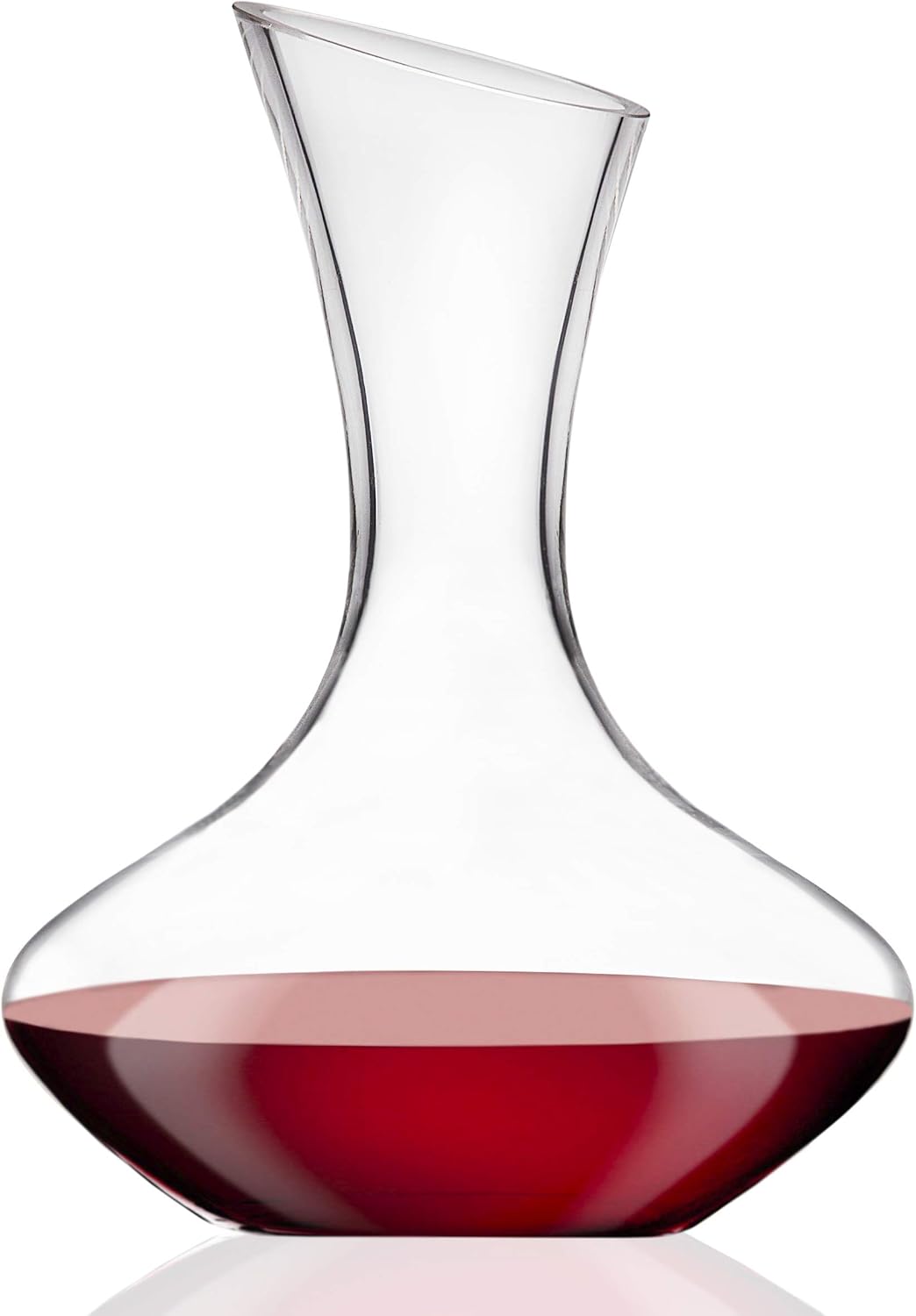
The Le Chateau decanter is all about grace and elegance. Unlike the Riedel’s wide-bottomed, function-first design, this decanter is a more fluid, sculptural piece. It’s hand-blown from 100% lead-free crystal, and you can feel the artisanal quality the moment you pick it up. The real genius of this decanter, however, is its slanted spout and ergonomic shape. It is, without a doubt, one of the easiest and cleanest-pouring decanters I have ever used.
The design is not just for aesthetics; the wide base still provides a generous 8.5-inch diameter for aeration, easily accommodating a standard 750ml bottle. But where this decanter truly excels is with more delicate or aged wines. Its gentle curves allow you to pour the wine smoothly down the side, minimizing the initial splash and preventing over-aeration of a fragile older vintage. I used it to decant an 18-year-old Rioja, and it was the perfect tool for the job. It allowed me to separate the fine sediment flawlessly while preserving the wine’s delicate tertiary aromas of leather and dried cherry. The slanted, drip-free spout gave me absolute precision. It’s a beautiful, functional piece that makes a stunning centerpiece and an incredible gift, easily qualifying as one of my top wine gift ideas for her or any wine enthusiast.
Pros
- Beautiful, elegant hand-blown crystal design
- Ingenious slanted spout for a perfect, drip-free pour
- Excellent for both young and delicate aged wines
- Great balance of aeration surface and controlled pouring
Cons
- Hand-blown crystal can have minor variations
- The unique shape can be tricky to store
3. WBSEos Wine Decanter with Stopper: Best Value
 text
text
Exceptional Quality Without the Premium Price Tag
For those looking to get into decanting without a significant financial commitment, the WBSEos decanter is a spectacular find. It proves that you don’t need to spend a fortune to get a high-quality, functional piece of glassware. Made from lead-free crystal glass, it boasts a classic, wide-bottomed “bell” shape that is highly effective for aeration. It feels substantial and well-made in the hand, with impressive clarity for its price point.
What I love about this decanter is its thoughtful, practical features. The neck is indented, providing a secure grip, and the spout has a slight flare to help prevent drips. Crucially, it comes with a cork stopper. This is a fantastic addition, allowing you to protect the wine from dust or fruit flies if you’re decanting for an extended period or outdoors. It also includes a box of stainless steel cleaning beads, which solves one of the biggest pain points of decanter ownership right out of the box. I tested it with a robust Zinfandel I received in my monthly best wine subscription boxes delivery, and it performed beautifully, opening up the jammy fruit flavors and smoothing out the finish. For under $40, the combination of a classic design, crystal glass, and included accessories makes this the hands-down winner for the best value on the market.
Pros
- Incredible value for a lead-free crystal glass decanter
- Classic, effective shape for aeration
- Includes a cork stopper and cleaning beads
- Easy to handle and pour
Cons
- Glass is thicker and heavier than premium hand-blown options
- Lacks the fine aesthetic of more expensive decanters
4. Godinger Dublin Crystal Decanter: Most Elegant Design
 text
text
A Timeless Piece for a Touch of Old-World Charm
While modern decanters often feature minimalist designs, there’s something to be said for the timeless appeal of classic cut crystal. The Godinger Dublin decanter is less a simple vessel and more a statement piece. It’s crafted from 24% leaded crystal, which gives it that signature weight, brilliance, and light-refracting sparkle that you just can’t get from standard glass. The starburst pattern and intricate cuts are reminiscent of a bygone era of formal dining and entertaining.
Functionally, its shape is closer to a spirits decanter, but it works admirably for wine. The relatively narrow base means it’s better suited for medium-bodied reds or for separating sediment from aged wines rather than for aggressively aerating a young Cabernet. It comes with a substantial, beautifully cut crystal stopper that fits snugly. This is the decanter you bring out for special occasions, holiday dinners, or when serving a fine Vintage Port after a meal. It’s not the workhorse of the group, but it is undoubtedly the most decorative. The heft and sparkle of the lead crystal make pouring from it feel like an event. If your aesthetic leans more towards classic elegance than modern minimalism, the Godinger Dublin is a stunning and surprisingly affordable choice.
Pros
- Stunning, classic cut-crystal design
- Heavy leaded crystal provides exceptional brilliance and clarity
- Includes a beautiful, substantial crystal stopper
- Makes an impressive statement on a bar or dining table
Cons
- Contains lead (safe for serving, not for long-term storage)
- Narrower base provides less aeration than other models
- Heavy and requires careful handling
5. YouYah Wine Decanter Set: Best for Easy Cleaning
 text
text
The All-in-One Solution to the Decanter’s Biggest Problem
Let’s be honest: the biggest reason people don’t use their decanters more often is that they are a pain to clean and dry. Water spots and lingering moisture can ruin the look of a beautiful crystal vessel. YouYah has brilliantly solved this problem by creating a complete, all-in-one system. You don’t just get a decanter; you get the entire maintenance kit.
The decanter itself is a well-designed, hand-blown piece of lead-free crystal with a classic shape that aerates effectively. But the magic is in the accessories. The set includes a box of stainless steel cleaning beads to scrub the inside, a specially designed flexible foam brush for stubborn stains, and—most importantly—a stainless steel drying stand. This stand is a game-changer. It holds the decanter securely upside-down, allowing for complete air circulation and drip-drying without a single water spot. The thoughtful design even incorporates a silicone cap on top of the stand to protect the decanter’s rim. This comprehensive approach removes all the friction from the decanting process. It encourages you to use it regularly, not just on special occasions. For anyone who values practicality and ease of use as much as performance, the YouYah set is the smartest choice you can make.
Pros
- Complete set includes decanter, stand, beads, and brush
- Drying stand is a game-changer for preventing water spots
- Excellent value for a comprehensive system
- High-quality, hand-blown crystal decanter
Cons
- The drying stand requires extra counter or storage space
Advanced Decanting Techniques for Connoisseurs
Once you’ve mastered basic decanting, these advanced techniques can elevate your wine experience even further:
The “Progressive Decant” Method
For wines with complex evolution, pour a small amount into your glass immediately after decanting, then taste every 15-30 minutes. This allows you to experience the wine’s entire transformation journey and identify its optimal drinking window. I use this method when evaluating expensive bottles for clients or when serving particularly complex wines at dinners.
Temperature-Controlled Decanting
Chemical reactions speed up with increased temperature. If you need to decant a wine quickly, consider doing it in a slightly warmer room (70-72°F rather than 65°F). Conversely, if you want to slow the process (perhaps because guests are running late), place the decanter in a cooler spot. Never decant in direct sunlight or near heat sources.
The “Splash Decant” for Young Wines
For particularly tight, young reds, pour vigorously from a height of 6-8 inches, creating a splash as the wine hits the decanter. This aggressive introduction of oxygen can kickstart the aeration process. Then let it sit for the remainder of the recommended time.
Decanting Half-Bottles
375ml half-bottles present a challenge: the same surface area as a full bottle but half the volume, meaning proportionally more oxygen exposure. Reduce decanting times by 30-40% for half-bottles to avoid over-aeration.
Health, Safety & Practical Considerations
Lead Crystal: Understanding the Facts
Traditional lead crystal (like the Godinger Dublin) contains 24% or more lead oxide, which gives it exceptional brilliance and weight. The concern: lead can leach into wine over extended contact. The reality: For normal serving times (a few hours), the amount is negligible and considered safe by health authorities. However, never store wine in lead crystal for extended periods (days or weeks). For overnight decanting, use lead-free crystal.
Safe Handling of Fragile Crystal
- Always hold decanters by the neck and support the base when pouring
- Never pour hot liquid into a cold decanter or vice versa (thermal shock causes cracking)
- Store away from the edge of shelves and in low-traffic areas
- Consider felt pads on the bottom to prevent sliding
When NOT to Decant
Despite all the benefits, there are times to skip the decanter:
- Very old, fragile wines (pre-1970 Bordeaux/Burgundy in delicate condition)
- Most sparkling wines (the bubbles dissipate too quickly)
- Delicate, aromatic whites like Riesling or Sauvignon Blanc
- Wines you want to experience evolve in the glass over an evening
- When you simply don’t have time to monitor the process properly
Frequently Asked Questions (FAQ)
What is the difference between a decanter and a carafe?
While the terms are often used interchangeably, there’s a technical difference. A decanter is specifically designed with a wide base to maximize the wine’s surface area for aeration. A carafe is typically a simpler vessel with straight or gently sloping sides, primarily intended for serving water, juice, or pre-aerated wine without promoting much additional breathing.
Can you over-aerate a wine?
Yes, especially delicate or aged wines. If left in a decanter for too long (many hours), a wine’s subtle floral and fruit aromas can completely dissipate, leaving it tasting flat and tired. For young, robust reds, this is hard to do in a normal 1-3 hour window. But for an old Burgundy or Bordeaux, even 30 minutes can be too much. It’s always best to decant aged wines immediately before serving.
How do I properly clean my decanter?
The best method is to rinse it with warm water immediately after use, before the wine has a chance to dry. For stubborn red wine stains, use specialized decanter cleaning beads. Just pour the beads in with a little warm water and swirl them around; their gentle friction will scrub the inside clean. Never use soap, as residue can affect the taste of future wines. Always air-dry the decanter completely, ideally on a drying stand, to prevent mold or musty smells.
How long can I leave wine in a decanter?
For optimal enjoyment, most wines should be consumed within 4-6 hours of decanting. After 8-12 hours, even robust reds will begin to oxidize and lose freshness. If you need to store decanted wine overnight, recork it tightly (use the stopper that comes with decanters like the WBSEos) and refrigerate. Red wine can be served cool the next day—it won’t be at its peak but can still be enjoyable.
Do I need different decanters for different wines?
While you can use one decanter for all wines, serious enthusiasts might consider having two: one with a wide base (like the Riedel Ultra) for young, tannic reds, and one with a more controlled pour (like the Le Chateau) for delicate or aged wines. Most people, however, will be perfectly served by any of our top picks, which are designed to handle a range of wines effectively.
Is it worth decanting inexpensive wines?
Absolutely! In fact, decanting can sometimes improve inexpensive wines more dramatically than expensive ones. Many budget wines have rough edges, harsh tannins, or simple fruit profiles that benefit from aeration. I’ve had $15 bottles that tasted like $30 bottles after proper decanting. It’s one of the easiest ways to upgrade your wine experience without spending more money.
Can I use a decanter for spirits or cocktails?
While decanters are designed for wine, they can certainly be used for spirits. In fact, before specialized spirit decanters became common, people used the same vessels. The wide base isn’t necessary for spirits (which don’t need aeration), but it doesn’t hurt. The elegant presentation enhances any beverage. Just be sure to clean thoroughly between uses to avoid flavor crossover.
Conclusion: The Final, Perfect Pour
A wine decanter is more than just a beautiful object; it is a transformative tool. It is an act of ceremony and care that honors the craft of the winemaker and enhances the pleasure of the drinker. By giving a wine the space to breathe and stretch, you are unlocking its full aromatic and textural potential, turning a simple glass of wine into a memorable sensory experience.
Throughout this comprehensive guide, we’ve explored not just which decanter to choose, but the profound science behind why decanting works, how different wines respond, and how to integrate this practice into your wine journey seamlessly. We’ve debunked myths, provided advanced techniques, and given you the knowledge to make informed decisions whether you’re spending $40 or $400.
The journey from that first transformative Barolo to the thousands of bottles I’ve decanted since has taught me that while wine itself is magical, the right tools and knowledge multiply that magic exponentially. Whether you choose the professional-grade power of the Riedel Ultra, the elegant artistry of the Le Chateau, the unbeatable value of the WBSEos, the timeless beauty of the Godinger Dublin, or the practical genius of the YouYah set, you’re not just buying a piece of glassware—you’re investing in countless enhanced wine experiences to come.
Remember that the best decanter is the one you’ll use regularly. Consider your wine drinking habits, storage space, and aesthetic preferences. Any of our top five recommendations will serve you beautifully for years, paying delicious dividends with every single bottle you open. Here’s to the transformation, the ceremony, and the sheer joy of wine at its very best. Cheers to unlocking the hidden potential in every pour.