Orange Wine vs. White Wine: The Ancient Technique Changing Modern Palates
If you have walked into a trendy wine bar recently, you have likely seen a section of the menu dedicated to “Skin Contact” or “Amber” wines. To the uninitiated, this looks like a new hipster fad. But orange wine is the oldest style of winemaking on the planet, pre-dating our modern conception of white wine by thousands of years.
The battle of Orange Wine vs. White Wine is not just about color — it is a battle between philosophy, texture, and intensity. While white wine is defined by its purity, acidity, and removal of grape solids, orange wine is defined by its embrace of the whole fruit: skins, seeds, and all. This guide will take you deep into the technical, historical, and culinary differences that separate these two styles.
The Core Difference: Skin Contact
To understand the difference, we must first understand how wine gets its color. The juice of almost all grapes — even red ones — is clear. Color comes entirely from the skins.
The Process: Crush & Separate.
Grapes are harvested and immediately pressed. The juice is separated from the skins instantly. Fermentation happens with just the clear juice.
- Result: Pale color, high acid, zero tannins.
- Focus: Purity of fruit and refreshing acidity.
- Analogy: Like biting into a peeled apple.
The Process: Crush & Soak (Maceration).
Grapes are crushed, but the juice is left to sit with the skins (and seeds) for days, weeks, or months during fermentation.
- Result: Amber/Orange color, savory depth, noticeable tannins.
- Focus: Texture, complexity, and oxidation.
- Analogy: Like biting into an apple with the skin on, seeds and all.
Think of it this way: orange wine is simply white wine made like red wine. By leaving the juice in contact with the skins — a process called maceration — the winemaker extracts pigments, phenols, and tannins that are normally discarded in white wine production.
The Maceration Spectrum: From Hours to Months
One of the most misunderstood aspects of orange wine is that it is not a binary — you do not simply have “white wine” and “orange wine.” There is an entire spectrum of skin-contact intensity, and the duration of maceration determines almost everything about the finished wine’s color, tannin level, aroma complexity, and style. Understanding this spectrum helps explain why one “orange wine” tastes like a slightly textured white while another tastes closer to a light red.
The winemaker’s control over maceration duration is also influenced by their fermentation vessel choice. In an open-top wooden vat, the skin cap at the top needs regular “punching down” to keep it moist and in contact with the fermenting juice — a physical, labor-intensive process that controls extraction intensity. In a sealed qvevri buried underground, the maceration proceeds more gently and slowly due to lower temperatures and reduced oxygen exposure. The vessel is as important as the duration.
Maceration simply means the soaking of grape solids (skins, seeds, and sometimes stems) in the juice or fermenting wine. In red winemaking, maceration is standard and essential — it provides the color, tannins, and phenolic compounds that define red wine. In orange wine, maceration is applied to white grapes — producing a wine that is technically “white” by grape variety but “red” by production technique. The International Organisation of Vine and Wine officially classifies orange wine as “white wine with maceration.”
The Color Spectrum: Reading the Glass
Orange wine is not one color — it spans an extraordinary range from barely-there gold to deep mahogany that looks almost like a light red. The color in the glass is one of the most reliable indicators of maceration duration and winemaking style, and learning to read it helps you know what you are about to taste before you even bring the glass to your nose.
Hours of contact
2–4 days
1–3 weeks
1–3 months
4+ months
The specific color within this range also depends on the grape variety. Pinot Grigio (Pinot Gris) — which has a pink-grey skin — produces a distinctly copper-pink skin-contact wine. In Italy, this specific style is called Ramato (meaning “auburn” or “copper-haired” in Italian) and has its own identity within the orange wine category. Ribolla Gialla produces a bright golden-amber. Gewürztraminer can produce very deep amber hues due to its thick, richly pigmented skin. Riesling, with its thin and lightly colored skin, produces the palest orange wines even with extended maceration.
Sensory Showdown: Taste & Texture
If you pour a glass of Sauvignon Blanc, you expect zesty lime, green apple, and a clean finish. If you pour a glass of skin-contact Sauvignon Blanc, you are in for a shock. The fruit retreats, replaced by something savory, nutty, and structured.
White Wine Profile
White wines are driven by primary aromas — fruit and flowers. They are prized for being “clean” and expressing the inherent character of the grape variety without interference from skins or oxidation.
Key Notes: Lemon, peach, white blossom, wet stone, fresh herbs, green apple.
Mouthfeel: Light to medium body, slick or crisp texture, refreshing, clean finish.
Orange Wine Profile
Orange wines display tertiary aromas — oxidation, earth, and nutty notes — right out of the bottle. Because they are often exposed to more oxygen during winemaking, they lose fresh fruit notes but gain savory complexity that rewards contemplative tasting.
Key Notes: Dried apricot, bruised apple, hazelnut, sourdough starter, dried orange peel, tea leaf, beeswax, ginger, yellow flowers.
Mouthfeel: Full body, “grippy” texture from tannins, dry finish that lingers, saline mineral quality in the best examples.

Unlock the Oxidation
Orange wines are robust. Unlike delicate whites, they often need air to “blow off” funky aromas and open up. A wide-bottomed decanter is essential for high-end amber wines.
Check PriceThe 4-Way Comparison: Where Orange Wine Sits
Orange wine is often described as sitting “between” white and red wine, but this framing undersells its uniqueness. It is more accurate to say it occupies its own distinct sensory space — borrowing elements from red, white, and even certain oxidative fortified styles while remaining wholly itself. This table positions orange wine accurately within the full spectrum of wine styles.
| Feature | White Wine | Orange / Skin Contact | Rosé | Red Wine |
|---|---|---|---|---|
| Grape Color | White/Green grapes | White/Green grapes | Red/Black grapes | Red/Black grapes |
| Skin Contact | None (juice only) | Days to months | Hours to days | Days to weeks |
| Color | Pale gold to straw | Gold to deep amber | Pale pink to salmon | Light ruby to deep purple |
| Tannins | None | Low to high | Very low | Medium to very high |
| Acidity | High | Medium-high | Medium-high | Medium |
| Body | Light to medium | Medium to full | Light to medium | Medium to full |
| Primary Aromas | Fresh fruit, flowers | Dried fruit, nuts, earth | Red fruit, floral | Dark fruit, spice |
| Serve Temp | 45–52°F (7–11°C) | 55–60°F (13–16°C) | 46–52°F (8–11°C) | 58–65°F (14–18°C) |
| Food Pairing | Seafood, light dishes | Bold spices, fermented foods, umami | Versatile, charcuterie | Red meat, hearty stews |
The orange wine vs. rosé confusion deserves special attention: they are essentially opposite techniques applied to opposite grapes. Rosé takes red grapes with brief skin contact to produce a delicate pink wine. Orange wine takes white grapes with extended skin contact to produce a structured amber wine. Despite their superficial resemblance in the glass (both sit between pale white and red in color), they are entirely different in philosophy, structure, and flavor.
History: 8,000 Years of Amber
The Georgian Cradle: Qvevri Winemaking
While white wine is the modern standard, orange wine is the ancient ancestor. The birthplace of wine is widely considered to be Georgia (the country in the Caucasus, not the US state). Archaeological evidence shows winemaking there dates back to 6000 BC — making it the oldest known continuous winemaking tradition on earth.
The traditional Georgian method involves filling massive egg-shaped clay vessels called Qvevri (also spelled Kvevri) with crushed grapes — skins, stems, and seeds included. These vessels are buried underground to control temperature naturally. The wine ferments and ages underground for months, turning a deep amber hue from contact with the skins. This method was the global norm for millennia until modern technology allowed the separation of skins to become fashionable in Europe from the 18th century onward.
The Georgian qvevri winemaking method received UNESCO recognition as an Intangible Cultural Heritage of Humanity — the first and only winemaking technique to receive this designation. This recognition acknowledges not just the method’s antiquity but its living cultural significance in Georgia, where qvevri wine remains central to national identity, religious ceremony, and hospitality.
Today, the “Orange Wine Revival” is centered in two places: Georgia (where it never left) and the border of Italy and Slovenia — specifically Friuli-Venezia Giulia — where visionary winemakers like Josko Gravner and Stanko Radikon resurrected the technique in the late 1990s as a deliberate rebellion against the technologically perfect but characterless industrial white wines that had come to dominate the Italian market.
This return to ancient methods aligns closely with the modern “Natural Wine” movement. To understand the philosophy of low-intervention winemaking, read our guide on Organic and Natural Wines.
Fermentation Vessels: How the Container Shapes the Wine
One of the defining aspects of orange wine production — one that distinguishes it from both conventional white and conventional red winemaking — is the diversity of vessels used for fermentation and aging. The choice of container profoundly influences the wine’s flavor, texture, and longevity, and understanding these options explains much of the variation you encounter across different orange wine producers.
Qvevri / Amphora (Clay)
The original vessel and still the most philosophically significant. Qvevri are egg-shaped, unglazed terracotta amphorae that can hold anywhere from a few dozen to several thousand liters. When buried underground to the neck, they maintain a naturally stable temperature of approximately 55–58°F (13–14°C) year-round — ideal for slow, controlled fermentation and aging. The clay is slightly porous, allowing very gentle micro-oxygenation similar to (but slower than) barrel aging. The interior is traditionally coated with beeswax after construction, which seals the porous clay and prevents any earthy ceramic flavor transferring into the wine. Clay-fermented orange wines typically have a distinctive mineral, saline quality alongside their fruit and oxidative notes — what some tasters describe as a “chalky” or “stony” undertone.
Large Neutral Oak
Many Friulian orange wine producers, including Radikon, ferment and age their skin-contact wines in large wooden barrels of 500–5,000 liters. Unlike the small new oak barrels used in much of Bordeaux and California, these large-format neutral barrels impart minimal wood flavor — they contribute structure through micro-oxygenation without adding vanilla, toast, or spice notes. The result is a wine where the skin-contact character is front and center without any oak overlay. Radikon’s wines typically spend three years in large oak followed by a year in bottle before release — a total aging program that integrates tannins and develops extraordinary complexity.
Stainless Steel
Some producers ferment skin-contact wines in stainless steel tanks — particularly for shorter maceration periods of days to a week or two. Stainless steel is non-porous and completely neutral — the wine develops no micro-oxygenation from the vessel and retains maximum freshness. Steel-fermented skin-contact wines tend to be brighter, more fruit-forward, and less oxidative than clay or wood equivalents. They are often the most approachable entry point into skin-contact wine for those accustomed to conventional white wine styles.
Concrete Egg
The concrete egg — a modern vessel that has gained significant popularity in the natural wine movement — combines the micro-oxygenation properties of clay with the neutral flavor profile of stainless steel. The egg shape creates a natural convection current in the fermenting wine, reducing the need for mechanical pumping and producing a distinctive textural roundness in the finished wine. Several New World natural wine producers use concrete eggs for skin-contact fermentation, producing orange wines with a smooth, integrated character.
When reading an orange wine label or tasting notes, vessel information is a useful quality and style indicator. “Qvevri” or “amphora” suggests a traditional, mineral-driven style with significant maceration. “Large oak barrels” suggests a Friulian approach — complex, structured, and age-worthy. “Stainless steel” suggests a more approachable, fruit-forward style. “Concrete egg” suggests natural wine movement influence with textural focus.
Best Grape Varieties for Orange Wine
Not all white grape varieties are equally suited to skin-contact winemaking. The grapes that produce the finest orange wines tend to share certain physical characteristics: thick skins (more tannin and pigment), aromatic complexity (aromas complex enough to survive and be enhanced by oxidative winemaking), and structural acidity (which provides the backbone that tannin alone cannot supply). Here are the key varieties that define the orange wine world.
Ribolla Gialla
The signature variety of Friuli-Venezia Giulia and the most celebrated orange wine grape. Thick skins, high acidity, and distinctive stone-fruit and herbal aromatics. Extended maceration produces wines of extraordinary complexity and aging potential. Gravner’s Ribolla is the benchmark.
Rkatsiteli
Georgia’s most widely planted white variety and the traditional grape for qvevri winemaking. Thick skins, very high acidity, and unusual aromatic complexity — quince, apricot, chamomile. Extended maceration in qvevri produces the defining Georgian amber wine style.
Pinot Grigio / Pinot Gris
The grape behind Ramato — Italy’s copper-pink skin-contact wine. Pinot Grigio’s pinkish-grey skin produces wines of distinctly copper or salmon hue. More approachable than Ribolla maceration, with a spiced pear, honeyed nectarine, and gentle tannin profile.
Gewürztraminer
Thick, deeply pigmented pink-orange skin produces very richly colored amber wines with intense aromatic complexity — rose water, lychee, ginger, clove. The heady aromatics of Gewürztraminer survive and are amplified by skin contact, producing extraordinary orange wines in Alsace and Alto Adige.
Malvasia
A broad family of varieties across Italy and Slovenia. Malvasia’s naturally rich, aromatic profile — orange blossom, apricot, honeysuckle — responds beautifully to short to medium maceration, producing amber wines with floral intensity alongside skin-derived texture.
Vitovska
A native Slovenian and Italian border variety that has become closely associated with the natural wine movement in the Carso plateau. Mineral-driven, saline, with high acidity. Skin-contact Vitovska is one of the most distinctive and terroir-expressive orange wines in existence.
Chardonnay & Sauvignon Blanc
International varieties increasingly used for skin-contact wines by natural wine producers worldwide. Chardonnay’s versatility responds well to short maceration, gaining a nutty, textured quality. Sauvignon Blanc produces fascinatingly exotic amber wines — the herbaceous, tropical character becomes earthy and saffron-like with extended skin contact.
Mtsvane & Kisi
Georgian indigenous varieties used alongside Rkatsiteli in traditional qvevri winemaking. Mtsvane adds floral freshness and citrus lift to blends; Kisi produces uniquely spiced, complex amber wines. Both are gaining international recognition as Georgia’s amber wine exports grow.
The Science of Tannins in White Grapes
We often hear about tannins in red wine — that drying sensation on your gums — but white grapes have tannins too. They live in the skins, seeds, and stems. In standard white winemaking, these solids are discarded immediately, so tannins never enter the wine. In orange winemaking, they are deliberately extracted.
During fermentation, the alcohol produced acts as a solvent — it dissolves the waxy coating of the skins and extracts phenolic compounds (tannins, pigments, and other bioactive molecules). This is why maceration duration is so directly linked to tannin level: more time in contact with skins equals more phenolic extraction. This gives orange wine its defining “structure” — a quality that white wine simply cannot have by design.
Chemically, this makes orange wine significantly more stable than white wine. Tannins are natural preservatives — antioxidants that protect the wine from oxidation. This is why many orange wines can be produced with little to no added sulfur (sulfites), whereas white wines usually require sulfur additions to prevent browning and bacterial contamination. The orange wine has already undergone a controlled degree of oxidation during its maceration, making it resilient against further spoilage.
Understanding tannins is crucial for appreciating the “grip” of an amber wine. For a deep dive into how tannins work on your palate, check out our article: What is Tannin in Wine?
Sulfites, Stability, and the Natural Wine Link
The relationship between orange wine and sulfites is one of the most practically significant — and most frequently misunderstood — aspects of the style. Understanding this relationship clarifies both why orange wine is so closely associated with the natural wine movement and what to expect from different production approaches.
Why White Wine Needs Sulfites
Sulfur dioxide (SO₂) is the primary preservative used in conventional white winemaking. Without sulfites, white wine is extremely vulnerable to oxidation — the juice itself, stripped of the protective tannins and phenolics that reside in the skins, browns rapidly when exposed to oxygen. Sulfites prevent this by acting as antioxidants and antimicrobials, allowing white wine to be bottled, transported, and stored without deteriorating. Most conventional white wines contain added sulfites at levels of 80–150 parts per million.
Why Orange Wine Can Have Less
When white grape juice is left in contact with the skins, it extracts phenolic compounds — including tannins and other antioxidants — that provide the wine with natural protective capacity against oxidation. These extracted polyphenols do much of the same protective work that added sulfites perform in conventional white wine, but they come from the grape itself rather than from laboratory-produced additives. The result is that many well-made orange wines require significantly lower sulfite additions — or in some cases, none at all — to remain stable through bottling, transportation, and cellaring.
This is one reason why orange wine became so central to the natural wine movement: it offers a technically viable pathway to minimal-sulfite production that conventional white winemaking does not. A natural white wine with zero added sulfites is extremely risky — it can develop bacterial faults, browning, or spoilage quickly. A well-made natural orange wine with zero added sulfites is far more defensible because the skin tannins provide inherent protection.
Orange Wine ≠ Natural Wine
It is important to state clearly: not all orange wine is natural wine, and not all natural wine is orange wine. Orange wine is a production technique (skin contact), not a philosophy. A producer can make an orange wine using conventional viticulture, commercial yeasts, temperature-controlled fermentation, and added sulfites — and the result is still technically orange wine. The association between orange wine and natural wine reflects the overlap of values and practitioners, not an inherent equivalence. When buying orange wine, look for “organic,” “biodynamic,” or “natural” designations separately if those qualities matter to you.
Many people who believe they are sensitive to sulfites in wine actually react to histamines and other biogenic amines that are present in higher concentrations in skin-contact wines due to extended fermentation and minimal filtration. Orange wine produced with minimal sulfite additions may still cause reactions in people who respond to these other compounds. If you have a known sulfite sensitivity, consult your doctor before assuming low-sulfite orange wine is suitable for you.
The Pioneer Winemakers: The Rebels of Friuli
The modern orange wine movement was not a gradual cultural shift — it was sparked by a small group of radical winemakers in a specific geographic area who decided to break decisively with the direction of their industry. Understanding these pioneers and their motivations reveals why orange wine carries such intellectual and cultural weight in the natural wine world.
Josko Gravner — Oslavia, Friuli-Venezia Giulia, Italy
Gravner is the figure most directly responsible for the modern orange wine renaissance in the Western world. In the 1990s, after building a celebrated reputation for technically perfect, internationally styled white wines, he experienced a crisis of confidence — the wines he was making were technically flawless but, he felt, characterless and disconnected from their terroir. A visit to Georgia in the early 2000s transformed his practice. He imported genuine qvevri from Georgia and began fermenting his Ribolla Gialla with months of skin contact in these buried clay vessels. The resulting wines — deep amber, tannic, structured, and extraordinary in complexity — were unlike anything the Italian wine world had seen. Gravner is now considered the intellectual godfather of the modern orange wine movement. His wines are aged for seven years before release and can age for decades.
Stanko Radikon — Oslavia, Friuli-Venezia Giulia, Italy
Radikon worked in parallel with Gravner and is equally important to the movement’s development. His approach — extended maceration (sometimes months) followed by three years in large neutral oak and a year in bottle — produced wines of extraordinary depth and longevity. Radikon was particularly influential in demonstrating that orange wine is not a novelty or an extreme style but a legitimate format for producing genuinely age-worthy fine wine. The estate continues under his son Saša’s direction, maintaining the same philosophy of minimal intervention and maximum patience. Radikon’s Oslavia wine and Ribolla are considered benchmarks of the style.
Dario Princic — Oslavia, Friuli-Venezia Giulia, Italy
A close contemporary of Gravner and Radikon in the same village of Oslavia, Princic represents the third pillar of the Friulian orange wine revolution. His approach is perhaps the most instinctive and agricultural of the three — extremely low sulfite additions, long macerations, and wines that express a rawer, more immediate terroir character. Princic’s Jakot (Friulano) is considered one of the finest and most distinctive orange wines produced in Italy.
Pheasant’s Tears — Signagi, Kakheti, Georgia
American winemaker John Wurdeman established Pheasant’s Tears in the Kakheti region of Georgia to produce qvevri wines from indigenous Georgian varieties. His work has been instrumental in bringing Georgian amber wine to international wine audiences and demonstrating that the qvevri tradition produces wines of genuine world-class complexity. Pheasant’s Tears Rkatsiteli and Mtsvane are among the most accessible and approachable introductions to Georgian amber wine.
Global Region Guide: Where the Best Orange Wines Come From
Georgia (Kakheti, Kartli)
The birthplace and spiritual home of amber wine. The Kakheti region in eastern Georgia is the heartland of qvevri production. Key varieties: Rkatsiteli, Mtsvane, Kisi, Chkhaveri. Style: deep amber, firm tannin, complex oxidative character, saline mineral finish. UNESCO-recognized tradition. Notable producers: Pheasant’s Tears, Baia’s Wine, Dila-O, Alaverdi Monastery.
Friuli-Venezia Giulia, Italy
The center of the modern orange wine renaissance in the West. The Collio and Colli Orientali subregions produce the world’s most celebrated non-Georgian orange wines. Key varieties: Ribolla Gialla, Friulano, Malvasia, Pinot Grigio (Ramato). Notable producers: Gravner, Radikon, Dario Princic, Skerk, Franco Terpin, Vodopivec.
Slovenia
Sharing the terroir of Friuli across the border, Slovenia has deep roots in skin-contact winemaking and produces orange wines of remarkable precision and minerality. Key varieties: Vitovska, Rebula, Malvasia, Pinot Gris. Notable producers: Movia, Keltis, Šumenjak, Marjan Simčič.
Sicily, Italy
The Sicilian natural wine movement has produced some of Italy’s most exciting orange wines. COS — the seminal Sicilian natural wine estate — uses amphora for their Pithos Bianco, a skin-contact Grecanico of extraordinary aromatic complexity. The warm Sicilian climate produces richer, more generous amber wines than the cooler Friulian style.
Austria
A small but growing cohort of Austrian producers, particularly in Burgenland and lower Austria, produce skin-contact wines from Grüner Veltliner, Welschriesling, and Gewürztraminer. Austrian orange wines tend toward greater precision and structural elegance than their Italian counterparts, reflecting the country’s viticultural tradition of restraint.
California & Oregon, USA
The American natural wine movement has embraced skin-contact production enthusiastically. California producers like Broc Cellars, Donkey & Goat, and Ampelos Cellars produce skin-contact wines from Chardonnay, Roussanne, and various other varieties. Oregon’s cool climate and Pinot-centric culture has produced skin-contact Pinot Gris wines of particularly distinctive character.
Australia & New Zealand
The natural wine scenes in Australia (particularly the Yarra Valley, Adelaide Hills, and McLaren Vale) and New Zealand (Central Otago, Hawke’s Bay) include growing numbers of skin-contact producers. Australian orange wines often show distinctive eucalyptus and native botanical notes alongside the expected dried-fruit character.
South Africa
South Africa’s vibrant natural wine scene, centered on the Swartland region, includes excellent skin-contact Chenin Blanc producers. The country’s signature white grape, Chenin Blanc, responds particularly well to skin contact — the variety’s naturally high acidity provides excellent structural counterbalance to the tannins extracted from its thick skins.
Advanced Food Pairing: The Spicy Advantage
This is where orange wine truly defeats white wine. Traditional white wines like Pinot Grigio are too delicate for bold spices — they get washed out. Red wines are often too high in alcohol or oak, which clashes with spice and increases the perception of heat. Orange wine occupies the perfect structural middle ground.
Orange Wine is the “Swiss Army Knife” of pairing. It has the acidity of a white wine to cut through fat, but the body and tannin of a red wine to stand up to protein and spice. This makes it the holy grail for difficult cuisines that resist conventional pairing rules.
The “Impossible” Pairings Solved
- Fermented and pickled foods: Kimchi, sauerkraut, pickles, miso, and fermented soy products are notoriously difficult to pair because their sharp acidity and funky character overwhelm most wines. Orange wine’s own oxidative and savory notes match these fermented flavors synergistically — this is the pairing that converts many skeptics.
- Indian and Southeast Asian curry: The aromatic intensity of orange wine — dried fruit, spice, dried peel — harmonizes with turmeric, cumin, coriander, and star anise in a way that lighter whites cannot manage. The tannins stand up to coconut milk richness; the acidity cuts through ghee.
- Fatty pork and duck: The tannins in orange wine scrub the palate clean of animal fat — performing the same function as red wine tannins, but with the added freshness of white wine acidity to keep each sip feeling clean.
- Aged and funky cheeses: Washed-rind cheeses (Époisses, Taleggio, Limburger) and blue cheeses (Roquefort, Gorgonzola) that overwhelm white wines are excellent matches for orange wine’s own funky, oxidative character.
- Charcuterie boards: Orange wine handles pickles, mustard, aged cheese, cured meat, and pâté simultaneously — the textural and aromatic complexity of the wine matches the variety on the board rather than being overwhelmed by any single element.
- Vegetarian umami dishes: Mushroom risotto, truffle pasta, roasted cauliflower, lentil dal — orange wine’s earthy, savory notes resonate profoundly with the umami character of these dishes in ways that simple white wine cannot.
If you love heat, orange wine is your best friend. Read more about handling heat in our guide to Wine Pairing with Spicy Food.

The Bible of Orange Wine
Simon Woolf’s “Amber Revolution” is the definitive book on the subject — detailing the history, the rebels, and the regions that brought this ancient style back into the modern spotlight.
Get the BookServing: Temperature, Glassware, and Decanting
Treating orange wine like white wine is the most common mistake beginners make. If you serve it ice cold, the tannins taste bitter and metallic, and the complex aromas are locked away.
Serving Temperature
The ideal temperature: Serve orange wine at cellar temperature — 55–60°F (13–16°C) — similar to a light red wine like Pinot Noir. This warmth allows the texture to soften and the aromatics of dried fruit, nuts, and spice to emerge fully. Taken straight from a standard refrigerator at 38°F, orange wine is frankly unpleasant — harsh, bitter, and mute. The solution: remove it from the refrigerator 30–45 minutes before serving, or keep it in a regular wine rack at cellar temperature rather than the refrigerator.
Glassware
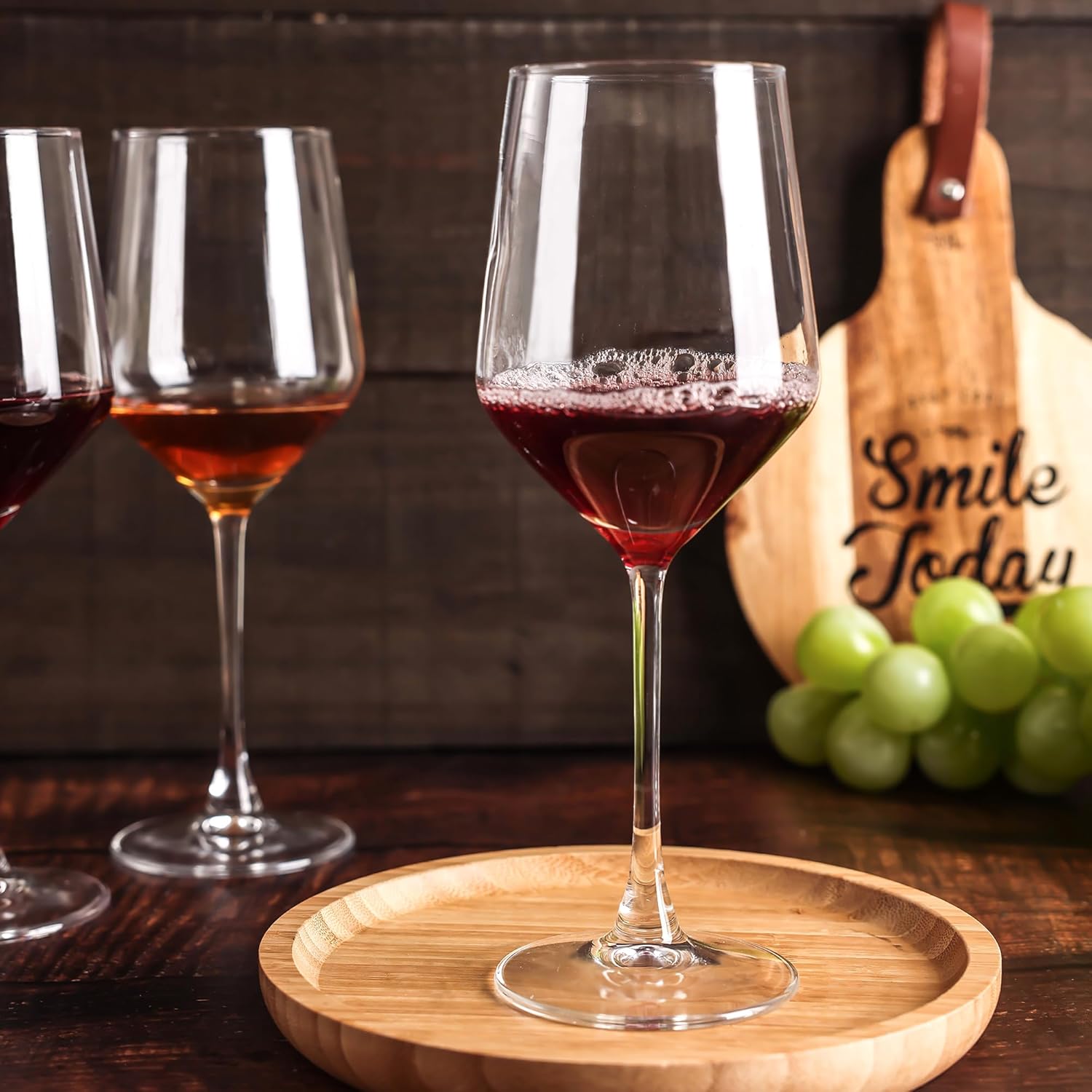
Skip the narrow white wine glass or flute. Orange wine needs a larger bowl — similar to a red wine glass — to allow the complex aromatics to develop and concentrate above the wine’s surface. A Burgundy-style glass with a wide bowl tapering toward the rim is ideal for the most complex, long-macerated amber wines. For lighter, shorter-maceration skin-contact wines, a standard red wine Bordeaux-style glass works well. The key is that the opening should be wide enough for you to get your nose inside the glass, which you genuinely need to do to appreciate orange wine’s complex aromatic profile.
Decanting
Many orange wines — particularly those aged for significant periods before release — benefit from 30 to 60 minutes in a decanter to “blow off” any reductive notes (volatile sulfur compounds that can manifest as struck match or rubber smells) that sometimes accumulate in low-intervention wines during bottle aging. Extended maceration wines especially may also throw a natural sediment — a combination of tannin precipitates and tartrate crystals — that is harmless but better separated by decanting before serving. After 30 minutes in a wide decanter, most orange wines open dramatically: the initially challenging aromatic profile softens, the tannins integrate, and the wine’s full complexity reveals itself.
Because they are tannic, some amber wines throw sediment. Learning how to use a decanter can separate the clear wine from the solids and improve both presentation and taste.
Aging Potential and Storage: Orange Wine Lasts Longer Than You Think
One of the most counter-intuitive aspects of orange wine — for drinkers accustomed to thinking of white wine as a drink-young category — is its remarkable aging potential. The same phenolic compounds extracted from the skins that give orange wine its grip and complexity also function as natural preservatives, allowing quality examples to develop and improve in the bottle for significantly longer than conventional white wines.
Aging Potential by Style
| Orange Wine Style | Drink From | Peak Window | Maximum Potential |
|---|---|---|---|
| Short maceration (1–7 days) | On release | 1–4 years | 5–6 years |
| Medium maceration (2–4 weeks) | 1–2 years | 3–8 years | 10–12 years |
| Long maceration (1–6 months) | 2–4 years | 6–15 years | 20+ years for top producers |
| Georgian qvevri style (6+ months) | 3–5 years | 8–20 years | 30+ years for best examples |
| Gravner / Radikon style | 7+ years (released at 7yr) | 10–25 years | 40+ years in exceptional vintages |
How to Store Orange Wine
The storage requirements for orange wine are essentially identical to those for quality red wine: a stable, cool temperature of 55–58°F (13–14°C), away from light and vibration, and ideally on its side if the bottle is sealed with cork. The tannins in orange wine provide natural protection against oxidative spoilage, so the storage requirements for an already-opened bottle are considerably more forgiving than for white wine. A resealed bottle of quality orange wine kept in the refrigerator will remain in excellent condition for 5–7 days — compare this to a conventional white wine that begins to degrade within 2–3 days of opening.
For very long-term storage of premium orange wines, treat them exactly as you would a premium Burgundy or aged Barolo — cellar temperature, horizontal storage, minimal disturbance. A Gravner or Radikon wine from a great year is genuinely a 20–30 year aging proposition.
Faults vs. Features: Is “Funky” a Flaw?
One of the most common stumbling blocks for wine drinkers approaching orange wine for the first time is the question of whether the unusual, challenging, or downright strange aromas they encounter represent winemaking skill or winemaking failure. The line between a fault and a stylistic feature is genuinely blurred in the orange wine world — understanding this distinction is essential to evaluating what you are tasting honestly.
Features: Intentional Complexity
Oxidative notes — dried fruit, nut, sherry-like warmth, dried flowers — are a feature of well-made orange wine, not a fault. The controlled oxidation that occurs during skin-contact fermentation and aging in clay or neutral oak is intentional and valued. These notes are the hallmark of the style, not evidence that the wine has spoiled. Cloudiness in orange wine is similarly a feature — the minimal filtration typical of natural orange wine production leaves natural particulates in suspension that give the wine a characteristically hazy appearance. This does not indicate spoilage; it indicates minimal intervention. Light tannin astringency in a white grape wine is a feature, not a flaw — it is the structural contribution of skin extraction that defines the category.
Genuine Faults to Watch For
Volatile acidity (VA) — the sharp, vinegar-like, nail-polish-remover smell of acetic acid and ethyl acetate — is a genuine winemaking fault caused by acetic acid bacteria converting alcohol to acetic acid. While small amounts are considered acceptable and even add complexity in some styles, high VA masks the wine’s character and indicates poor hygiene or fermentation control. In natural orange wine, some VA is accepted by producers and fans as a natural byproduct of minimal-intervention winemaking — but a wine that smells primarily of vinegar is flawed regardless of its philosophy. Brettanomyces (Brett) — producing barnyard, leather, horse, or mousy notes — is another fault that occurs more frequently in natural wine due to reduced sulfite use. Low levels of Brett add interesting complexity; high levels make the wine undrinkable. Mousiness — a specific, persistent unpleasant aftertaste described as mouse cage, wet crackers, or stale cereal — is a definitive fault produced by specific lactic acid bacteria and is never a feature, regardless of natural wine philosophy.
A useful test for distinguishing features from faults: decant the wine for 30 minutes and retaste. Genuine features of well-made orange wine — oxidative notes, earthiness, light funkiness — will remain present but become more integrated and pleasant. Genuine faults — volatile acidity, strong Brett, mousiness — will either remain just as unpleasant or actually intensify with air exposure. If the wine improves dramatically with air, it likely had reductive notes (a winemaking artifact) rather than genuine faults.
Buying Guide: How to Find and Choose Orange Wine
Orange wine is still a niche category in most mainstream retail environments, but its availability has expanded dramatically as demand has grown. Here is a practical guide to finding, selecting, and buying orange wine at different experience levels and price points.
Where to Find It
Independent wine merchants and natural wine specialists are the most reliable source for quality orange wine — staff at these shops typically understand the category and can guide you toward bottles suited to your experience level. Online retailers specializing in natural, organic, or biodynamic wine carry extensive orange wine selections with detailed tasting notes. Wine bars with dedicated “orange” or “skin contact” menus are ideal for first exposure, as you can taste before committing to a full bottle. Many supermarkets now carry at least a few skin-contact options, though quality at this level varies considerably.
Buying by Price Point
| Budget | What to Expect | Where to Look |
|---|---|---|
| Under $20 | Entry-level skin contact — usually short maceration (days), lighter color and tannin, more approachable. Good for first-time orange wine drinkers. | Italian Pinot Grigio Ramato, basic Slovenian Rebula, everyday natural wine producers |
| $20–$45 | Quality regional examples with genuine maceration character. Medium-length maceration, interesting grape varieties, distinctive terroir expression. | Friuli Collio producers, Georgian Pheasant’s Tears, Sicilian COS Pithos, Austrian skin-contact |
| $45–$100 | Premium quality with serious aging potential. Long maceration, distinctive vessel (qvevri or large oak), complex and age-worthy. | Radikon, Skerk, Vodopivec, top Georgian amber wines |
| $100+ | The pinnacle. Long maceration, extended aging before release, extraordinary complexity and longevity. | Gravner (released at 7+ years), top-vintage Radikon, rare Georgian qvevri wines |
Label Red Flags and Green Lights
Look for: “Skin contact,” “macerated white,” “amber wine,” “qvevri,” “amphorae,” or “extended maceration” — these indicate deliberate, thoughtful skin-contact production. Organic or biodynamic certification suggests the grapes themselves are of high quality. Named grape varieties on the label (Ribolla Gialla, Rkatsiteli, Vitovska) indicate a producer working with varieties suited to the technique.
Be cautious of: Generic “orange wine” labels with no detail on maceration or production method — these can be marketing exercises using days of skin contact rather than genuine amber wine production. Brands that adopted the term “orange wine” primarily for trend-following rather than genuine commitment to the style often produce pale, tannin-free “orange-ish” wines that deliver little of what the category promises.
Blind Tasting: How to Identify Orange Wine in the Glass
If a glass of mystery wine is placed in front of you, these are the sensory signals that point toward orange wine rather than conventional white, red, or rosé.
- Color: Any color between deep gold and copper-amber in a wine poured from what looks like a white wine bottle (clear or lightly tinted glass) is a strong orange wine indicator. True white wine rarely achieves this depth of gold without oxidation damage; orange wine achieves it through intentional extraction.
- Nose — dried fruit: Dried apricot, dried orange peel, quince, beeswax, tea, hazelnut, and walnut are signature orange wine aromatics that do not appear in conventional white wine unless the bottle has been open for days.
- Nose — savory notes: Sourdough, honey gone hard, dried mushroom, hay, saffron. These savory-sweet oxidative notes are characteristic of skin contact and age.
- Palate — tannin: A drying, grippy sensation on the gums from a wine that pours the color of white wine is almost definitive evidence of skin contact. No conventional white wine has perceptible tannins.
- Palate — body: Full body with low fresh fruit in a wine that is clearly not red or rosé points strongly to extended skin contact.
- Palate — finish: A long, drying, saline or mineral finish with dried fruit notes persisting well after swallowing is a hallmark of quality orange wine.
In competitive blind tasting, the combination of white-wine acidity + red-wine tannin + amber color essentially confirms orange wine without further deliberation. No other wine category produces this specific combination of sensory signals. The only potential confusion is with very oxidized conventional white wine (which may appear amber and nutty) — but oxidized white wine will lack tannin entirely, allowing you to distinguish the two.
Frequently Asked Questions
No. It is made from white grapes. The orange/amber color comes entirely from the grape skins staining the juice during fermentation — a process called maceration. The name “orange wine” refers to the color of the finished wine, not any citrus ingredient. Some producers in Georgia and elsewhere prefer the term “amber wine” to avoid exactly this confusion.
It can, particularly in shorter-maceration natural orange wines where some volatile acidity is present. The combination of bruised apple notes, tangy acidity, and slight funkiness in some styles does echo good farmhouse cider. This is often intentional and part of the style’s appeal. Longer-maceration, barrel-aged examples are much more complex and “wine-like” — closer to a structured red wine in feel, with dried fruit, hazelnut, and tea rather than fresh apple.
No — they are essentially opposites. Rosé is made from red grapes with very brief skin contact (hours) to extract just a blush of color. Orange wine is made from white grapes with very extended skin contact (days to months) to extract significant color, tannin, and phenolic complexity. Despite both sitting “between” white and red in color, they are produced by opposite techniques from opposite grape families and taste dramatically different.
Significantly longer than white wine — typically 5–7 days in the refrigerator with a good stopper, compared to 2–3 days for most white wine. The skin-extracted tannins and phenolics act as natural antioxidants that slow the oxidation process. Some robust, heavily macerated orange wines improve for a day or two after opening as they aerate. A note: very delicate, low-sulfite natural orange wines are an exception — some of these can decline quickly once opened, similar to low-sulfite white wine.
Cloudiness in orange wine is almost always a deliberate feature, not a fault. Most quality orange wines are made with minimal or no filtration, leaving natural particulates — yeast cells, tannin precipitates, and other grape-derived solids — in suspension in the bottle. These contribute to the wine’s textural complexity and are entirely harmless. Gentle refrigeration can cause some of these particles to settle; decanting will separate the clear wine from any settled sediment. Do not confuse this natural cloudiness with the haziness of a spoiled or bacterially compromised wine — which typically has a distinctly unpleasant smell alongside the cloudiness.
No — this is a common misconception. Orange wine refers to a production technique (white grapes made with skin contact), not a philosophy. A producer can make skin-contact wine using conventional viticulture, commercial yeasts, temperature-controlled fermentation, and added sulfites. The resulting wine is technically orange wine by method. The association between orange wine and natural wine reflects the overlap of practitioners and values in the current market, but they are not synonymous. Always check for separate organic, biodynamic, or “natural” designations if those properties matter to you.
Quality orange wine is genuinely age-worthy — often more so than equivalent-quality white wine. The phenolic compounds extracted from the skins provide natural antioxidant protection that extends longevity. Entry-level skin-contact wines are best within 3–5 years. Premium long-maceration examples from producers like Gravner, Radikon, and the finest Georgian qvevri producers can age for 20–40 years in the best vintages. Gravner releases his wines at 7 years of age and they are designed for another 20–30 years of development.
Ramato is the Italian name for skin-contact Pinot Grigio (Pinot Gris) wine, predominantly from Friuli-Venezia Giulia. The name means “auburn” or “copper-haired” in Italian, referring to the distinctive copper-pink color produced by Pinot Grigio’s pinkish-grey skin. Ramato predates the modern orange wine movement by centuries — it was the traditional way Pinot Grigio was made in Friuli before industrial winemaking standardized direct-pressed, pale-colored production. It is now undergoing a revival as part of the broader skin-contact renaissance.
This is the key question for newcomers. Funky but correct orange wine smells and tastes of dried fruit, nuts, earth, hay, sourdough, dried herbs, and oxidative notes — complex and unusual but not unpleasant once you adjust your expectations. A genuinely faulty orange wine smells of vinegar (volatile acidity), nail polish remover (ethyl acetate), or has a persistent unpleasant “mousy” aftertaste that no amount of airing resolves. The best test: pour a glass and let it sit for 30 minutes. If it improves, it is likely a good wine with reductive notes needing air. If it stays unpleasant or worsens, it has genuine faults.
For most newcomers, a short-to-medium maceration Italian skin-contact wine is the most accessible entry point. Look for a Pinot Grigio Ramato from Friuli, or a Ribolla Gialla from a producer who uses 1–2 weeks of maceration rather than months. These wines show the textural difference and amber color clearly while remaining fruit-forward and approachable enough not to alienate a palate accustomed to conventional white wine. Serve at cellar temperature (around 55°F), not ice cold, and pair with a charcuterie board for the best first impression. Once you are comfortable with this style, move to longer maceration and Georgian qvevri wines for the full depth of what the category offers.