Single Zone vs Dual Zone Wine Cooler: The Complete Buyer’s Decision Guide
Everything you need to know about temperature zones, cooling technology, bottle capacity, and which type of wine fridge is truly worth your money.
What Are Wine Cooler Temperature Zones — and Why Do They Matter?
Whether you’re a weekend sipper, a serious collector, or somewhere in between, the single most important decision you’ll make when buying a wine refrigerator isn’t the brand or the bottle count — it’s choosing between a single zone vs dual zone wine cooler.
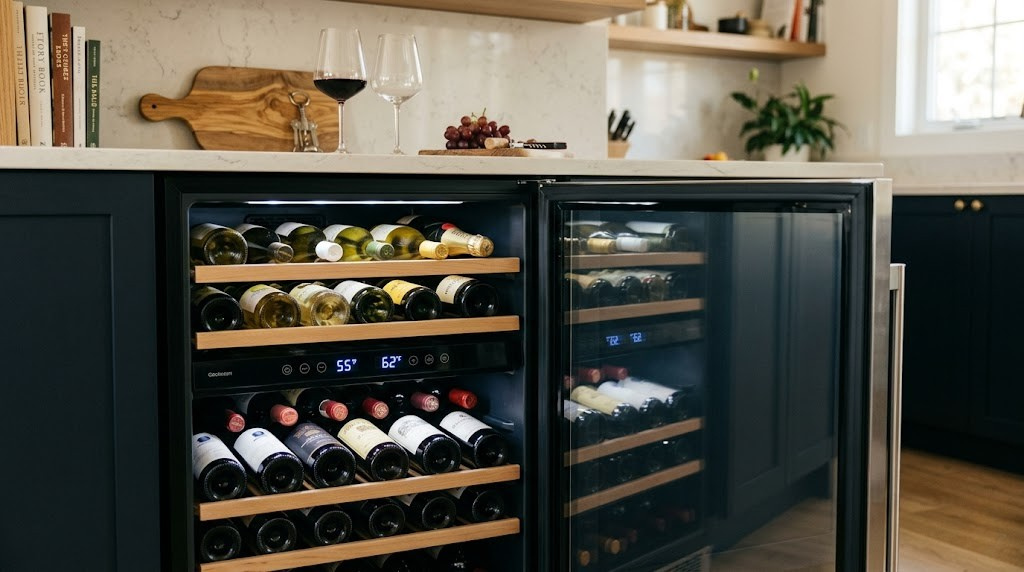
Walk into any kitchen appliance store or browse any wine accessories website, and you’ll immediately be confronted with this choice. On one side: sleek, simple, single-temperature units designed to maintain one consistent environment across every bottle. On the other: sophisticated dual-zone refrigerators with separate chambers, each holding a different temperature, for those who refuse to compromise between their reds and whites.
The difference sounds simple. But the implications cascade into everything — how you store wine, how long your bottles age, how much you spend, and whether your Burgundy is served at the same temperature as your Champagne. (Spoiler: it absolutely shouldn’t be.)
This guide is going to settle the debate once and for all. We’ll dig into the science of wine storage temperatures, the engineering behind cooling zones, and the real-world use cases that should determine your purchase. We’ll also examine the top wine cooler models available today, so you finish this article ready to buy — with confidence.
If you’re just starting your journey into proper wine preservation, it helps to first understand the fundamentals of home wine storage — including temperature and humidity. But if you already know why temperature matters and just want to settle the single-vs-dual-zone debate, you’re in exactly the right place.
Quick AnswerIf you drink primarily one wine style (all reds, or all whites), a single zone wine cooler is smarter and more economical. If you regularly enjoy both reds and whites — or want to store and serve at different temperatures — a dual zone wine cooler is worth every extra dollar.
Single Zone Deep Dive
Single Zone Wine Coolers: Everything You Need to Know
A single zone wine cooler maintains one uniform temperature throughout its entire interior. There are no dividers, no separate compartments, no independent thermostats — just one consistent climate from the top shelf to the bottom.
This simplicity is, paradoxically, both its greatest strength and its most significant limitation. Understanding when that simplicity works in your favor — and when it works against you — is the key to making the right choice.
How Single Zone Coolers Work
Whether a single zone unit uses thermoelectric or compressor cooling (more on that distinction in our thermoelectric vs compressor guide), the fundamental operation is the same: one temperature sensor reads the internal environment and one cooling mechanism responds to maintain the set point. The entire cabinet — top to bottom, front to back — is treated as one unified thermal environment.
Most single zone wine coolers allow you to set temperatures anywhere from roughly 40°F to 65°F (4°C to 18°C), which covers most wine storage and serving needs. The question is just whether that one temperature is the right one for everything you’re storing.
The Ideal Use Case for Single Zone Units
Single zone wine coolers shine brightest in these scenarios:
- Red wine collectors who want to maintain a consistent cellar temperature (typically 55–58°F) for long-term aging
- White wine enthusiasts who chill all their whites and sparkling wines at a similar serving temperature
- Apartment dwellers and urban wine drinkers who need a compact, budget-friendly solution
- Bar and restaurant pre-service chillers that maintain one specific serving temperature
- Casual drinkers who open bottles within a week or two of purchase rather than aging for years
The question of whether you even need a wine fridge often comes down to exactly this: how diverse is your drinking? If you answer “I mostly drink Cabernet Sauvignon” or “I almost exclusively drink Sauvignon Blanc,” a single zone unit is a perfectly rational choice.
Single Zone Wine Cooler: Pros and Cons
✓ Advantages
- Lower purchase price
- Simpler controls and operation
- Fewer mechanical components = less to break
- Quieter operation in many models
- More even temperature distribution
- Better long-term aging conditions (one stable zone)
- Greater bottle capacity per dollar spent
- More compact footprint options available
✗ Disadvantages
- Cannot simultaneously store reds and whites at ideal temps
- Less flexibility as your palate evolves
- Not ideal if you entertain with diverse wines
- May require compromise between aging and serving temps
- Not suitable for storing Champagne and full-bodied reds together

Wine Enthusiast 32-Bottle Compressor Wine Cooler
A top-rated single zone compressor cooler trusted by serious collectors. Stable temps, UV-protected door, quiet operation.
View on Amazon →Dual Zone Deep Dive
Dual Zone Wine Coolers: Everything You Need to Know
A dual zone wine cooler contains two separate temperature-controlled compartments within a single unit. Each zone has its own thermostat, its own temperature sensor, and — in most modern designs — its own independent cooling circuit or at minimum, a shared compressor with a zone-separation mechanism.
The result is a wine refrigerator that can simultaneously maintain, say, 55°F in the upper section for aging reds while keeping the lower section at 45°F for chilled whites — without any compromise between the two.
For wine lovers who regularly pour both red and white, or who want to maintain a clear separation between their aging collection and their immediate drinking stock, the dual zone configuration is transformative. It’s the difference between a wine cooler that stores wine and one that truly manages it.
How Dual Zone Temperature Separation Works
Dual zone coolers achieve their independent temperature management through one of two primary engineering approaches:
1. Dual Independent Compressors: The premium approach. Each zone has its own separate compressor, refrigerant loop, and thermostat. Both zones operate completely independently — neither affects the other, even during start-up and cool-down cycles. These units are more expensive, heavier, and use more energy, but they offer the most precise and stable temperature control in both sections simultaneously.
2. Single Compressor with Zone Separation: The more common (and more affordable) approach. A single compressor cools the entire unit, but a damper system, baffle, or internal divider controls airflow between the two zones. One zone typically gets cooled first, then airflow is diverted to manage the other. This system works well but can sometimes allow slight cross-zone temperature drift under heavy use or warm ambient environments.
Understanding which system your target unit uses matters, especially if you’re serious about long-term aging in both zones simultaneously. You can learn more about cooling mechanisms in our thermoelectric vs compressor comparison.
Zone Layout: Upper Zone vs Lower Zone
In most dual zone wine coolers, the upper zone is warmer and the lower zone is cooler. This follows basic physics: cold air sinks, warm air rises. The lower zone naturally benefits from the proximity of the compressor cooling coils and the settling of cold air. The upper zone, slightly insulated from the compressor and warmed by its proximity to room-temperature air, sits at a higher stable temperature.
This default layout is actually ideal for most wine collections: store your red wines (55–65°F) in the upper zone and your white wines (45–50°F) or sparkling wines (40–45°F) in the lower zone. Some premium units reverse this with upper-zone whites and lower-zone reds, but the standard arrangement works beautifully for most users.
Dual Zone Wine Cooler: Pros and Cons
✓ Advantages
- Simultaneously stores reds and whites at ideal temps
- Separate aging and serving zones within one unit
- Perfect for hosts who entertain with diverse wines
- More versatile as your collection grows and diversifies
- Reduces kitchen clutter (one unit does the work of two)
- Allows proper Champagne storage alongside full-bodied reds
- Future-proof investment for evolving wine tastes
✗ Disadvantages
- Higher upfront cost vs comparable single zone units
- More mechanical complexity = slightly more repair risk
- Often noisier than single zone thermoelectric units
- Zone separation may not be perfectly precise in budget models
- Higher energy consumption with dual compressor designs
- Larger footprint for the same total bottle count
Wine Enthusiast 32-Bottle Dual Zone Compressor Cooler
One of the most reliable dual zone wine coolers on the market. UV-resistant glass, digital controls, and stable independent zones for red and white wines.
Check Price on Amazon →The Science of Wine Temperature
Wine Storage Temperatures: Why One Size Doesn’t Fit All
The core argument for dual zone wine coolers rests on a single undeniable fact: different wines have different ideal temperatures for storage and for serving. Collapsing these into a single compromise temperature doesn’t just mean suboptimal serving conditions — it can actively accelerate the aging of wines that should be stored colder, or retard the development of wines that need slightly warmer conditions.
Here’s a look at the ideal temperature ranges for common wine styles, both for long-term storage and for the moment they’re poured into the glass. Proper serving temperature is one of the most overlooked aspects of wine enjoyment — something we explore in depth in our guide to why a wine thermometer is your most important tool.
🌡️ Ideal Storage & Serving Temperatures by Wine Style
Notice the enormous gap between a full-bodied red (60–65°F) and a classic Champagne (40–44°F). That’s a 20°F spread — a gulf that no single zone cooler can bridge. If you try to split the difference at 52°F, your Cabernet Sauvignon will be cold and muted, and your Champagne will be too warm, causing it to age faster and lose its delicate bubble structure.
For collectors who take aging seriously, the universal truth is: wines age best at 55°F. This cellar temperature is cold enough to slow chemical reactions but warm enough to allow the slow, complex evolution that gives aged wine its character. A single zone cooler set to 55°F is a perfectly legitimate long-term aging solution — as long as you’re okay removing bottles to chill whites in the kitchen fridge for 30 minutes before serving.
If that compromising workaround bothers you — and for serious wine enthusiasts, it should — a dual zone cooler eliminates the problem entirely. To understand why wine improves with age and how temperature accelerates or retards that process, our article on why wine gets better with age goes deep on the chemistry involved.
The “Universal” Storage Temperature Myth
You’ll sometimes see wine coolers marketed with the idea of a “universal wine storage temperature.” The concept is that 55°F is the right temperature for all wines. This is partially true — for long-term storage, 55°F is indeed a reasonable cellar temperature that won’t damage any style of wine.
But “won’t damage” and “ideal” are very different standards. Serving a Sancerre at 55°F means it’s 8–10°F warmer than it should be. Serving a Bordeaux at 55°F means it’s 7–10°F colder than its peak. The single zone cooler at 55°F is a compromise — acceptable for storage, but suboptimal at the moment of truth: when you pour.
Pro TipEven if you own a single zone wine cooler set to 55°F, remove white wines and place them in a regular fridge 30–45 minutes before serving. For reds, remove them from the cooler 20–30 minutes before serving to allow them to warm slightly. This simple habit dramatically improves how your wines taste.
Head-to-Head
Single Zone vs Dual Zone Wine Cooler: The Complete Comparison
Let’s put both types side by side across every dimension that matters to a wine buyer. This table is designed to give you a definitive reference at a glance.
| Feature / Criterion | Single Zone | Dual Zone |
|---|---|---|
| Temperature Zones | 1 uniform zone | 2 independent zones |
| Red + White storage simultaneously | ✗ Compromise temp | ✓ Each at ideal temp |
| Long-term aging performance | ✓ Excellent at 55°F | ✓ Excellent in both zones |
| Upfront cost | ✓ Lower (typically) | ✗ Higher by 20–50% |
| Energy efficiency | ✓ More efficient | ⚬ Slightly less efficient |
| Mechanical complexity | ✓ Simpler | ⚬ More components |
| Bottle capacity per $ spent | ✓ Better value per bottle | ⚬ Slightly lower value |
| Temperature precision | ✓ Very precise | ✓ Precise (premium models) |
| Champagne storage | ✗ Difficult alongside reds | ✓ Perfect — separate zone |
| Serving variety at a dinner party | ✗ Requires planning ahead | ✓ Every wine ready to serve |
| Noise level | ✓ Often quieter | ⚬ Varies by model |
| Best for | Single-style collectors, budget buyers, compact spaces | Mixed collections, entertainers, serious enthusiasts |
The Cost Difference: Is Dual Zone Worth the Premium?
Across the market, comparable dual zone models typically cost 20–45% more than equivalent single zone units at the same bottle capacity. At the 24–32 bottle range — a popular size for home enthusiasts — that might mean $180–$250 for a quality single zone vs $280–$400 for a quality dual zone.
Is that gap worth it? It depends entirely on how you drink. If you genuinely entertain with both reds and whites, the answer is yes — a dual zone unit replaces two separate appliances. If you’re a dedicated red wine devotee who occasionally splurges on a Chardonnay, the answer is probably no.
For a curated list of options across the price spectrum, our roundup of best wine coolers under $500 is an excellent starting point, as is our comprehensive best dual zone wine coolers guide.
Decision Framework
Who Should Buy Single Zone — and Who Should Buy Dual Zone?
Forget the specs and the price sheets for a moment. The right choice comes down to your personal relationship with wine. Here’s a clear-eyed decision framework based on real drinking habits and lifestyle.
- You drink primarily one style (reds OR whites)
- Your budget is under $250
- You’re building a long-term aging cellar of one wine type
- Space is limited and you need the most bottles per cubic foot
- You’re new to wine and still discovering your preferences
- You don’t entertain frequently with mixed wine service
- You prefer thermoelectric cooling (near-silent)
- You store wine primarily for aging, not same-day serving
- You regularly enjoy both red and white wines
- You entertain guests and serve multiple wine styles
- You collect Champagne or sparkling wine alongside reds
- You want separate aging and serving temperature zones
- You’re willing to invest $300+ for long-term versatility
- You want one unit to handle your entire wine management
- Your collection is growing and diversifying
- You value never compromising on serving temperature
The Collector vs The Entertainer
There’s a useful mental distinction here: the collector and the entertainer. Pure collectors — people who buy wine specifically to let it age for 5, 10, or 20 years before opening — actually often prefer single zone units. They set one stable cellar temperature, load the unit, and wait. Every bottle gets the same, consistent environment. When they finally open a special bottle, they’ve already planned ahead for serving temperature.
Entertainers, on the other hand, need wine ready to serve at a moment’s notice. They’re opening the cooler for a dinner party on Friday night and need the Pinot Gris cold and the Côtes du Rhône at room temperature — simultaneously. A single zone cooler simply cannot deliver this without pre-planning. A dual zone cooler does it automatically.
Most of us are somewhere in between, which is why the growing popularity of dual zone models makes so much sense. As your interest in wine deepens, your collection naturally diversifies. You discover Alsatian Rieslings and Barolo in the same month. A dual zone cooler grows with you.
Thinking About It DifferentlyAsk yourself: in the last 3 months, how many times did you wish you had a chilled white wine when only a warm bottle was available, or vice versa? If the answer is more than twice, you’re already experiencing the pain point that a dual zone cooler solves.
Wine Enthusiast 32-Bottle Dual Zone Cooler
Store reds and whites at their ideal temperatures simultaneously. One of the most trusted names in home wine refrigeration.
View on Amazon →Technology Deep Dive
Cooling Technology: Compressor vs Thermoelectric in Zone Coolers
The zone configuration (single or dual) is just one dimension of the wine cooler decision. The cooling technology — compressor or thermoelectric — is an equally important axis that dramatically affects performance, noise, energy use, and suitability for different environments.
Compressor Cooling: The Workhorse
Compressor wine coolers work exactly like your kitchen refrigerator — a refrigerant is compressed and expanded in a loop to transfer heat from inside the unit to outside. They’re powerful, capable of reaching and maintaining low temperatures regardless of ambient room temperature, and they’re the only viable option for dual zone units that need to maintain genuinely different temperatures in two compartments simultaneously.
The tradeoffs with compressor cooling: they produce some vibration (which can theoretically disturb wine sediment over very long periods), they generate some operational noise, and they cost slightly more to run than thermoelectric alternatives. However, modern compressor wine coolers have become dramatically quieter than they were a decade ago. Units from reputable brands like Wine Enthusiast, Whynter, and NewAir operate at 45–55 dB, comparable to a library or quiet office.
For our complete reviews of leading compressor brands, see our Wine Enthusiast cooler review, Whynter wine cooler review, and NewAir wine cooler review.
Thermoelectric Cooling: The Silent Option
Thermoelectric coolers use the Peltier effect — an electrical current is passed through a junction of two semiconductor materials, causing heat to flow from one side (inside the unit) to the other (outside). There are no moving mechanical parts beyond a small fan, which means near-silent operation and zero vibration.
The catch: thermoelectric cooling is limited in its temperature differential. Most thermoelectric units can only cool to roughly 20–25°F below ambient room temperature. In a kitchen kept at 72°F, that means a minimum internal temperature around 47–52°F — perfectly adequate for white wine serving but insufficient for the precise dual-zone temperature management that serious collectors need.
This is why virtually all dual zone wine coolers use compressor technology. The requirement to maintain two significantly different temperatures simultaneously simply exceeds what thermoelectric systems can reliably deliver. If you see a “dual zone thermoelectric” unit advertised, approach with caution — the zone separation in such systems is usually minimal and imprecise.
Thermoelectric
Near-silent, no vibration, energy-efficient — but limited temperature range and only suitable for single zone
Compressor
Powerful, reaches low temps in any climate, required for dual zone — some noise but modern units are very quiet
Dual Compressor
Premium dual zone setup — each zone has its own independent compressor for perfect, uncompromising temperature precision
Smart Cooling
Modern units with app control, temperature logging, and adaptive learning for the most stable long-term conditions
Sizing and Capacity
Bottle Capacity, Sizing, and the Zone Trade-off
Here’s a practical reality that many buyers don’t consider until it’s too late: adding a second zone often costs you bottle capacity. A dual zone 32-bottle cooler effectively gives you two 16-bottle compartments — and those two separate zones require insulated dividers and additional structural elements that eat into storage space.
A single zone 32-bottle unit, by contrast, uses every cubic inch efficiently across one uniform space. No dividers, no baffles, no wasted space. This is why single zone coolers routinely offer better bottle-per-dollar value than dual zone alternatives.
Zone Capacity Distribution
In most dual zone coolers, the capacity split between zones follows one of these patterns:
| Total Capacity | Upper Zone (Warm/Red) | Lower Zone (Cool/White) | Typical User |
|---|---|---|---|
| 24-bottle dual zone | 12 bottles | 12 bottles | Casual collector, apartment dweller |
| 32-bottle dual zone | 16–18 bottles | 14–16 bottles | Active enthusiast, frequent entertainer |
| 46-bottle dual zone | 24–28 bottles | 18–22 bottles | Serious collector with diverse cellar |
| 66-bottle dual zone | 36–40 bottles | 26–30 bottles | Home sommelier, restaurant pre-service |
Notice how the upper zone (for reds) tends to get slightly more capacity than the lower zone in many designs. This reflects the reality of most wine collections: red wine lovers typically have more bottles aging in the cellar than whites, which are often purchased for near-term consumption. Manufacturers have tuned their designs accordingly.
Freestanding vs Built-In and Its Impact on Zone Performance
Whether your cooler is freestanding or built-in affects zone performance too. Freestanding units require adequate air clearance around the sides and back — typically 3–5 inches — for the compressor to expel heat. If you install a freestanding dual zone unit in a tight cabinet without this clearance, the compressor works harder, runs warmer, and may struggle to maintain precise zone temperatures.
Built-in units are designed for zero-clearance installation with front-venting compressors. They cost more but integrate cleanly into kitchen cabinetry and perform more consistently in enclosed spaces. For built-in or undercounter wine cooler options, check our roundup of top-rated wine refrigerators which covers both installation types.
Sizing Rule of ThumbAlways buy more capacity than you think you need. Wine collections grow faster than expected, especially as your interest deepens. If you’re considering a 12-bottle unit today, buy the 24-bottle. If you’re between 32 and 46, go 46. The only wine cooler you’ll regret is the one that ran out of space six months after you bought it.
Wine Enthusiast 32-Bottle Wine Cooler
Ideal for growing collections — 32 bottles across two zones with compressor stability. UV-protective glass keeps your wine safe from light damage.
Shop on Amazon →Features That Matter
Key Features to Look for in Any Wine Cooler — Single or Dual Zone
Regardless of whether you land on single or dual zone, certain features separate good wine coolers from great ones. Here’s what to evaluate when comparing specific models.
UV-Resistant Glass Door
UV radiation is one of wine’s primary enemies. Direct sunlight or strong artificial UV light can trigger photodegradation, causing premature aging, color changes, and off-flavors — particularly in white wines and Champagnes. A quality wine cooler should have a UV-resistant or UV-blocking tempered glass door. This doesn’t mean opaque; you can still see your bottles beautifully. It simply means harmful radiation is filtered before it reaches your wine.
Solid door units (no glass at all) offer the best UV protection, but most buyers understandably want to see their collection. A tinted, UV-coated glass is the ideal balance.
Digital Temperature Control with Display
Analog thermostats (the dial type) are imprecise. A 5–10°F variance from the set point is normal with dial controls, which is unacceptable for a dual zone unit where precise temperature separation is the entire point. Digital controls with clear numerical displays — ideally showing both the set temperature and the actual current temperature — are non-negotiable in any serious wine cooler.
Premium models feature touchscreen controls, temperature memory (the unit returns to its previous settings after a power outage), and even Bluetooth or Wi-Fi connectivity for remote monitoring.
Vibration Reduction
Vibration is the enemy of long-term wine aging. The agitation disturbs sediment in aged red wines, can disrupt the slow biochemical reactions that create complex aged flavors, and — with constant mechanical vibration — may even gradually strip the flavor compounds from wine over years of exposure.
Look for: compressors with vibration-dampening mounts, wooden or cushioned shelving that isolates bottles from mechanical movement, and units that specifically advertise “low vibration” or “anti-vibration” systems.
Humidity Management
The ideal relative humidity inside a wine cooler is 50–70%. Below 50%, corks begin to dry out — even inside the cooler — which allows air infiltration that oxidizes your wine. Above 70%, mold growth becomes a risk.
Most wine coolers don’t actively manage humidity (unlike full walk-in wine cellars), but quality units are designed with sufficient sealing and interior materials to maintain a naturally stable humid environment. Some premium models include a small water reservoir or humidity tray. For more on the relationship between humidity and wine storage, our guide to wine cellar essentials covers this comprehensively.
Shelf Material and Configuration
The shelf material matters more than most buyers realize. The best options, in order of quality:
- Solid wood shelves: Natural vibration absorption, attractive presentation, gentle on bottle labels. Found in premium units.
- Wooden-railed metal shelves: Good compromise of durability and vibration reduction. Common in mid-range coolers.
- Wire metal shelves: Durable but transmit more vibration. Acceptable for short-term storage, less ideal for long-term aging.
- Plastic shelves: Only acceptable in compact, thermoelectric units for short-term storage.
Also consider whether shelves are removable and adjustable — this allows you to accommodate larger format bottles (magnums, Champagne bottles) that are taller and wider than standard Bordeaux-style bottles. A cooler that can’t fit your Champagne is a significant limitation.
Lock
If you’re storing valuable bottles or have children in the house, a keyed lock is a valuable feature. Check our list of best wine fridges with a lock if this is a priority for you.
Interior Lighting
Good LED interior lighting lets you easily identify bottles without opening the door (which fluctuates the temperature). Look for cool-spectrum LED lights that don’t generate significant heat. Avoid incandescent interior lighting — the heat production is counterproductive.
2026 Top Picks
Best Single Zone and Dual Zone Wine Coolers in 2026
To help you make a concrete decision, here’s an overview of the current leading wine cooler models in both categories, across key price points. For deeper individual reviews, follow the links provided — we’ve tested or thoroughly evaluated each of these brands.
Best Single Zone Wine Coolers
| Model | Capacity | Temp Range | Cooling Type | Best For |
|---|---|---|---|---|
| Wine Enthusiast 32-Bottle Top Pick | 32 bottles | 40–65°F | Compressor | Serious aging collectors |
| Ivation 18-Bottle | 18 bottles | 46–64°F | Thermoelectric | Apartments, quiet spaces |
| NewAir 29-Bottle | 29 bottles | 40–65°F | Compressor | Budget-conscious buyers |
| Kalamera 24-Bottle | 24 bottles | 41–68°F | Compressor | Undercounter installation |
| Antarctic Star 12-Bottle | 12 bottles | 54–65°F | Thermoelectric | Countertop, tight budgets |
For complete reviews of these brands, see our Ivation wine cooler review, Kalamera 24-bottle review, NewAir review, and Antarctic Star review.
Best Dual Zone Wine Coolers
| Model | Capacity | Zone 1 (Upper) | Zone 2 (Lower) | Cooling Type |
|---|---|---|---|---|
| Wine Enthusiast 32-Bottle Dual Editor’s Choice | 32 bottles | 50–65°F | 40–50°F | Compressor |
| Vinotemp 28-Bottle Dual Zone | 28 bottles | 54–66°F | 46–54°F | Thermoelectric |
| Whynter 46-Bottle Dual Zone | 46 bottles | 50–66°F | 40–50°F | Compressor |
| NewAir 33-Bottle Dual Zone | 33 bottles | 54–65°F | 46–54°F | Compressor |
For brand-level reviews of these dual zone options, our Vinotemp wine cooler review and Whynter wine cooler review provide detailed performance analysis. Our comprehensive best wine fridges guide covers even more options across all categories.
Wine Enthusiast 32-Bottle Dual Zone — Editor’s Choice
The gold standard in home wine refrigeration. Independent zones, UV protection, compressor power, and whisper-quiet operation.
See Latest Price on Amazon →Placement & Installation
Where to Place Your Wine Cooler: Installation Tips for Optimal Performance
The best wine cooler in the world will underperform if it’s installed incorrectly. Location and placement directly affect temperature stability, compressor longevity, energy consumption, and — critically for dual zone units — the ability to maintain precise, independent temperatures in both compartments.
Ambient Temperature: The Invisible Variable
Every wine cooler is rated to perform within a specific ambient temperature range — typically 50–85°F for compressor units, or 55–80°F for thermoelectric models. Place your cooler outside this range and performance degrades rapidly.
In practical terms, this means:
- Garages: Often too cold in winter (below 50°F) or too hot in summer (above 90°F) for reliable cooler operation. If you live in a climate with extreme seasonal temperatures, a garage installation is risky.
- Basements: Usually excellent — stable temperatures year-round, rarely exceeding 75°F. An ideal location if accessible.
- Kitchens: Good if away from the oven and dishwasher. Avoid placing near heat-generating appliances.
- Dining rooms and living rooms: Excellent — usually climate-controlled, consistent temperature, and convenient for entertaining.
Clearance Requirements
Compressor wine coolers — including virtually all dual zone models — require airflow clearance for heat dissipation:
- Rear clearance: minimum 3–5 inches from the wall
- Side clearance: 2–3 inches on each side (for freestanding units)
- Top clearance: 2–3 inches above the unit
- Built-in models: zero side/rear clearance required, but front ventilation must remain unobstructed
If you’re building a dedicated wine storage area, also consider the humidity management and lighting factors covered in our wine cellar essentials guide. Proper cellar design and cooler placement work together for the best long-term results.
Leveling
A wine cooler that isn’t level will have a door that doesn’t seal properly, leading to temperature fluctuations and condensation issues. Use the adjustable feet (present on most models) to ensure the unit is perfectly level before loading it with bottles. This is a two-minute step that most people skip — and then wonder why their cooler has trouble maintaining temperature.
Power Supply
Most home wine coolers run on standard 110–120V household circuits. However, large dual zone models with dual compressors can draw significant current — sometimes requiring a dedicated circuit to avoid tripping breakers. Check the unit’s amperage draw before installation and consult an electrician if you’re installing a large unit in an older home with limited circuit capacity.
Beyond the Cooler
Completing Your Wine Setup: Essential Accessories for Cooler Owners
A great wine cooler is the foundation of a great wine experience — but it’s just the beginning. The full experience of opening, serving, and enjoying wine is enhanced by a thoughtfully chosen set of accessories that complement your cooler investment.
Wine Openers and Corkscrews
Even the most carefully stored wine is only as enjoyable as the moment it’s opened. A quality corkscrew isn’t a luxury — it’s a necessity. From the classic waiter’s corkscrew to electric models that open bottles in seconds, the right opener elevates the ritual. See our guide to the top-rated wine bottle openers and our comparison of electric vs manual wine openers.
Decanters and Aerators
Once you’re storing wine properly, you naturally want to serve it properly too. Decanting opens up reds that have been stored tightly sealed, allowing them to breathe and reveal their full aromatic potential. An aerator speeds up this process for everyday drinking. Our aerator vs decanter comparison helps you choose between these approaches, and our guide to wine decanter shapes, capacity, and materials will help you select the right vessel for your collection.
Wine Glasses
The glass matters more than most people realize. Serving a carefully stored Barolo in a tumbler is like playing a Beethoven sonata on a toy keyboard — the bones are there, but the expression is lost. Our guide to top red wine glass picks by style and variety is essential reading for anyone serious about getting the most from their wine cooler investment. And if you’re choosing between glass styles, our Bordeaux vs Burgundy glass comparison covers the key differences.
Wine Preservers and Stoppers
Not every bottle gets finished in one sitting — especially when you’re serving multiple wines at dinner. A quality wine preserver extends the life of open bottles, and paired with your dual zone cooler, allows you to keep open whites at serving temperature and open reds at storage temperature simultaneously. Our comparison of Coravin vs Vacu Vin covers the two leading preservation systems in depth. The best wine stoppers can be found in our top wine stoppers guide.
Wine Thermometer
Even the best wine coolers aren’t perfectly precise at every shelf position. A wine thermometer lets you verify actual bottle temperatures and fine-tune your cooler’s settings. This is particularly valuable for dual zone users who want to confirm that their zone separation is performing as expected. Our comprehensive article on why a wine thermometer is your most important wine tool makes a compelling case for this often-overlooked accessory.
Explore the Wine Enthusiast 32-Bottle Dual Zone
Pair it with the right glasses, opener, and decanter — and every bottle from your cooler becomes a true experience.
View on Amazon →Buying Checklist
The 10-Point Wine Cooler Buying Checklist
Before you click “add to cart,” run through this checklist. It covers the key criteria that experienced wine buyers evaluate — and the common mistakes that result in buyer’s remorse six months after purchase.
| # | Criterion | Single Zone Consideration | Dual Zone Consideration |
|---|---|---|---|
| 1 | Wine Style Portfolio | Do I drink mostly one style? | Do I regularly pour both reds and whites? |
| 2 | Budget | $150–$300 range | $280–$600+ range |
| 3 | Space Available | Compact options from 6–18 bottles | Usually starts at 18–24 bottle minimum |
| 4 | Installation Type | Freestanding or built-in | Most dual zones are freestanding; verify if built-in needed |
| 5 | Cooling Technology | Thermoelectric (quiet) or compressor (powerful) | Compressor required; dual compressor for best precision |
| 6 | Noise Tolerance | Thermoelectric = silent; compressor = mild hum | All dual zones use compressors; check dB rating |
| 7 | Temperature Range | Verify it covers your preferred wine style’s range | Verify each zone covers its intended wine style range |
| 8 | Shelf Type | Wood or cushioned metal preferred | Same — ensure lower zone shelves are cushioned |
| 9 | Door Type | UV-resistant glass or solid door | UV-resistant glass preferred; solid not ideal for dual zone |
| 10 | Future Collection Growth | Buy 30–50% more capacity than current need | Consider whether your white/red ratio is stable |
One more thing that experienced wine buyers consistently recommend: if you’re torn between two specific models, don’t read just the product listings. Read the one-star reviews. That’s where you discover whether the compressor is genuinely quiet, whether the temperature holds in a warm room, and whether the door seals stay intact after 18 months of daily use.
If you’re also considering forgoing a wine cooler entirely and relying on existing storage, our guide to how to store wine without a wine fridge is worth reading — though for any serious collection, dedicated refrigeration is always the better long-term answer.
Avoid These Pitfalls
7 Common Wine Cooler Mistakes and How to Avoid Them
Even after choosing the right zone configuration, many buyers make avoidable mistakes that undermine their cooler’s performance. Here are the most common errors and how to sidestep them.
1. Setting the Temperature Too Cold
The instinct when you first get a wine cooler is often to set it as cold as possible — treating it like a regular refrigerator. This is a mistake. Below 45°F, wine aging essentially stops, corks can dry out faster than expected, and delicate aromatic compounds in white wines can precipitate out. Keep your cooler in its optimal range: 55°F for a single zone aging setup, or zone-specific temperatures for reds and whites in a dual zone unit.
2. Opening the Door Too Frequently
Every time you open your wine cooler door, warm ambient air rushes in. The compressor then has to work to bring the temperature back down. In dual zone units, this can temporarily disturb the temperature differential between zones. Form the habit of knowing what you want before you open the door.
3. Overpacking
Jamming bottles in without space between them restricts airflow and creates micro-climates inside the cooler — pockets where the temperature diverges from the set point. Leave at least a finger’s width between bottles and ensure the internal fan (in compressor models) is never obstructed by a stray bottle.
4. Ignoring the Ambient Environment
As discussed in the placement section, ambient temperature profoundly affects your cooler’s performance. A dual zone unit struggling against a 90°F garage will have its compressor running almost continuously — degrading longevity and potentially failing to maintain proper zone separation.
5. Buying Too Small
The most universal regret among wine cooler owners. Collections grow, gift bottles accumulate, you discover you’ve been buying by the case. A 12-bottle cooler that was “plenty” in January is overflowing by October. The rule of thumb: buy 40–50% more capacity than your current collection requires.
6. Storing Open Bottles in the Wine Cooler
An open bottle of wine — even well-stopped — releases aromatic compounds into the cooler’s interior. These can transfer to other bottles over time. Always use a proper wine stopper or preservation system and store open bottles in a regular refrigerator for short-term storage. See our guide to the how long wine lasts after opening for storage timelines.
7. Neglecting the Carbon Filter (If Present)
Some wine coolers include activated carbon filters to remove odors from the internal air environment. These filters need periodic replacement — typically every 6–12 months. A saturated carbon filter not only stops filtering odors but can actually begin releasing them back into your cooler. Check your manual and replace per schedule.
Frequently Asked Questions
Single Zone vs Dual Zone Wine Cooler: FAQs
A single zone wine cooler maintains one uniform temperature throughout its entire interior, while a dual zone wine cooler has two separate compartments — each with its own independent thermostat — that can be set to different temperatures. This allows you to simultaneously store red wines at 60–65°F and white wines at 45–50°F without compromising either. Single zone units are simpler and more affordable; dual zone units are more versatile for collectors who enjoy multiple wine styles.
Yes, you can physically store both in a single zone cooler, but you’ll have to compromise on temperature. The ideal storage temperature for red wines is 55–65°F, while whites are best at 45–50°F. A single zone set to 55°F will store both without damaging them, but whites will be slightly warm for serving and reds slightly cool. You’d need to move bottles to a regular fridge (whites) or leave them at room temperature (reds) before serving. If serving convenience matters to you, a dual zone cooler eliminates this compromise entirely.
It depends entirely on your drinking habits. If you regularly enjoy both red and white wines, entertain guests with diverse wine selections, or collect Champagne alongside full-bodied reds, a dual zone cooler is absolutely worth the 20–50% price premium. It effectively replaces two separate appliances and eliminates all temperature-compromise decisions. However, if you drink primarily one wine style or are new to wine, a single zone unit offers excellent value and performs perfectly well for its intended use.
For a typical dual zone wine cooler: set the upper zone (for reds) to 58–65°F and the lower zone (for whites) to 44–50°F. If you also store Champagne or sparkling wine in the lower zone, consider setting it to 40–44°F. For long-term aging rather than immediate serving, 55°F across both zones is a reasonable cellar temperature, but you’ll need to remove bottles and adjust temperatures before serving. The exact ideal temperatures vary by wine style — consult a wine temperature guide or our thermometer article for specifics.
Dual zone wine coolers universally use compressor cooling, which produces some operational noise. Single zone units can use thermoelectric cooling, which is nearly silent with no moving parts. In terms of direct comparison: a single zone thermoelectric cooler is quieter than any dual zone compressor model. However, modern dual zone compressor units have become significantly quieter — typically operating at 45–55 dB, similar to a quiet office or library. If you need absolute silence (bedroom installation), consider a single zone thermoelectric unit. For all other environments, a quality dual zone compressor cooler’s noise level is minimal and unobtrusive.
Yes — and this is actually one of the most sophisticated uses of a dual zone cooler. Set one zone (typically the upper zone) to long-term aging temperature (55°F) for bottles you want to age for 2–10+ years. Set the other zone to serving temperature (45–50°F for whites, or 58–65°F for reds ready to drink now). You essentially create a mini cellar and a ready-to-serve section in one unit. This setup is especially useful for collectors who purchase wine early for aging but also maintain a rotating stock of bottles ready for immediate enjoyment.
For most home wine enthusiasts, a 32–46 bottle dual zone cooler is the sweet spot. This gives you approximately 16–24 bottles in one zone and 16–22 in the other — enough for meaningful red and white collections without requiring the floor space of a large freestanding unit. If you entertain frequently or collect actively, a 46–66 bottle model provides more flexibility. If space is very limited (apartment, small kitchen), a 24-bottle dual zone is compact enough to fit in most undercounter spaces while still providing genuine dual-zone functionality.
Neither single zone nor standard dual zone wine coolers actively manage humidity the way a full cellar conditioning system would. However, a properly sealed wine cooler naturally maintains adequate humidity — typically 50–70% — through the moisture content of the internal air. Dual zone coolers, because they have more internal volume segmented by a baffle or divider, can sometimes have slightly different humidity levels between zones. The cooler zone (for whites) may be slightly drier due to condensation forming on the cooling elements. Premium dual zone models address this with humidity trays or reservoirs in the lower zone. For long-term aging in either zone type, maintaining 55–70% relative humidity protects corks from drying out.
For pure long-term aging of a single wine type, a single zone cooler set to 55°F is actually the ideal solution. The uniform temperature throughout the entire cabinet means every bottle — regardless of shelf position — ages at exactly the same rate and under exactly the same conditions. A dual zone unit, while capable of excellent aging performance, introduces a slight degree of zone-boundary temperature variation that doesn’t exist in a single zone model. That said, for mixed collections with both reds and whites that you intend to age for 5+ years, a premium dual zone unit with precise temperature controls performs excellently. The difference in aging performance between a quality single zone and quality dual zone cooler is minimal in real-world conditions.
The terms “wine fridge” and “wine cooler” are often used interchangeably in common usage, but there’s a subtle distinction in the industry. A “wine cooler” technically refers to any appliance that cools wine — including thermoelectric units and compact countertop chillers. A “wine fridge” typically implies a more substantial refrigerator-style appliance designed for long-term storage, with features like UV protection, precise temperature control, and proper humidity management. In practice, both terms are used to describe the same category of products. Our wine fridge vs regular fridge comparison covers why dedicated wine storage is superior to using a standard kitchen refrigerator.
The Verdict
Single Zone vs Dual Zone Wine Cooler: The Final Decision
After thousands of words, numerous comparison tables, and a deep dive into the science and engineering of wine refrigeration, the answer to the single zone vs dual zone question comes down to a single honest assessment of your wine life.
Choose single zone if: You have a clear, consistent wine preference (primarily reds or primarily whites), you’re working with a limited budget, or you’re building a dedicated long-term aging cellar for one wine style. Single zone coolers are mechanically simpler, more energy-efficient, offer better bottle-per-dollar value, and — for focused collectors — represent exactly the right tool for the job.
Choose dual zone if: You genuinely love both red and white wine, you entertain guests with multiple wine styles, you collect Champagne or sparkling wine alongside full-bodied reds, or you want one appliance to handle both long-term aging and ready-to-serve chilling. The premium you pay for dual zone is not a luxury surcharge — it’s the cost of never compromising on serving temperature, for any bottle, ever.
Whichever path you choose, invest in quality over bargain-hunting. A well-built wine cooler from a reputable brand — with UV protection, digital temperature controls, quality shelving, and a reliable compressor — will serve your collection faithfully for 10–15 years. A cheap unit that fails to maintain temperature or vibrates constantly is no better than leaving your wine in a pantry.
For more guidance on building the perfect wine storage setup, explore our complete wine cooler guide, our roundup of best wine fridges across all categories, and our top-rated freestanding wine refrigerators. And if you’re building a full wine lifestyle — from storage to serving to pairing — our essential wine accessories for hosts and wine and food pairing guide will complete the picture.
Ready to Find Your Perfect Wine Cooler?
Whether you’re team single zone or team dual zone, the right wine refrigerator is out there waiting for your collection. Start with our top-rated picks.
Shop Top Pick on Amazon Best Dual Zone Picks →