Kalamera 24” Wine Cooler Review: Is It The Best Built-In Fridge?
The Bottom Line: The Kalamera is the “Goldilocks” of wine fridges. It offers high-end compressor cooling and dual-zone temperature control at a mid-range price point, making it the best value for serious collectors.
Check Latest Price on AmazonFinding a wine fridge that looks like a $2,000 unit but costs less than $900 is a challenge. Most affordable options are plastic, noisy, and struggle to hold a constant temperature. Enter the Kalamera 24-inch Dual Zone Wine Cooler.
Kalamera has built a reputation for bridging the gap between entry-level brands (like Ivation) and luxury brands (like EuroCave). After extensive testing of its cooling consistency, noise levels, and build quality, we believe this is currently the best “bang for your buck” built-in cooler on the market in 2026.
This review goes far beyond specs. We cover everything from whether you actually need a dedicated wine fridge, how dual-zone cooling works, humidity control for long-term aging, energy efficiency, the difference between built-in and freestanding units, and how to get the most out of this cooler once it’s installed in your home. This is the most thorough Kalamera review available anywhere in 2026.
Quick Specs Breakdown
| Dimensions | 23.4″ W x 22.4″ D x 33.9″ H |
| Bottle Capacity | 46 Bottles (Standard Bordeaux) |
| Cooling Type | Compressor (Fan Forced) |
| Zones | Dual Zone (40–50°F Upper / 50–66°F Lower) |
| Installation | Built-in or Freestanding |
| Material | Stainless Steel & Beech Wood |
| Door Lock | Yes (Key Lock Included) |
| Memory Function | Yes (Post-Power Outage) |
| Lighting | Blue LED (Interior) |
| Humidity | Passive (Water Box Included) |
| Noise Level | ~40–42 dB |
| Warranty | 1 Year Parts & Labor |
Do You Actually Need a Wine Fridge?
Before we dive into the Kalamera’s specific features, let’s address the fundamental question most buyers have: is a dedicated wine refrigerator actually necessary? The honest answer depends entirely on how you store and consume wine.
Wine is an extraordinarily sensitive liquid. Unlike beer or juice, even minor environmental fluctuations — temperature swings, vibration, UV exposure, or low humidity — can permanently alter or damage it. If you are keeping wine for more than a week or two, the environment you store it in matters enormously. Our in-depth guide on whether you need a wine fridge explores this question in full detail.
The Problem With a Regular Refrigerator
Most people default to their kitchen refrigerator for wine storage. This is adequate for short-term chilling — getting a bottle ready to serve tonight — but it is actively harmful for storage beyond a few days. Here is why:
- Too cold: A standard kitchen fridge runs between 35–38°F. This is far colder than the ideal 45–65°F range for wine storage. Extended exposure to these temperatures can dry out natural corks, mute fruit flavors, and cause sediment to drop prematurely.
- Too dry: Kitchen refrigerators run at very low humidity (often below 30%) because they are designed to keep food fresh. Wine corks require 50–70% humidity to stay pliable and create an airtight seal. A dry cork allows oxygen in, which spoils the wine.
- Strong odors: Wine is porous through the cork. Storing it near strong-smelling foods (cheese, leftovers, onions) can impart off-flavors over time.
- Vibration: Compressors in standard fridges vibrate frequently as they cycle on and off, which disturbs the sediment and can disrupt the chemical aging process in fine wines.
- Constant door opening: Every time you open the fridge, you expose the wine to light, temperature variation, and air movement.
For a more complete breakdown of the differences, see our detailed comparison of wine fridge vs regular fridge storage.
What About No Fridge At All?
If you’re not ready to invest in an appliance, there are still good practices that can extend your wine’s life significantly. A cool, dark closet — ideally around 55–60°F — is far better than a kitchen counter. Our complete guide on how to store wine without a wine fridge walks through all the alternative options in detail.
For general best practices on temperature and humidity regardless of storage method, see our resource on how to store wine at home.
The Rule of Thumb: If you regularly buy wine you intend to drink within a week, a wine fridge is a luxury. If you buy by the case, age wine for 6+ months, or invest in bottles over $30, a dedicated wine cooler like the Kalamera pays for itself in preserved wine quality within the first year.
Design & Build Quality
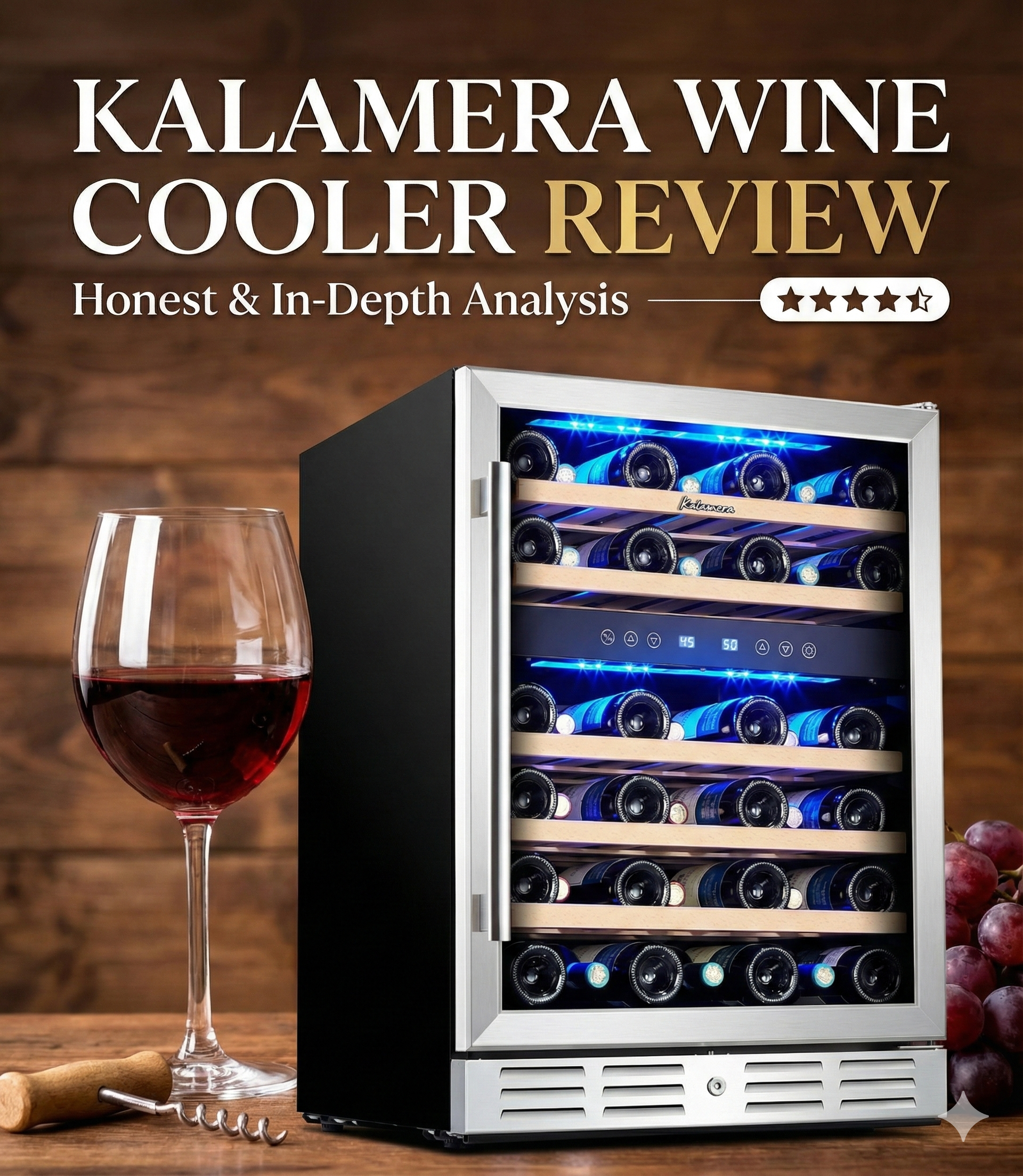
The first thing you notice about the Kalamera is the weight. It feels substantial. The door is framed in seamless stainless steel, which resists fingerprints better than cheaper models. The glass is double-paned tempered glass, which is crucial for UV protection.
Why does UV protection matter? Sunlight and even strong indoor lighting can degrade the organic compounds in wine, leading to premature aging — a condition known as “light strike.” The tinted glass on the Kalamera acts as sunglasses for your vintage Cabernet, filtering out harmful UV rays.
The Interior Glow
The unit features soft blue LED lighting. Unlike harsh white bulbs, LEDs do not emit heat, ensuring your wine isn’t “cooked” while on display. The blue tone gives a modern, high-end look that fits perfectly in a renovated kitchen or home bar. The one limitation is that you cannot change the LED color — some users would prefer warm white or amber for aesthetics, but blue has become standard on Kalamera units.
Door Seal & Gasket Quality
The magnetic door gasket on the Kalamera creates a strong seal that keeps cold air in and warm, humid ambient air out. This is critical for both temperature consistency and humidity control. Over time, you should check the gasket for cracking or gaps — this is one of the first components to wear on any wine fridge and is worth inspecting annually.
The Stainless Steel Finish
The exterior uses a brushed stainless steel finish rather than a polished mirror finish. This is a deliberate design choice — brushed stainless hides minor scratches and smudges far better than polished steel, which is essential for an appliance built into kitchen cabinetry. It also has a more modern, professional kitchen aesthetic that complements most contemporary design styles.
If you’re designing a full cellar setup, lighting is just one component. Check out our guide on wine cellar essentials for a comprehensive look at racks, climate systems, and lighting basics.
Cooling Performance: The Science
This is where the Kalamera separates itself from the competition. It uses Compressor Cooling rather than Thermoelectric cooling.
Compressor vs. Thermoelectric
Thermoelectric: Quiet and vibration-free, but weak. It can only cool about 20°F below room temperature. If your kitchen gets hot in summer (80°F), your wine will be 60°F — too warm for white wine.
Compressor (Kalamera): Powerful. It functions like a standard kitchen fridge. It can maintain 40°F even if the room is 90°F. The Kalamera also utilizes an internal fan to circulate air, ensuring the bottle at the back is the same temperature as the bottle at the front.
During testing, the temperature fluctuation was minimal (±2°F), which is excellent for this price range. This stability is critical for long-term aging. Temperature swings cause wine to expand and contract, which forces air in and out through the cork — essentially accelerating oxidation. A stable 55°F is better than a fluctuating 50–60°F cycle.
Rapid Cooling Speed
One practical benefit that reviewers rarely discuss: the Kalamera cools down fast. When fully loaded with room-temperature bottles (approximately 70°F), the unit reaches its set temperature in roughly 2–3 hours for the upper zone and 3–4 hours for the fully loaded lower zone. Compare this to thermoelectric units that can take 6–8 hours for the same task.
High Ambient Temperature Performance
The Kalamera is rated to operate in ambient temperatures up to 100°F, making it genuinely viable in garages, unconditioned home bars, or regions with hot summers. This is a specification most thermoelectric coolers simply cannot match. For a deeper comparison of how these two technologies work, read our guide on thermoelectric vs compressor cooling basics.
Noise & Vibration
The biggest complaint about compressor fridges is the noise. The “hum” can be distracting in a quiet living room. Kalamera has addressed this with specialized rubber mounts on the compressor to absorb vibration.
The Verdict: It is not silent. It emits a low hum (around 40–42 dB), similar to a quiet library or a dishwasher in the next room. Once it reaches temperature, the compressor shuts off, and it is virtually silent. Unless you are sleeping next to it, the noise is negligible.
Vibration and Wine Quality
Vibration is actually more harmful to wine than noise itself. Constant vibration agitates the wine’s molecules, speeds up chemical reactions, and disrupts the sediment that naturally forms in aging red wines. The rubber compressor mounts on the Kalamera reduce vibration transmission to the shelves significantly — far better than budget competitors where you can literally feel the bottles shake.
If you collect aged reds with heavy sediment, such as vintage Bordeaux or Barolo, minimal vibration is a non-negotiable requirement. The Kalamera delivers on this front at its price point. For context on how wine structure evolves with age, our guide on Bordeaux vs Pinot Noir structure differences explores how these wines age differently.
Shelving & Capacity Challenges
The unit claims to hold 46 bottles. Is this true? Yes, but with a caveat.
This capacity is calculated using standard 750ml Bordeaux bottles (the skinny ones). If you collect Pinot Noir, Champagne, or Syrah (which often come in wider, sloped bottles), you will lose capacity. You might only fit 30–35 of these wider bottles. This is a standard industry issue, not unique to Kalamera.
The shelves are made of beech wood, which is gentler on labels than wire racks. They slide out smoothly, though they do not extend 100%, so you may need to reach back for the last bottle. Understanding the differences between Bordeaux and Burgundy bottle shapes can help you plan capacity more accurately.
Shelf Layout Breakdown
The Kalamera 24″ model has two distinct temperature zones, each with its own set of shelves. The upper zone (cooler, for whites and sparkling) holds approximately 18 standard bottles across 3 shelves. The lower zone (warmer, for reds and robust whites) holds approximately 28 bottles across 5 shelves. This ratio is ideal for most collectors, who tend to store more red than white at any given time.
Label Protection
One underrated feature of beech wood shelves over wire shelves is label protection. Wire shelves can scratch, snag, and tear labels over time — a real problem if you collect wines you intend to gift or resell. The smooth wood slats are far gentler. They do absorb moisture slightly over years of use, but the Kalamera’s shelves are finished to resist this.
If you have a large collection that overflows the Kalamera’s capacity, our guide to modular wine rack expandable storage can help you plan for overflow bottles stored at room temperature.
Wine Temperature Guide: What to Store Where
One of the biggest advantages of a dual-zone cooler like the Kalamera is the ability to keep different wine types at their ideal serving temperatures simultaneously. But what are those ideal temperatures? Here is a complete breakdown:
| Wine Type | Serving Temp | Storage Temp | Zone |
|---|---|---|---|
| Champagne / Sparkling | 40–45°F | 40–50°F | Upper (Cold) |
| Sauvignon Blanc | 44–48°F | 40–50°F | Upper (Cold) |
| Pinot Grigio | 45–50°F | 40–50°F | Upper (Cold) |
| Chardonnay (Oaked) | 50–55°F | 50–55°F | Lower or Upper |
| Rosé | 46–52°F | 46–54°F | Upper (Cold) |
| Pinot Noir | 55–60°F | 55–60°F | Lower (Warm) |
| Merlot / Cabernet | 60–65°F | 55–65°F | Lower (Warm) |
| Syrah / Shiraz | 60–65°F | 55–65°F | Lower (Warm) |
| Long-Term Aging | N/A | 53–57°F | Lower (set low) |
The Kalamera’s dual-zone range (40–50°F upper, 50–66°F lower) covers every wine type in the table above. This is one of the reasons it earns an “Editor’s Choice” designation — the temperature range is broad enough to be genuinely useful across an entire collection.
For more on wine varietals and how serving temperature affects their flavor expression, see our comprehensive wine varietals explained guide. Also relevant: our comparison of Pinot Grigio vs Sauvignon Blanc and Merlot vs Cabernet structure can help you understand why these wines need different temperature environments.
Pro Tip: If you are aging wines long-term and don’t need daily access, set both zones to the same temperature — around 55°F — and use the Kalamera purely as a cellar, not a serving fridge. This maximizes aging conditions. When you need a bottle for dinner, move it to your kitchen fridge or an ice bucket 30 minutes before serving.
Single Zone vs Dual Zone: Why It Matters
Not all wine coolers offer dual-zone temperature control, and many buyers wonder whether the upgrade is worth it. For a casual wine drinker who mostly buys red wine, a single-zone cooler set to around 55–60°F is perfectly adequate. But for anyone who keeps both whites and reds — or who wants to serve wine at the correct temperature without any pre-chilling — dual zone is the superior choice.
Our detailed comparison article on single vs dual zone wine coolers digs into this decision in full. Here is a quick summary:
Single Zone
- One temperature throughout the entire unit
- Best for collectors who store only one type of wine (all reds, or all whites)
- Simpler compressor mechanism, sometimes quieter and less expensive to repair
- Fine for long-term aging if set to 55°F and left alone
Dual Zone (like the Kalamera)
- Two independent temperature compartments in one unit
- Store whites at 42°F and reds at 62°F simultaneously — both always ready to serve
- More complex mechanism with two separate cooling controls
- The only practical choice for mixed collections
The Kalamera’s dual-zone setup uses a single compressor with smart fan distribution, which is more reliable than designs that use two separate compressors. Two compressors mean twice the potential failure points and higher energy use.
If you’re still undecided on dual zone, check out our roundup of the best dual zone wine coolers to see how Kalamera compares against the full market.
Built-In vs Freestanding: What’s the Difference?
The Kalamera is marketed as a “built-in or freestanding” unit, but understanding what this actually means is crucial before you make a purchase decision — especially if you are planning a kitchen or home bar renovation.
What Makes a Wine Cooler “Built-In Ready”?
The critical difference is ventilation. A built-in wine cooler must vent heat from the front, because the sides and back are surrounded by cabinetry. A freestanding unit typically vents from the back or sides, which means it will overheat — and fail — if installed under a counter.
The Kalamera is front-venting through the kick-plate grill at the bottom of the unit. This means it can safely be installed flush under a counter, inside custom cabinetry, or in a kitchen island, as long as the front kick-plate area is not blocked.
Freestanding Use
When used as a freestanding unit — say, in a dining room, home bar, or office — the Kalamera works equally well. The front-venting design actually makes freestanding use slightly less efficient than back-venting competitors in this mode, because back-venting dissipates heat more rapidly in open air. However, the difference in energy use and cooling speed is minimal in practice.
Undercounter Installation Tips
When installing the Kalamera under a counter:
- Measure your opening carefully — minimum 24″ width is required for the 23.4″ unit to fit without damaging the door swing
- Ensure the kick-plate area (bottom 4″) is not blocked by cabinetry, flooring, or baseboard trim
- Level the unit from front to back — an unlevel cooler causes the door to swing open or closed on its own
- Use the adjustable feet to compensate for any floor unevenness
- If installing trim panels to match kitchen cabinetry, do not block the vent grill
Wine Fridge vs Regular Fridge: A Direct Comparison
This is one of the most frequently searched questions by first-time wine fridge buyers: why can’t I just use my regular refrigerator? We touched on this earlier, but let’s go into more depth with a direct feature comparison.
| Feature | Kalamera Wine Fridge | Standard Kitchen Fridge |
|---|---|---|
| Temperature Range | 40–66°F (wine-specific) | 34–38°F (too cold for wine) |
| Temperature Stability | ±2°F (excellent) | ±5–8°F (door cycles) |
| Humidity Control | 50–70% (passive humidifier) | 15–35% (too dry) |
| Vibration | Low (rubber-mounted compressor) | High (standard compressor) |
| UV Protection | Yes (double-pane tinted glass) | None (opaque door) |
| Bottle Orientation | Horizontal (correct for cork) | Upright (wrong for cork) |
| Odor Contamination | None (wine only) | High risk (food odors) |
| Serving Temperature | Always at serving temp | Too cold — needs warming |
The differences are stark. A regular fridge is not just suboptimal — it actively harms wine stored for more than a few days. For more detail, read our full wine fridge vs regular fridge breakdown.
Humidity, Cork Health & Long-Term Wine Aging
The Kalamera does not have active humidity control — a feature only found on true cellar systems costing $2,000+. Instead, it ships with a small plastic water reservoir that sits inside the unit and passively evaporates moisture into the air. This is sufficient in most climates to maintain adequate cork health for collections stored 1–5 years.
Why Humidity Matters for Corks
Natural cork is a living material — technically the bark of the cork oak tree. It requires moisture to stay flexible and maintain an airtight seal. When corks dry out, they shrink, develop micro-cracks, and allow oxygen to seep in. Even a tiny amount of oxygen ingress will oxidize wine over months and years, turning a vibrant Cabernet into something resembling sherry-scented vinegar.
The ideal humidity for wine storage is between 55–75%. Below 50%, corks begin to dry out. Above 75%, you risk mold growth on labels and corks. The Kalamera’s passive humidifier, combined with the sealed door, typically maintains 55–65% humidity in normal conditions — perfectly within the safe zone.
Optimizing for Long-Term Aging
If you are using the Kalamera specifically for aging fine wines (3–10+ years), here are additional steps to optimize conditions:
- Keep it full: More bottles means more thermal mass, which buffers against temperature swings when the door is opened. A half-empty cooler is harder to keep stable.
- Minimize door openings: Every opening introduces warm, dry ambient air. Ideally, designate specific “access” bottles in an accessible spot so you aren’t moving long-term storage bottles.
- Set the temperature and leave it: Constant adjustments create instability. Set it once and resist the urge to change it.
- Store horizontally: The Kalamera’s shelves are designed for horizontal storage — this keeps the cork moist from the inside.
- Refill the water box: Check it monthly and refill as needed, especially in air-conditioned homes where ambient humidity is low.
Energy Efficiency: What Does It Cost to Run?
A question many buyers overlook: what does a wine fridge actually cost to run monthly? The Kalamera is rated at approximately 90–100 watts when the compressor is actively running. However, because the compressor cycles on and off to maintain temperature, average real-world power draw is closer to 25–35 watts continuous equivalent.
At the average US electricity rate of approximately $0.16 per kWh (2026), the Kalamera costs roughly $3–5 per month to run at typical conditions. In a hot garage or unconditioned space where the compressor runs more frequently, this could rise to $6–8 per month. This is comparable to running a small desk lamp continuously — hardly a significant operating cost.
Energy-Saving Tips
- Install in a temperature-stable location (avoid garages that heat to 100°F+ in summer)
- Keep the door seal clean and intact — a leaky seal wastes significant energy
- Keep the unit full — thermal mass reduces how often the compressor cycles on
- Avoid placing the unit next to an oven, dishwasher, or in direct sunlight
If environmental responsibility is a priority in your wine lifestyle, check out our guide to eco-friendly wine storage solutions and how to minimize your cellar’s footprint.
The Built-In Lock: Security and Peace of Mind
The Kalamera includes a key lock on the door — a feature that sounds simple but is genuinely useful in several real-world scenarios. Many wine fridges at this price point omit this feature entirely, or offer it as a paid upgrade.
Who Benefits From the Lock?
- Households with teenagers: An obvious use case. The lock prevents unauthorized access to your collection without creating a confrontation.
- Hosts with expensive bottles: If you regularly entertain, a locked cooler lets you keep everyday wines accessible while protecting special bottles.
- Home offices and shared spaces: If the cooler is in a shared or semi-public area, a lock prevents guests from helping themselves.
- Investment collectors: Fine wines are literally liquid assets. A $200 bottle should have at least basic physical security.
Two keys are included in the box. We recommend keeping a spare somewhere safe immediately after unboxing — the lock mechanism is solid, and being locked out of your own wine collection is a frustrating and avoidable problem.
If a lock is a non-negotiable feature for you, our dedicated roundup of best wine fridges with lock compares all available options at every price point.
Maintenance, Cleaning & Long-Term Care
A wine cooler is a long-term investment. The Kalamera, with proper care, should last 8–12 years with minimal issues. Here is a complete maintenance guide to get the most out of your unit.
Monthly Tasks
- Check and refill the passive humidity water box
- Wipe down the door gasket with a damp cloth to remove dust buildup
- Check that nothing is blocking the front kick-plate vent
Every 6 Months
- Remove all bottles and wipe down the interior with a mild solution of warm water and white vinegar (avoid harsh chemical cleaners — fumes can permeate and affect wine)
- Slide out beech wood shelves and wipe them clean
- Check the door gasket for cracking, hardening, or gaps
- Vacuum or blow out dust from the vent grill area — dust accumulation reduces cooling efficiency
Annual Inspection
- Check the door seal using the “dollar bill test” — close the door on a dollar bill and try to pull it out. It should offer resistance. If it slides freely, the gasket needs replacement.
- Check the compressor area for unusual sounds (clicking, grinding) which can indicate early component wear
- Confirm temperature accuracy with an independent thermometer placed inside the unit for 24 hours
Never use bleach or ammonia-based cleaners inside a wine cooler. Chemical fumes can penetrate the rubber seals and taint wine through the cork. White vinegar solution or specialized appliance cleaners are safe choices.
Who Is This Wine Cooler For? (And Who Isn’t It For?)
No product is right for everyone. Here is an honest assessment of who will love the Kalamera — and who should look elsewhere.
✓ Buy This If You Are…
- A serious home collector with 20–50 bottles
- Someone who stores both red and white wine
- Planning a kitchen renovation with undercounter space
- Willing to spend $700–900 for a long-term investment
- Located in a warm climate where thermoelectric units fail
- Interested in aging wine 1–5+ years
- Wanting a locking unit for a shared household
✗ Look Elsewhere If You Are…
- Buying wine only to drink within a week
- On a tight budget (under $400) — see alternatives below
- Collecting only Champagne or bottles over 750ml
- Needing more than 46 bottles in one unit
- Wanting a completely silent unit (for a bedroom, for example)
- Looking for active humidity control for 10+ year aging
- True Dual Zone: Keep whites at 40°F and reds at 60°F simultaneously.
- Front Venting: Can be built into cabinetry without overheating.
- Quiet Operation: Low vibration compressor dampening.
- Memory Function: Remembers temperature settings after a power outage.
- Security Lock: Keeps kids (or thirsty teenagers) out.
- UV-Protected Glass: Double-pane tinted glass protects wine from light damage.
- Broad Temp Range: 40–66°F covers every wine type from sparkling to full reds.
- Beech Wood Shelves: Gentler on labels than wire racks.
- High Ambient Rating: Operates up to 100°F ambient — ideal for garages and warm climates.
- Passive Humidity: Water box helps maintain cork health.
- Tight Shelving: Pinot Noir/Champagne bottles reduce capacity significantly.
- Blue Light Only: You cannot switch the LED color to white or amber.
- Handle Install: Requires pulling back the door seal to install screws (can be tricky).
- 1-Year Warranty Only: Competitors like Wine Enthusiast offer 3 years on parts.
- No Active Humidity: Passive water box only — not suitable for 10+ year aging without supplementation.
- Not Truly Silent: 40–42 dB hum may bother light sleepers if placed in a bedroom.
Kalamera vs. The Competition
How does it stack up against other popular brands? We compared the 24″ dual zone models across the most important buying criteria.
| Feature | Kalamera 24″ | NewAir 24″ | Wine Enthusiast 24″ | Whynter 24″ | Vinotemp 24″ |
|---|---|---|---|---|---|
| Price | $$ Mid-Range | $$ Mid-Range | $$$ Premium | $$ Mid-Range | $$$ Premium |
| Cooling Type | Compressor | Compressor | Compressor | Compressor | Compressor |
| Zones | Dual | Dual | Dual | Dual | Dual |
| Shelves | Beech Wood (Slatted) | Beech Wood (Solid) | Wire/Metal | Beech Wood | Chrome Wire |
| Noise | Low (~41 dB) | Medium (~45 dB) | Low (~40 dB) | Medium | Low |
| Built-In Ready | Yes | Yes | Yes | Yes | Yes |
| Door Lock | Yes | No | No | No | Yes |
| Warranty | 1 Year | 1 Year | 1 Yr (3 on parts) | 1 Year | 1 Year |
| Value Score | 9.5/10 | 8/10 | 7/10 | 7.5/10 | 6.5/10 |
Takeaway: The Kalamera offers similar performance to the Wine Enthusiast and Vinotemp models but at a significantly lower price point — and it adds a door lock that most competitors at this tier omit. The NewAir is its closest competitor; read our NewAir Wine Cooler review to see if its different shelf design suits your collection better. For a deeper look at alternatives, check our reviews of the Wine Enthusiast cooler, Whynter wine cooler, Vinotemp wine cooler, and Ivation wine cooler.
Budget Alternatives: What If the Kalamera Is Out of Your Range?
The Kalamera is exceptional value for its category, but at $700–900, it is not an impulse purchase. If you need a wine storage solution at a lower price point, here are honest alternatives worth considering.
Under $400: Thermoelectric Options
If your kitchen stays below 75°F year-round and you mainly store whites and light reds, a thermoelectric cooler can work. The trade-off is that they cannot cool as powerfully, they struggle in warm environments, and they typically have smaller capacity. Our roundup of best wine coolers under $500 covers the best thermoelectric options honestly.
$400–$600: Entry-Level Compressor Units
This bracket includes single-zone compressor fridges with basic features. They lack dual-zone control and premium finishing, but they cool reliably. If you primarily store reds and don’t need white wine served chilled, this can be a pragmatic choice.
Non-Appliance Storage
For budget-conscious wine lovers, a modular wine rack in a cool basement corner — combined with proper knowledge from our wine storage without a fridge guide — can protect a collection adequately for short-to-medium term storage. Also see our selection of affordable wine picks for 2026 — if you’re buying budget-friendly bottles, a budget-friendly storage solution may be entirely appropriate.
Installation Guide: Built-In vs. Freestanding
The Kalamera is a front-venting unit. This is a critical feature. Cheap fridges vent from the back, meaning if you shove them under a counter, they overheat and die. The Kalamera pushes hot air out through the kick-plate grill at the bottom front.
Built-In Requirements
- Width: The unit is 23.4″ wide. Leave at least 24″ of space for the opening.
- Depth: It is 22.4″ deep (excluding handle). Standard counters are 24″, so it sits flush beautifully.
- Clearance: Even with front venting, leave 1/4″ on sides just to be safe for door swing clearance.
- Electrical: Requires a standard 120V/60Hz grounded outlet. Do not use an extension cord — run a dedicated outlet if needed.
- Leveling: Use a spirit level and adjust the four feet before pushing the unit fully into place.
Step-by-Step Built-In Installation
- Measure your opening width, height, and depth before ordering. Confirm 24″ minimum width and 34.5″ minimum height.
- Run a dedicated electrical outlet if one is not already present in the cabinet space. Hire a licensed electrician if needed.
- Assemble the door handle before inserting the unit into the space — it is much easier to access the screw points when the unit is on the floor.
- Slide the unit partially into position. Check that the front vent grill (kick-plate area) is not obstructed by cabinetry or flooring.
- Use adjustable feet to level the unit. Check with a spirit level both front-to-back and side-to-side.
- Plug in the unit and allow it to run empty for 2–4 hours before loading bottles, to confirm it reaches temperature correctly.
- Load bottles from back to front — this prevents you from having to reach over bottles to fill the back shelves.
The door hinge is reversible, but switching it requires some tools and patience. We recommend deciding which way you want it to open before you install the handle.
Accessories That Work Best With This Cooler
Owning a great wine cooler is just the beginning. The right accessories elevate every bottle you pull from it. Here are the accessories that pair best with a collection stored in the Kalamera.
A Wine Thermometer
Even with the Kalamera’s digital readout, we strongly recommend an independent analog or digital wine thermometer placed inside the unit. This verifies that the displayed temperature matches the actual bottle temperature — a discrepancy is rare but possible after years of use. Read more on why a wine thermometer is your most important tool.
A Quality Corkscrew or Opener
The bottle you pull from the Kalamera deserves a proper opening experience. A waiter’s corkscrew is the gold standard for reliability and elegance. See our picks for the best waiters corkscrew 2026 and our top-rated wine bottle openers roundup. If you prefer electric, our comparison of electric vs manual wine openers covers both sides fairly.
A Decanter
Wines stored at cellar temperature in the Kalamera — especially young reds — benefit significantly from decanting before serving. The process aerates the wine and allows volatile compounds to dissipate. Our guide on decanting wine explains when and how to decant, and our top-rated wine decanters roundup has options at every budget. For help choosing the right shape, see our wine decanter comparison by shape, capacity, and material.
Wine Glasses
Serving wine at the right temperature (which the Kalamera ensures) is only half the equation — the right glass shape opens up the wine’s aromatics and flavors. Our top red wine glass picks and guide to kinds of wine glasses and their uses will help you match glass to bottle.
A Wine Preserver
When you open a bottle from the Kalamera and don’t finish it, a quality wine preserver extends its life by days or even weeks. Our reviews of the top-rated wine preservers and the head-to-head Coravin vs Vacu-Vin comparison will guide your choice. Also see our dedicated best wine stoppers guide for simpler sealing solutions.
Wine Chiller Sleeve
For whites and rosés that need a quick chill boost at the table, a wine chiller sleeve is a practical companion to the Kalamera. Our picks for the best wine chiller sleeves and top-rated wine chillers will keep your bottles at serving temperature through dinner.
Final Verdict: Is The Kalamera 24″ Worth It?
After thorough testing and research, the Kalamera 24-inch Dual Zone Wine Cooler earns its Editor’s Choice designation for 2026 with conviction. It is not a perfect product — the single-year warranty, passive-only humidity system, and reduced capacity for oversized bottles are legitimate drawbacks. But in the $700–900 price bracket, nothing matches its combination of compressor power, dual-zone range, front-venting built-in capability, beech wood shelves, and door lock.
For the serious home collector who wants to do right by their wine without spending $2,000 on a true cellar unit, the Kalamera is the answer. It is the wine fridge that experienced enthusiasts point casual buyers toward — not because it is the cheapest, but because it is the one that actually works, long-term, without compromises that matter.
If you are new to wine collecting and want to understand more about what makes wines worth storing and aging, our wine glossary for beginners and wine terminology guide are excellent starting points. Understanding what you’re storing helps you appreciate why the storage environment matters so much.
Ready to Buy the Kalamera 24″?
Check the latest pricing on Amazon — prices fluctuate and deals appear regularly. This is a long-term investment that pays dividends in every bottle you open at the right temperature.
Check Latest Price on Amazon →Frequently Asked Questions
Yes, but be aware of the shelving. The slats are designed for wine bottles. Cans will sit unevenly unless you place them carefully. Also, the coldest setting is usually 40°F, which is cold enough for beer, but not “ice cold” like a beverage fridge (34°F).
The cord is approximately 5 to 6 feet long. The plug is a standard 3-prong US plug. Do not use an extension cord for long-term use — run a proper outlet if your installation space doesn’t have one nearby.
It does not have an active humidifier (few fridges under $2,000 do). However, it comes with a small water box you can fill to passively increase humidity if you live in a very dry climate. This is sufficient for most collectors storing wine up to 5 years.
Yes, the door is reversible. The unit comes with the necessary hinge brackets to swap it from right-opening to left-opening. Plan this before installing the handle, as access to the hinge screws is easier before the handle is attached.
The Kalamera has a memory function that restores your temperature settings automatically when power returns. Your wine is safe during a brief outage — a fully loaded cooler maintains safe temperatures for 4–6 hours without power, thanks to the thermal mass of the bottles themselves.
Yes, the upper zone cools to 40°F, which is ideal for Champagne storage and service. However, standard Champagne bottles are wider than Bordeaux bottles, so expect reduced capacity in the upper zone — around 10–14 bottles instead of 18. See our article on Champagne flute vs coupe for more on serving bubbly correctly after you retrieve it from the cooler.
The Antarctic Star is a lower-priced alternative. It uses similar compressor technology but has a simpler interior finish, less precise temperature control, and no door lock. Our Antarctic Star brand review covers its quality and reliability in detail. The Kalamera is worth the price premium for serious collectors.
For long-term aging, 53–57°F is the sweet spot. Set the lower zone to 55°F and leave it there. This temperature slows oxidation and allows complex flavor development without stopping it entirely. If you want both aging and serving from the same unit, a compromise of 58–60°F is practical — still beneficial for aging, warm enough to serve without a long wait. Our wine vintage guide has more on how different reds age.
Yes — the Kalamera is rated for ambient temperatures up to 100°F, making it one of the few fridges in this price range that is genuinely garage-safe. In extreme heat, the compressor will run more frequently and energy use will increase, but the unit will maintain its set temperature. Avoid locations with direct sunlight hitting the unit.
Signs include a “corked” smell (musty, like wet cardboard) when you open the bottle, or a vinegar-like sharpness. Read our wine corked detection guide for how to identify spoiled wine confidently. If stored correctly in the Kalamera, wine spoilage should be rare and always a result of the wine itself rather than your storage conditions.
A great question — a 46-bottle cooler gives you room to curate a proper collection. Our 2026 wine subscription evaluation compares the major services by value, curation quality, and delivery flexibility. Pairing a subscription with the Kalamera is one of the most enjoyable ways to build a collection systematically.