Residual Sugar in Wine: The Complete Guide to Sweetness, Dryness & Everything In Between
What RS actually means, why your “dry” wine might surprise you, and how sugar levels shape every sip — explained without the chemistry degree.
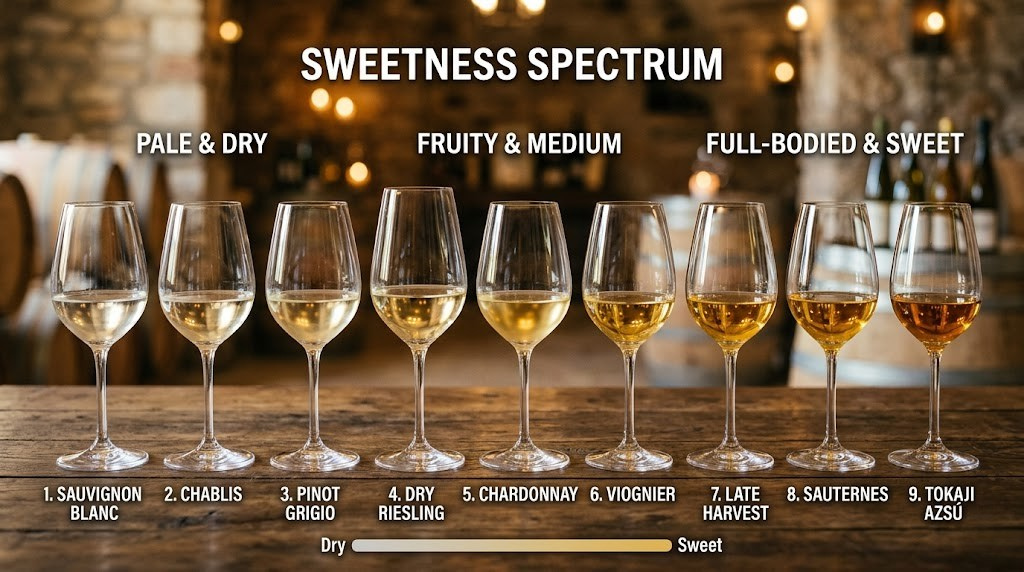
Pick up almost any bottle of wine and you’ll see the word “dry” somewhere — on the label, in the tasting notes, from the sommelier’s lips. Yet that supposedly dry Chardonnay somehow tastes soft and a little lush. That “bone dry” Riesling has an almost honeyed finish. What’s going on?
The answer almost always comes down to residual sugar — one of the most important, least understood variables in wine. Understanding it doesn’t require a chemistry degree. But it does require a willingness to look past the marketing language and into the actual numbers that shape what’s in your glass.
This guide covers everything: what residual sugar is, how it gets there, how to find it on a label (when it’s disclosed at all), why you might be tasting sweetness you didn’t expect, which wines have the most and least, and how sugar interacts with acidity, alcohol, and tannin to create the total sensory experience of every bottle you open. By the end, you’ll be a significantly more informed buyer — and a more perceptive taster.
1. What Is Residual Sugar in Wine?
Residual sugar (commonly abbreviated as RS) is the sugar that remains in a finished wine after fermentation is complete. During fermentation, yeast converts the natural grape sugars — primarily glucose and fructose — into alcohol and carbon dioxide. In a perfectly complete fermentation, all sugar would be consumed and the resulting wine would contain zero residual sugar. In practice, this rarely happens perfectly, and in many wine styles it’s deliberately prevented.
RS is measured in grams per liter (g/L) or, less commonly, as a percentage. A wine with 2 g/L of RS is considered essentially dry; a wine with 200 g/L is extraordinarily sweet — think Tokaji Eszencia or a late-harvest German Trockenbeerenauslese. The range between those extremes is where most of the world’s interesting wines live.
The Two Types of Sugar in Grapes
Grape berries contain two primary fermentable sugars: glucose and fructose, typically in roughly equal proportions at harvest. As fermentation proceeds, yeast preferentially consumes glucose first, then fructose. This matters because fructose is sweeter than glucose on the palate — approximately 1.7 times sweeter by perception. This means a wine with 10 g/L of mostly-fructose RS will often taste sweeter than a wine with 10 g/L of glucose-dominant RS. It’s one reason RS numbers alone don’t tell the complete sweetness story.
Residual sugar = the total fermentable and non-fermentable sugars remaining in wine after fermentation, measured in grams per liter (g/L). In the EU, wines labeled “dry” must contain fewer than 4 g/L RS (or up to 9 g/L if the acidity is within 2 g/L of the RS). In the USA, there is currently no federal requirement to disclose RS on wine labels at all.
What Sugar Actually Tastes Like in Wine
Sugar in wine contributes more than just sweetness. At lower levels (under about 5 g/L), RS contributes body and texture — a sense of roundness or weight on the mid-palate — without registering as distinctly “sweet.” This is why many wines that are technically dry feel richer and more generous than their zero-sugar counterparts. At higher levels (above 10–15 g/L), sweetness becomes perceptible as a distinct flavor. Above 45 g/L, wines are unmistakably, identifiably sweet.
Understanding this texture-vs-sweetness distinction is essential for understanding why so many wine descriptions seem to contradict each other. A wine can be “technically dry” and “richly textured” simultaneously — and both descriptions are accurate.
Wine Tasting Journal — Track Sweetness & RS Notes
Record tasting impressions including sweetness perception, RS data, and flavor profiles across every bottle you try.
Shop Wine Journals on Amazon →2. How Residual Sugar Forms During Fermentation
To understand why some wines have RS and others don’t, you need to understand what controls fermentation — and what can interrupt or intentionally stop it. This isn’t esoteric chemistry; it’s the practical reason why a Moscato d’Asti is sweet and a Brut Champagne is dry even though both start from the same biological process.
The Natural Fermentation Process
Yeast (primarily Saccharomyces cerevisiae) feeds on sugar and produces alcohol and CO₂ as byproducts. As alcohol levels rise, the yeast environment becomes increasingly hostile — most yeast strains die or become inactive once alcohol reaches approximately 15–16% ABV. If a wine’s starting sugar is high enough that the yeast can’t consume all of it before dying from their own alcohol output, the remaining sugar stays in the wine as natural RS.
This is exactly what happens in late-harvest wines and dessert wines made from botrytized grapes (affected by Botrytis cinerea, or noble rot) or frozen grapes (Eiswein/Ice wine). The initial sugar concentration is so extreme that fermentation becomes impossible to complete.
Deliberate Interruption: Stopping Fermentation Early
In many wine styles, fermentation is deliberately halted before completion to preserve desired RS levels. This is standard practice for:
- German Riesling in Spätlese, Auslese, Beerenauslese, and TBA styles — fermentation is stopped by refrigeration or by adding sulfur dioxide, preserving natural grape sweetness
- Port wine — fermentation is stopped by the addition of grape spirit (fortification), which raises alcohol to ~20% and kills the yeast instantly, preserving up to 100 g/L or more of RS
- Demi-sec and doux Champagne — dosage (a sugar and wine mixture) is added after disgorgement, adjusting final RS after fermentation is complete
- Moscato d’Asti — fermentation is stopped at very low alcohol (~5.5% ABV) using refrigeration, preserving abundant natural sweetness
Accidental Residual Sugar: Stuck Fermentation
Not all RS is intentional. Stuck fermentation — when yeast prematurely stops fermenting before all sugar is consumed — can leave unintended RS in a wine. This happens due to nutrient deficiencies, temperature extremes, or pH problems. Stuck fermentation is considered a winemaking fault because it leaves unpredictable amounts of sugar that the winemaker didn’t intend. The resulting wines can be unstable and prone to refermentation in the bottle — creating unwanted bubbles and bottle failure.
This is distinct from intentional RS management, where the winemaker has precise control over the final sugar level. The difference between a great Spätlese and a flawed table wine is often exactly this: intentional precision vs. accidental imbalance.
These pathways have different effects on wine character beyond just sweetness. Natural high-RS wines from botrytized grapes carry the complex aromatics of noble rot — saffron, marmalade, ginger. Deliberately stopped fermentations in Riesling preserve the vivid, pure fruit character of the grape. Post-fermentation sugar addition can sometimes feel less integrated. Understanding which pathway produced the RS in a specific wine adds another layer of appreciation to what’s in your glass.
3. RS Levels: From Bone Dry to Lusciously Sweet
The wine industry uses a sweetness spectrum to categorize wines, though the precise thresholds vary by country and regulatory body. Here’s the universal framework — the one that allows you to place any wine on the sweetness map before you open it.
No perceptible sweetness. Crisp, clean finish. Most table wines aim here.
Slight hint of sweetness. Often described as “just a touch” or “round.”
Clearly sweet. Balances richness with acidity. Riesling Auslese territory.
Unmistakably sweet. Sauternes, Tokaji, late harvest wines.
Extraordinary concentration. TBA, Eiswein, Tokaji Eszencia.
EU vs. USA Labeling Thresholds
| Term | EU Legal Threshold (g/L RS) | US Practice (g/L RS) | Perceived Sweetness |
|---|---|---|---|
| Dry / Trocken | <4 g/L (up to 9 if acidity compensates) | No legal definition; typically <10 | No sweetness perceived |
| Off-Dry / Halbtrocken | 4–12 g/L | ~5–15 g/L in practice | Barely perceptible hint |
| Medium / Lieblich | 12–45 g/L | ~15–50 g/L | Clearly noticeable sweetness |
| Sweet / Süss | >45 g/L | >50 g/L | Dominant sweetness |
| Brut (Champagne/sparkling) | <12 g/L | <12 g/L | Dry to very slightly sweet |
| Extra Brut (sparkling) | <6 g/L | <6 g/L | Bone dry, austere |
| Demi-Sec (sparkling) | 32–50 g/L | ~35–50 g/L | Noticeably sweet |
| Doux (sparkling) | >50 g/L | >50 g/L | Very sweet |
Understanding these thresholds becomes especially important when exploring German wine classifications, where the sweetness spectrum runs from Trocken (bone dry) through Kabinett, Spätlese, Auslese, Beerenauslese, and Trockenbeerenauslese. Each step represents a significant RS increase tied to the ripeness of the grapes at harvest — a key concept in the wine vintage guide, since great harvest conditions directly determine how much natural sugar the grapes develop.
4. Why “Dry” Wines Can Taste Sweet — The Acidity-Sugar Paradox
Here is one of wine’s most fundamental and under-explained realities: a wine’s perceived sweetness is not the same as its actual residual sugar. The total sensory impression of sweetness — what your brain registers when you taste — is the result of a complex interaction between RS, acidity, alcohol, tannin, and oak character. You can have technically dry wine that tastes sweet, and technically off-dry wine that tastes dry.
How Acidity Suppresses Perceived Sweetness
This is the most important factor. High acidity counterbalances and suppresses the perception of sweetness. A German Riesling Spätlese with 30 g/L of RS and 9 g/L of total acidity can taste drier and crisper than a California Chardonnay with 3 g/L of RS and only 5 g/L of acidity — because the Chardonnay’s low acid lets the residual sugar taste rich and round, while the Riesling’s high acid cuts right through the sweetness.
This is why German winemakers have always understood that acidity and RS are not opposites to be traded off but partners to be balanced. The Riesling grape’s naturally high acidity is precisely what allows German wine to carry substantial RS while still tasting fresh and vivid rather than cloying. Our comparison of Pinot Grigio vs. Sauvignon Blanc acidity illustrates how dramatically acidity varies even across dry white wines.
Alcohol’s Role in Sweetness Perception
Alcohol also contributes to perceived sweetness. Higher-alcohol wines (13.5%+) often taste fuller, richer, and slightly sweeter on the palate even when technically dry. This is why powerful New World reds — Napa Cabernet at 15% ABV, Barossa Shiraz at 15.5% — can seem lush and generous compared to their Old World counterparts at 12.5–13%, even when RS levels are similar or identical. Understanding how ABV appears on wine labels gives you another data point for predicting a wine’s flavor profile.
Oak and Vanilla: The Sweetness Illusion
New oak barrels impart vanilla, caramel, coconut, and toast flavors that our brains associate with sweetness — even in the absence of actual sugar. A wine with 2 g/L of RS aged in 100% new French oak can taste considerably “sweeter” than a wine with 6 g/L of RS aged in neutral vessels, purely because the oak-derived aromas trigger sweetness associations. This is one of the reasons oaked white wines — particularly California Chardonnay and certain Australian styles — are often perceived as sweeter than their actual RS would suggest.
“Sweetness in wine is a dialogue between what the chemistry says and what the brain hears. They’re rarely speaking the same language.” — Common observation among sensory scientists in enology programs
Tannin: The Counter to Sweetness
For red wines, tannin acts as a counterbalancing force to sweetness perception. High tannin levels create dryness and astringency on the palate that can mask RS. This is part of why dry tannic reds — young Barolo, structured Bordeaux — feel so austere even when they technically contain the same RS as a softer, lower-tannin wine. Understanding what tannins do in wine is essential context for understanding how sweetness perception works in red wines specifically.
5. Residual Sugar by Wine Type & Region
Every major wine category has a characteristic RS range — though individual bottles within any category can vary significantly. Here’s a comprehensive breakdown of where different wines fall on the sweetness spectrum, with specific RS data where available.
Still White Wines
Sparkling Wines
| Sparkling Style | RS Range (g/L) | Taste Profile | Examples |
|---|---|---|---|
| Brut Nature / Zero Dosage | 0–3 g/L | Austere, precise, mineral-driven | Jacques Selosse, Billecart-Salmon BdB |
| Extra Brut | 0–6 g/L | Bone dry, nervy, high acidity | Many grower Champagnes |
| Brut (most common) | 0–12 g/L | Dry with subtle richness | Moët Brut Imperial, Veuve Clicquot Yellow |
| Extra Dry / Extra Sec | 12–17 g/L | Counterintuitively, slightly sweeter than Brut | Many Prosecco styles |
| Sec / Dry | 17–32 g/L | Noticeably sweet | Less common; food pairing style |
| Demi-Sec | 32–50 g/L | Clearly sweet; dessert style | Moët Nectar Impérial |
| Doux | >50 g/L | Very sweet; rare | Some Moscato styles |
| Moscato d’Asti | 80–120 g/L | Very sweet, low alcohol (~5.5%) | Saracco, Ceretto |
The counterintuitive naming in sparkling wine labels trips up almost everyone at first. “Extra Dry” Prosecco is actually sweeter than “Brut” Champagne. “Dry” sparkling wine is noticeably sweet. This naming convention evolved for historical reasons that no longer make practical sense — which is why we have a dedicated explainer on the differences between Prosecco and Champagne that covers dosage and sweetness conventions in detail.
Red Wines
Most red wines fall in the 0–4 g/L range and are technically dry. However, several categories carry more RS than consumers typically realize:
| Red Wine Style | Typical RS (g/L) | Why RS Varies |
|---|---|---|
| Barolo / Barbaresco | 0–3 g/L | Fully fermented; tannin dominates; bone dry |
| Bordeaux (classified) | 1–4 g/L | Dry; ripeness adds body not sweetness |
| Pinot Noir (Burgundy) | 1–3 g/L | Dry; fruit-forward illusion from fragrant esters |
| California Zinfandel | 3–15 g/L | High RS common; jammy, high alcohol style |
| Malbec (Mendoza) | 2–6 g/L | Rich fruity character; often small RS contribution |
| Lambrusco (sweet styles) | 40–80 g/L | Deliberately sweet; amabile and dolce styles |
| Ruby Port | 80–120 g/L | Fortified; fermentation stopped early by brandy |
| Tawny Port (20yr) | 90–130 g/L | Fortified; oxidative aging concentrates RS |
California Zinfandel is worth special attention. Many mass-market Zinfandels contain 8–15 g/L of RS — enough to be genuinely off-dry — without any disclosure on the label. Consumers buying these wines as “dry red wines” are often surprised by the palpable sweetness, which some love and others find off-putting. This is one of the clearest examples of why knowing how to look for RS data matters when you’re building your palate literacy. A starting point for building that vocabulary is our wine tasting vocabulary guide.
Dessert & Fortified Wines
| Wine | RS Range (g/L) | How Sweetness Is Achieved |
|---|---|---|
| Sauternes | 100–200 g/L | Noble rot concentrates sugar; natural fermentation limit |
| Tokaji Aszú 5 Puttonyos | 120–200 g/L | Noble rot; concentrated aszú berries pressed into base wine |
| German TBA (Trockenbeerenauslese) | 150–400 g/L | Individually selected botrytized dried berries; extreme concentration |
| Eiswein (Ice Wine) | 150–350 g/L | Grapes freeze-concentrated; pressed while frozen |
| Vintage Port | 80–120 g/L | Fermentation stopped by brandy addition at ~6–8% natural alcohol |
| Pedro Ximénez Sherry | 300–500 g/L | Sun-dried grapes; extraordinarily concentrated; almost syrup |

Wine Folly: Magnum Edition — Visual Wine Education
The best visual guide to understanding wine styles, sweetness levels, and regional differences. Perfect for anyone building their wine knowledge.
Shop on Amazon →6. Finding Residual Sugar on Wine Labels
Here’s an uncomfortable truth: in most countries, including the United States, winemakers are not required to disclose residual sugar on wine labels. You can read an American wine label from front to back and find no RS information whatsoever. This is a significant gap in consumer information — particularly given how much RS varies within categories labeled identically as “dry.”
Where RS IS Disclosed by Law
The European Union has the most transparent RS labeling requirements. EU wines sold within the EU must display a sweetness descriptor if they are still wines claiming a category beyond “wine” (i.e., PDO and PGI wines). Sparkling wines sold in the EU must always show their sweetness category (Brut Nature, Extra Brut, Brut, Extra Dry, Sec, Demi-Sec, Doux). Germany has perhaps the most precise system, where Prädikat designations (Kabinett through Trockenbeerenauslese) correlate directly with minimum ripeness levels at harvest, giving you a predictable RS range for each tier.
For a full breakdown of what every element on a wine label means and where to find the useful information, our guide on how to read wine labels is the most comprehensive reference available.
Where to Find RS Information When It’s Not on the Label
When RS isn’t disclosed (which is most of the time for American wines), you have several reliable options:
- Winery website: Many quality-focused producers publish full technical sheets including RS, pH, total acidity, and alcohol. Look for a “tech sheet” or “technical data” section.
- Wine apps: Vivino, CellarTracker, and Wine-Searcher often include RS data sourced from technical sheets or user notes. Some entries are incomplete, but for popular wines the data is usually available.
- Critic tasting notes: Professional critics often note sweetness level even when the label doesn’t — phrases like “just a whisper of sweetness,” “bone dry finish,” or “racy and off-dry” are calibrated RS signals from experienced palates.
- Retailer staff: A knowledgeable wine shop can often tell you the RS of a wine they carry, especially if they’ve requested tech sheets from importers.
Decoding Sparkling Wine Labels
7. Residual Sugar, Calories & Health Considerations
For health-conscious wine drinkers, RS is more than a taste question — it’s a calorie and blood sugar question. Sugar is caloric, and the RS in wine adds to a bottle’s total caloric load beyond what comes from alcohol alone. Understanding this helps you make more informed choices without giving up wine entirely.
How RS Adds Calories to Wine
Each gram of sugar contributes approximately 4 calories. So:
| Wine Style | RS (g/L) | Sugar Calories per 5oz Glass (~148ml) | Alcohol Calories (est.) | Total Approx. Calories |
|---|---|---|---|---|
| Bone Dry White | 0–2 g/L | ~0–1 cal | ~100–110 cal | ~100–111 cal |
| Brut Champagne | ~9 g/L | ~5 cal | ~90 cal | ~95 cal |
| Off-Dry Riesling | ~20 g/L | ~12 cal | ~80 cal | ~92 cal |
| Demi-Sec Champagne | ~40 g/L | ~24 cal | ~90 cal | ~114 cal |
| Sauternes | ~130 g/L | ~77 cal | ~110 cal | ~187 cal |
| Vintage Port (3oz pour) | ~100 g/L | ~44 cal | ~140 cal (20% ABV) | ~184 cal |
The key insight from this table: for most dry to off-dry wines, the sugar contribution to total calories is relatively small — alcohol dominates. The bigger caloric jump comes from very sweet dessert wines where both RS and alcohol are high. If you’re managing caloric intake, the practical advice is to choose drier styles and be moderate with dessert wines, rather than obsessing over RS differences within the dry to off-dry range.
RS and Glycemic Impact
For those managing blood sugar — whether due to diabetes, pre-diabetes, or metabolic health awareness — RS is more consequential than for the general population. Even the relatively small amounts of sugar in off-dry wines (20–30 g/L) represent meaningful carbohydrate content when consumed in regular quantities. A 5-ounce glass of Spätlese at 25 g/L RS contains approximately 3.7 grams of sugar — similar to several small crackers.
Bone-dry wines (under 4 g/L) have a negligible glycemic impact from sugar alone. The alcohol itself has a complex effect on blood sugar that varies by individual and timing relative to food consumption. Anyone with specific medical concerns should consult their healthcare provider — this guide is educational, not medical advice.
Hangovers, Headaches & RS
The persistent belief that sweet wines cause worse hangovers or headaches than dry wines is not well-supported by research. Headaches are more commonly linked to alcohol content, histamines (especially in red wines), biogenic amines, and individual sensitivity to sulfites. That said, our deep dive into whether aerating wine reduces hangovers explores the actual science behind what causes wine-related discomfort more thoroughly. RS is unlikely to be the primary culprit in most cases.
✅ Lower RS Wines (Under 4 g/L)
- Negligible sugar calorie contribution
- Minimal glycemic impact
- Generally better for metabolic health goals
- More food-versatile (high-acid, dry styles)
- Easier to use wine preservation systems
🍯 Higher RS Wines (Over 20 g/L)
- More calorie-dense
- Meaningful carbohydrate content
- Opens faster after longer cellaring
- Often consumed in smaller servings
- Usually lower alcohol — partially offsets sugar calories

Coravin Wine Preservation System — For Sweet Wines Too
High-RS dessert wines are expensive. Preserve them for weeks after opening without losing a drop of their precious sweetness.
Shop Coravin on Amazon →8. Food Pairing by Sweetness Level
Residual sugar isn’t just a taste variable — it’s a food-pairing variable. The sweetness level of a wine fundamentally determines which foods it will harmonize with and which it will clash against. There’s one overarching principle that governs everything:
The wine should always be at least as sweet as the food. Food sweeter than the wine makes the wine taste sour, thin, and unpleasant. — One of the most reliable rules in wine-food pairing
Dry Wines (0–4 g/L) — The Food All-Rounders
Bone-dry wines are the most food-versatile. Their high acidity and lack of sweetness allow them to cut through fat, complement savory umami flavors, and refresh the palate between bites without competing with food flavors. Classic pairings: seafood with crisp whites, aged cheeses with structured reds, steak with full-bodied dry reds. The rule of matching wine weight to food weight applies here.
Off-Dry Wines (4–12 g/L) — Spice’s Best Friend
Wines with a touch of RS are extraordinarily good with spicy food. The slight sweetness soothes capsaicin heat while the acidity keeps the pairing lively. A Spätlese Riesling with Thai green curry, a slightly off-dry Gewurztraminer with Indian dal — these are some of food and wine’s greatest partnerships. Our dedicated guide on wine pairing with spicy food explores this in depth. Similarly, sushi and wine pairing often benefits from wines with a tiny touch of RS to complement soy sauce’s sweet-savory character.
Sweet Wines (45–120 g/L) — Classic Dessert Partnerships
The classic rule applies most strictly here: sweet wine must be as sweet or sweeter than the dessert. Sauternes with foie gras is one of wine’s legendary pairings — the wine’s richness and acidity cut through the fattiness while the sweetness complements the liver’s richness. Sauternes with a too-sweet dessert is a clash. German Beerenauslese with a fresh fruit tart works; with a chocolate fudge cake, probably not. For chocolate pairings, the higher the cacao percentage, the drier the wine you can use successfully.
- 0–4 g/L (Dry): Seafood, red meat, hard cheeses, charcuterie, most savory dishes
- 4–12 g/L (Off-Dry): Spicy cuisines, Asian food, sushi, soft cheese, fruit-based starters
- 12–45 g/L (Medium): Fruity cheeses, mild blue cheese, fruit desserts, not-too-sweet pastry
- 45–120 g/L (Sweet): Foie gras, fruit tarts, crème brûlée, blue cheese, light sponge cake
- 120+ g/L (Very Sweet): Alone as meditation; or with salty blue cheese to create extraordinary contrast
The intersection of sweetness and food pairing principles runs deeper than these quick rules. Our comprehensive food and wine pairing guide explores how acidity, tannin, and body interact with sweetness to create successful or failed pairings. And for Thanksgiving specifically, the off-dry white wine category is underrated — slightly sweet Riesling handles the entire table from turkey to sweet potato to cranberry sauce without a single clash.
9. Residual Sugar & Aging Potential
One of the most powerful and counterintuitive truths in wine: high RS doesn’t prevent aging — it enables it. Some of the world’s longest-lived wines carry substantial residual sugar. German Riesling TBA and Eiswein can age for 50–100 years. Sauternes from great vintages regularly improves for 30–50 years. Hungarian Tokaji Aszú can last centuries in good cellars. What protects these wines is the same combination of factors every great wine depends on: high acidity, natural preservatives, and complexity that continues to evolve.
How Sugar Functions as a Preservative
Sugar itself acts as a natural preservative in wine, inhibiting microbial activity at high concentrations. This is one reason the world’s most concentrated sweet wines — Tokaji, TBA, Pedro Ximénez Sherry — are extraordinarily stable. The high osmotic pressure created by their extreme sugar content creates an inhospitable environment for microorganisms. Combined with their typically high sulfur dioxide levels (SO₂ is used more aggressively in sweet wine production to prevent refermentation), these wines can maintain their structure and continue developing in bottle essentially indefinitely.
The Role of Acidity in Sweet Wine Aging
Acidity is the skeleton of any wine built for aging — and sweet wines with high acidity age most gracefully. This is why German Riesling ages so magnificently: its extraordinarily high natural acidity (often 7–9+ g/L) provides structural backbone that keeps even high-RS wines vibrant and fresh over decades. Sauternes, with its distinctive golden color and complex botrytis flavors, develops deeper honeyed, spiced, and almost savory complexity over decades precisely because the acidity holds everything together.
Low-acid sweet wines — certain new-world off-dry styles, some Muscat-based wines — don’t age the same way. Without sufficient acidity to provide structure, high RS becomes cloying and heavy as the wine develops in bottle. These wines are best enjoyed young.
Vintage Variation & RS in Age-Worthy Sweet Wines
For great dessert wines, vintage quality is especially critical. In poor vintages, grapes may not achieve the natural sugar concentration needed to produce great Sauternes or Spätlese. The botrytis that concentrates Sauternes requires specific autumn weather conditions — warm days, misty mornings, dry afternoons — that don’t occur every year. This is why Sauternes vintages are discussed almost as fervently as red Bordeaux vintages, and why the best years (2001, 2009, 2011, 2013) command significant premiums. Our wine vintage guide covers this dimension of dessert wine assessment.
For home storage of sweet wines you’re aging, the same conditions apply as for any wine — stable cool temperature, appropriate humidity, and darkness. A dedicated wine refrigerator is ideal. Sweet wines at high RS levels are less sensitive to minor temperature fluctuation than delicate dry reds, but they still deserve proper conditions over the long term. Our guide to wine cellar essentials covers the full storage picture.
10. How Winemakers Control Residual Sugar
Achieving a specific RS target is one of the winemaker’s most precise technical challenges. Unlike acidity or tannin, which are shaped by vineyard management and extraction, RS involves directly controlling a biological process — fermentation — that has its own dynamic nature. Here’s how it’s done across different wine styles.
Method 1: Refrigeration (Cold Arrest)
The most common technique for preserving RS in white and rosé wines is rapidly cooling the fermenting wine to near-freezing temperatures, which puts the yeast into dormancy. This is standard practice for German Riesling, Moscato d’Asti, and many off-dry commercial whites. Once the fermentation is halted, the wine is also treated with sulfur dioxide to prevent restart, then filtered to remove any remaining live yeast cells.
Method 2: Fortification
Adding neutral grape spirit (brandy) raises the alcohol level above yeast tolerance instantly, killing the fermentation dead. Port wine is the classic example — grape spirit is added when fermentation has converted roughly half the natural sugar to alcohol, leaving the rest as RS. The resulting wine is at ~20% ABV with 80–120 g/L of RS. Sherry-style Muscat and other fortified wines use the same technique.
Method 3: Süssreserve (Sweet Reserve)
Used traditionally in Germany and still occasionally today, Süssreserve involves fermenting the wine to near-dryness, then adding back a small amount of unfermented fresh grape juice before bottling to achieve the target RS. The result is fresher and more aromatic than RS achieved by stopping fermentation, since the added juice is unoxidized and vibrant. Critics argue it’s less authentic; proponents say the aromatics are superior.
Method 4: Dosage in Champagne
After riddling and disgorgement (removing the yeast sediment from bottle-fermented sparkling wine), a liqueur d’expédition — a mixture of wine and sugar dissolved in wine — is added to top up the bottle and achieve the target RS. The amount of dosage determines whether a Champagne is Extra Brut (minimal dosage), Brut (moderate dosage), or Demi-Sec (substantial dosage). This is the most precisely controlled RS technique because it’s done after all other winemaking is complete and every variable is known. The comparison between Prosecco and Champagne production includes a detailed look at how dosage works vs. Prosecco’s different approach.
Method 5: Natural Concentration — No Intervention
For the great dessert wines — Tokaji, Sauternes, German Prädikat wines — no artificial intervention is needed. The grapes arrive at the winery with such extreme natural sugar concentration that the yeast simply cannot ferment everything before dying. The winemaker’s role is to facilitate fermentation under controlled conditions, allow it to proceed as far as naturally possible, and then stabilize the resulting wine. This “natural” approach to high RS is philosophically distinct from deliberate early arrest — and the resulting wines are typically more complex and long-lived.
11. Why Sweetness Perception Varies Between Individuals
Even with complete RS data in hand, predicting how sweet a wine will taste to any individual is complicated by a remarkable fact: people vary significantly in their sensitivity to sweetness. What tastes obviously sweet to one taster can taste practically dry to another at the same RS level. This isn’t imagination — it’s physiology.
Supertasters and Sweetness
Approximately 25% of the population are genetic “supertasters” — individuals with a higher density of taste receptors (specifically fungiform papillae) on their tongues. Supertasters are more sensitive to all tastes: sweetness, bitterness, acidity, and fat. For these individuals, even wines with 3–5 g/L of RS may register as perceptibly sweet, while bitterness (from tannins and acidity) is also more intense. This is why some wine drinkers consistently prefer lower-tannin, lower-acid, and lower-RS wines — they’re not less sophisticated; they’re more physically sensitive.
Sensory Adaptation and Context
What you eat and drink immediately before tasting a wine changes how sweet it registers. Eating a salty food before wine tasting can temporarily suppress sweetness perception, making a wine taste drier than it is. Eating something very sweet first — like dessert — will make the subsequent wine taste drier by contrast. This is why tasting protocol (water, neutral crackers, and palate-cleansing between wines) exists, and why wine tasting kits often include palate cleansers.
Temperature & Sweetness
Serving temperature affects sweetness perception meaningfully. White wines served warmer than their ideal temperature taste sweeter; served colder, they taste drier. This is why sweet wines are best enjoyed quite cold (6–8°C / 43–46°F) — the chill keeps the sweetness in check and allows the wine’s acidity to come forward. A Sauternes served too warm becomes syrupy and cloying; at the right temperature, it’s balanced and precise.
For any wine, serving at the correct temperature is fundamental to how it tastes. Our guide on why a wine thermometer is your most important tool explains this with practical precision. And if you’re storing wines at home for both drinking and occasional cellaring, a dual-zone wine cooler allows you to maintain different ideal temperatures for sweet vs. dry wines simultaneously.
12. Practical Buying Guide: Choosing by Sweetness Level
All this science and theory lands here: in front of a wine rack or online shop, making actual buying decisions. Here is a practical, actionable framework for using RS knowledge when selecting wine — organized by the situation you’re in and what you’re trying to achieve.
Buying for Food: Match the Dish’s Sweetness
The single most useful RS insight for everyday wine buyers: if your dish has any sweetness (teriyaki, sweet-spicy sauce, fruit-forward salsa, honey-glazed anything), you need an off-dry wine with at least 5–10 g/L of RS. Trying to pair a bone-dry 2 g/L white with a honey-glazed salmon creates a clashing, unpleasant experience. A Riesling Kabinett or Washington State Riesling with 8–15 g/L solves this immediately.
Buying for People Who “Don’t Like Dry Wine”
Many casual wine drinkers describe themselves as preferring “sweeter” wine — and the wine industry has historically under-served them with quality options. Here are genuinely excellent wines with noticeable RS that don’t sacrifice complexity:
- German Riesling Spätlese (15–60 g/L) — Complex, age-worthy, not cloying
- Alsace Gewurztraminer (8–40 g/L) — Exotic, aromatic, food-friendly
- Vouray Demi-Sec (12–45 g/L) — Chenin Blanc from Loire; honeyed but vivid
- Moscato d’Asti (80–120 g/L) — Low alcohol, effervescent, pure
- White Zinfandel (15–40 g/L) — Much-maligned but honest about its sweetness
- Prosecco Extra Dry (12–17 g/L) — Fruity, approachable, crowd-pleasing
Our affordable wine picks guide includes excellent options across all sweetness levels. And for tracking down quality bottles at price points that make sense, our look at wine subscription services includes options that cater to off-dry and sweet wine preferences.
Buying Dry Wine: What to Look For
If you’re confident you want a truly dry wine with minimal RS, here’s what to look for on the label:
- EU sparkling: “Brut,” “Extra Brut,” or “Brut Nature” — all under 12 g/L
- German wine: “Trocken” (dry) designation — under 9 g/L by law
- Italian wine: “Secco” or “Asciutto” — dry designations
- US wine: Look for tech sheets; absence of disclosure ≠ dry. Most “dry” US table wines are under 5 g/L, but Zinfandel can be significantly higher
- Champagne / sparkling: Avoid “Extra Dry” (counterintuitively sweeter) — stick with “Brut” or drier designations
| Situation | Target RS Range | Best Wine Choices |
|---|---|---|
| Party / crowd-pleasing | 6–15 g/L | Prosecco, off-dry Riesling, Grenache Blanc |
| Dinner with rich savory food | 0–4 g/L | Burgundy, Barolo, Chablis, Muscadet |
| Spicy Asian cuisine | 8–20 g/L | Kabinett or Spätlese Riesling, Gewurztraminer |
| Dessert pairing | 45–120 g/L | Sauternes, Tokaji, Beerenauslese |
| After-dinner sipping | 80–120 g/L | Port, Muscat, Pedro Ximénez |
| Gift for uncertain tastes | 5–12 g/L | Brut Champagne, off-dry Vouvray |
| Long-term cellaring | 15–100 g/L | German Auslese, Sauternes, Vintage Port |
When you open bottles from your collection — sweet or dry — knowing how long wine lasts after opening and how to preserve it properly is essential. Sweet wines with high RS actually stay fresh longer after opening than dry wines, as the sugar acts as a natural preservative. Still, a quality wine stopper or preservation system like a Coravin or Vacu-Vin will extend any wine’s life meaningfully.

Digital Wine Thermometer — Serve Every Wine at Its Ideal Temperature
Sweet wines served too warm taste cloying. Get the temperature right and everything improves — especially high-RS wines.
Shop Wine Thermometers →Frequently Asked Questions: Residual Sugar in Wine
Sugar Is Just One Variable — But It’s a Powerful One
Residual sugar is simultaneously one of wine’s most measurable attributes and one of its most perceptually complex. The g/L number tells you one thing; your palate, the acidity, the temperature, the oak, the alcohol, and your own biology tell you another. Understanding the gap between those two realities is what separates a wine label reader from a real wine taster.
Use RS knowledge practically: match sweetness to your food, identify off-dry wines that masquerade as dry, find the dessert wines worth cellaring, and stop being surprised when that oaky California Chardonnay tastes “sweet” despite the dry designation. You now have the framework to understand exactly what’s happening — and to choose more intentionally.
Every bottle is a conversation between the grape, the winemaker, and your own sensory system. Residual sugar is one of the most important things that conversation is about.
📖 Bookmark This GuideKeep Exploring
Deepen your understanding of wine sweetness and flavor with these related guides:
- Dry Wine Guide — Everything about bone-dry styles and how to identify them
- Wine Vintage Guide — How harvest year determines natural sugar levels
- ABV on Wine Labels — How alcohol and RS interact on the palate
- What Is Tannin in Wine — Tannin’s role in counterbalancing sweetness
- How to Pair Wine with Food — Using sweetness as your primary pairing guide
- Wine Glossary — All the RS-related terms decoded
- Prosecco vs. Champagne — Dosage and sweetness differences explained
- Natural Wine Guide — How minimal-intervention winemaking affects RS