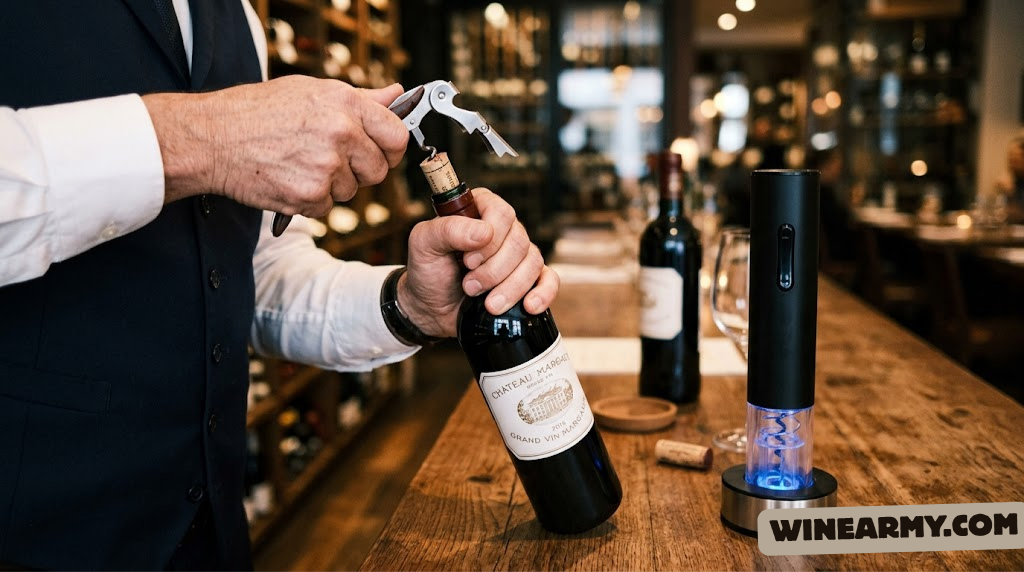
What’s the Real Difference Between Electric and Manual Wine Openers?
Pull a wine bottle from the rack, and the next thing you need is an opener. It sounds simple. But stand in the wine accessories aisle — or scroll through hundreds of listings online — and the choice between an electric wine opener and a manual corkscrew quickly feels anything but simple.
This comparison exists because both categories have evolved dramatically over the past decade. Electric wine openers are no longer clunky, battery-hogging gadgets reserved for those who never learned to use a corkscrew. And manual wine openers aren’t just the old-fashioned tool your grandfather kept in a kitchen drawer — today’s best models are precision-engineered instruments that professional sommeliers swear by.
The honest truth? Neither type is universally better. The right answer depends entirely on who you are, how often you open wine, where you open it, and what you value in the experience. This guide will walk you through every meaningful distinction — from the mechanics of the pull to long-term reliability, from price points to use cases — so you can make a confident, informed decision.
If you’re deep into the world of wine accessories already, you might also want to explore our full review of top-rated wine bottle openers across all categories, or our dedicated guide on wine openers compared where we stack up every style side by side.
We’ll also bust a few myths along the way — including the popular idea that electric openers are somehow “less serious” for wine lovers, and the equally misguided belief that manual corkscrews are too difficult for everyday home use.
How Each Type Works: The Mechanics Behind the Bottle
Before comparing outcomes, it’s worth understanding the mechanism behind each category. The way an opener works directly determines its performance, failure points, and ideal use case.
How Electric Wine Openers Work
An electric wine opener uses a battery-powered motor (rechargeable via USB-C in modern models, or AA/AAA batteries in older versions) to drive a spiral worm screw into the cork and then retract it automatically. The user simply places the device over the bottle neck, presses a button to insert the worm, and presses again to withdraw it. The cork comes out in under ten seconds with zero manual twisting required.
Most modern electric openers can handle 30–80 bottles per charge, depending on battery capacity. Premium models like the top-rated electric corkscrews we’ve reviewed feature foil cutters, LED indicators, and ergonomic grips designed for one-handed operation.
How Manual Wine Openers Work
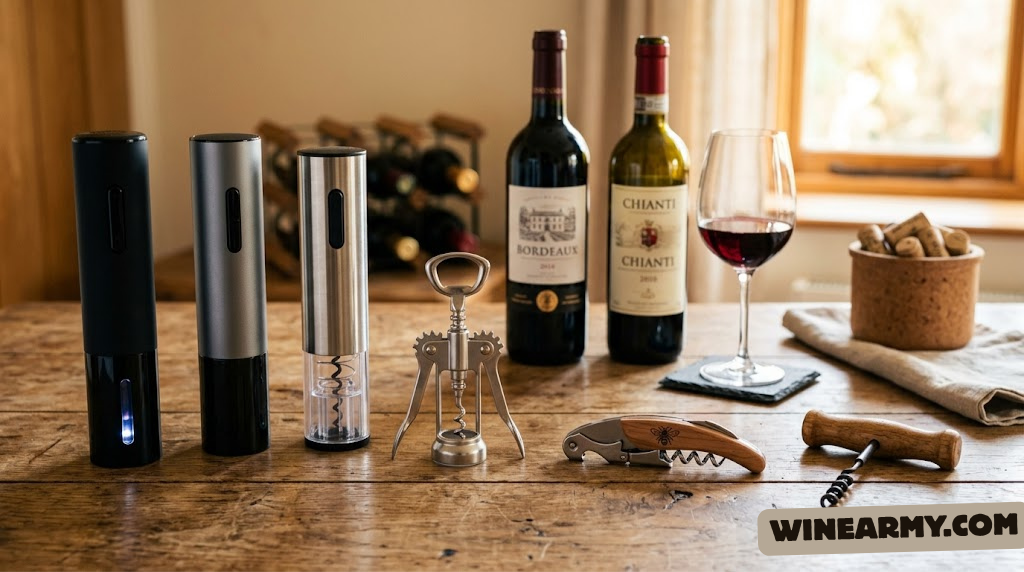
Manual wine openers come in several sub-types, each with a distinct mechanism. The three most common are:
- Waiter’s Corkscrew (Sommelier Knife): A foldable tool with a worm screw, a foil cutter, and a lever that uses the bottle lip as a fulcrum. The user inserts the worm by twisting with one hand, then levers the cork out in one or two pulls. Compact, reliable, and widely considered the professional standard.
- Winged Corkscrew (Butterfly): A two-armed opener where you insert the worm by pressing down, and the wings rise as the worm drives in. Then you push both wings down to extract the cork. Easy to use but bulkier and often less reliable on aged or fragile corks.
- Lever/Rabbit Corkscrew: A countertop or handheld device that uses a mechanical lever system to insert and extract the cork with a single handle push-and-pull. Very fast (rivals electric speed), handles a wide range of corks well, but expensive and not portable.
The waiter’s corkscrew, often called a sommelier knife, is the tool of choice in virtually every professional setting. If you’ve been to a restaurant and watched a sommelier open a bottle tableside, that’s almost certainly what they were using. Our best waiter’s corkscrew guide for 2026 goes deep on why this format dominates at the professional level.
Head-to-Head Performance: Speed, Reliability, and Cork Safety
Let’s get into the numbers and real-world performance that actually matter when you’re at the table with guests waiting.
Speed
In terms of raw speed, both types can open a bottle remarkably quickly — but in different ways. A well-practiced waiter’s corkscrew user can open a bottle in 15–20 seconds. An electric opener does the same job in 8–12 seconds. For most home contexts, this difference is irrelevant. For a bartender or server opening dozens of bottles per shift, it adds up.
Reliability on Difficult Corks
This is where things get nuanced. Cork materials vary enormously — from tight, pristine natural corks in a newly bottled wine to old, dried, crumbling corks in a vintage bottle, to synthetic (plastic/composite) corks that have a different texture and grip. Here’s how each type handles them:
| Cork Type | Electric Opener | Waiter’s Corkscrew | Winged Corkscrew | Rabbit Lever |
|---|---|---|---|---|
| Standard natural cork | ✔ Excellent | ✔ Excellent | ✔ Good | ✔ Excellent |
| Synthetic / plastic cork | ~ Variable | ✔ Good | ✗ Struggles | ✔ Good |
| Aged / fragile cork | ✗ Risk of breaking | ✔ Best control | ✗ Poor | ~ Moderate risk |
| Long/tall corks (Champagne-style) | ✗ Usually incompatible | ✔ Handles well | ✗ Incompatible | ✗ Often incompatible |
| T-top (Port/fortified) | ✗ Incompatible | ✗ Not designed | ✗ Incompatible | ✗ Incompatible |
| Screw cap (Stelvin) | ✗ Not applicable | ✗ Not applicable | ✗ Not applicable | ✗ Not applicable |
The biggest practical concern for wine collectors and enthusiasts is the aged or fragile cork scenario. Electric openers apply consistent torque during extraction, which doesn’t “feel” the resistance changing — they keep pulling at the same rate even if the cork is disintegrating. An experienced user with a waiter’s corkscrew can feel the resistance, slow down, and adjust. If you’re regularly opening bottles from a wine cellar or aged collection, that tactile feedback is genuinely valuable.
For a complementary angle, see our guide on how to open a wine bottle without a corkscrew — useful when any tool fails.
Performance Score Comparison (Out of 10)
Electric Manual (Waiter’s Corkscrew)

Cuisinart CWO-25 Electric Wine Opener
One of the top-selling electric wine openers on Amazon. Rechargeable, opens up to 80 bottles, and comes with a built-in foil cutter.
View on AmazonElectric Wine Openers: A Complete Deep Dive
Electric wine openers have come a long way from the awkward, poorly balanced devices of the early 2000s. Today’s best models are sleek, reliable, and genuinely useful tools — not just novelty gadgets. Here’s everything you need to know about them.
The Technology Inside Modern Electric Openers
The core components of an electric wine opener are: a rechargeable lithium-ion battery (or AA/AAA batteries in budget models), a small but powerful DC motor, a worm screw (helix) made from food-grade stainless steel, and a gear reduction system that converts motor speed into the torque needed to penetrate and extract cork. High-end models add soft-start motors (which insert the worm slowly to avoid cork damage), automatic stop-and-reverse mechanisms, and USB-C charging ports.
Related: If you enjoy automated wine tools in general, take a look at our guide to top electric aerators for wine and the best electric wine chillers.
Pros of Electric Wine Openers
✅ Pros
- Zero effort — ideal for arthritis, limited grip strength, or hand injuries
- One-handed operation is genuinely possible
- Consistently fast opening every single time
- No technique to learn — works perfectly for beginners
- Impressive at parties — guests often find them fascinating
- Most include a built-in foil cutter
- Makes a memorable, practical gift
- Rechargeable models have very low running costs
- Great for high-volume contexts (wine bars, events)
❌ Cons
- Requires charging or batteries — can fail at inconvenient moments
- Bulky and not suitable for travel or pocket carry
- Higher upfront cost for quality models
- No tactile feedback — risky on aged/fragile corks
- More failure points (motor, battery, gear) than a simple lever
- Not compatible with oversized or non-standard corks
- Motor can wear out over time, especially in cheap models
- Feels “impersonal” to some enthusiasts
Who Makes the Best Electric Wine Openers?
The electric wine opener market has matured considerably. Quality options are available at every price point, but there are meaningful differences in build quality and reliability. Notable brands include Cuisinart, OXO Good Grips, Secura, Coravin (at the high end), and Ozeri. Our dedicated top electric corkscrews guide breaks down the best performers with real-world test results.
Battery Life: What to Expect
Budget AA/AAA battery-powered models: expect 15–25 bottles before replacement. Entry-level rechargeable models: 30–50 bottles per charge. Premium rechargeable models: 60–100+ bottles per charge. At an average consumption of 2–3 bottles per week, a quality rechargeable opener should be charged roughly once per month.
Design Considerations
Modern electric openers vary significantly in form factor. Cylindrical (tube-shaped) models are most common and easiest to grip. Pistol-grip models offer better control. Countertop lever-style electric models blend electric automation with the rabbit-lever aesthetic. The best designs prioritize balance — the opener should feel stable when placed on the bottle neck without you gripping it tightly.

OXO Good Grips Rechargeable Electric Wine Opener
OXO’s ergonomic design is excellent for users with grip issues. Opens up to 30 bottles per charge with a comfortable soft-touch grip.
View on AmazonElectric Opener Feature Checklist
When shopping for an electric wine opener, evaluate it against this checklist:
- Rechargeable vs. battery-powered: Rechargeable (USB-C preferred) is almost always the better long-term choice.
- Bottle capacity per charge: Look for 40+ for regular home use.
- Foil cutter included: Not essential, but very convenient.
- Worm screw material: Stainless steel is a must. Avoid painted or coated screws that can chip.
- Ergonomics: It should feel balanced when held over the bottle. Test if possible.
- Reversibility: Ensure the motor reverses reliably to extract the cork from the worm after each use.
- Warranty: Look for at least 1 year. Quality brands offer 2–3 years.
Manual Wine Openers: The Full Story
The manual wine opener is one of the most enduring tools in kitchen history. The basic corkscrew principle — a helix screw driven into a soft cork — hasn’t changed since the 17th century. What has changed is the sophistication of the mechanisms built around it, the metallurgy of the worm, and the ergonomics of the handle.
There’s also a cultural dimension to the manual opener that’s worth acknowledging. Many wine lovers feel that opening a bottle with a waiter’s corkscrew is part of the ritual of wine. The flick of the knife to cut the foil, the precise insertion of the worm, the two-stage lever pull — for these enthusiasts, using an electric opener would feel like skipping the opening act of a play.
A good sommelier can open a bottle with a waiter’s knife in under fifteen seconds. But it’s not about speed — it’s about being fully present for every step of the experience.
The Waiter’s Corkscrew: Why Professionals Choose It
The waiter’s corkscrew dominates the professional world for several reasons. First, it’s compact — it fits in a shirt pocket or apron pocket. Second, it’s battery-free — it will work anywhere, anytime, without charging. Third, with quality construction (look for a Teflon-coated worm and a double-hinge lever), it’s extremely reliable and precise. Fourth, the tactile feedback allows an experienced user to feel a fragile cork and adjust their technique accordingly.
For a detailed look at the best performers in this category, see our best waiter’s corkscrew picks for 2026.
Pros and Cons of Manual Wine Openers
✅ Pros
- No batteries or charging required — always ready
- Compact and highly portable (waiter’s style fits in a pocket)
- Tactile feedback helps protect fragile/aged corks
- Extremely durable — quality models last decades
- Low cost of entry — excellent options from $8–$30
- Professional and ritualistic appeal for wine enthusiasts
- Works in any environment, including outdoors
- No failure points beyond a bent worm or worn lever
❌ Cons
- Requires physical dexterity — difficult for arthritis or grip issues
- Learning curve for beginners (waiter’s style especially)
- More effort per bottle — significant when opening many bottles
- Poor-quality worm corkscrews can break corks
- Winged/butterfly style is notoriously unreliable on some corks
- Rabbit/lever corkscrews are bulky despite being manual
- Foil cutter usually a separate tool (unless built into waiter’s knife)
Choosing the Right Worm Screw
The helix worm is the most critical component of any corkscrew. A hollow-bore, open-coil helix (sometimes called a “Teflon worm”) slides through cork cleanly, leaving the cork intact. A solid-core or “gimlet” screw (more like a pointed drill bit than a true helix) destroys the interior of the cork as it enters. Always choose a true helix for any quality manual opener.
Understanding cork vs. screw cap dynamics also matters — some wines intentionally use synthetic corks or screw caps, making any corkscrew irrelevant.
Manual Opener Sub-Type Comparison
| Type | Portability | Ease of Use | Cork Safety | Price Range | Best For |
|---|---|---|---|---|---|
| Waiter’s Corkscrew | ✔ Excellent | ~ Learning curve | ✔ Best | $8–$60 | Enthusiasts, professionals, travelers |
| Winged Butterfly | ~ Moderate | ✔ Very easy | ✗ Risky | $5–$25 | Casual beginners |
| Rabbit / Lever | ✗ Bulky | ✔ Very easy | ~ Good | $25–$80 | Home countertop, high-volume |
| Twin-Prong (Ah-So) | ✔ Good | ✗ Tricky | ✔ Excellent | $10–$40 | Aged, fragile corks; no worm |
| Countertop Lever | ✗ None | ✔ Effortless | ✔ Very good | $40–$200 | Wine bars, parties, frequent use |

Pulltap’s Classic Evolution Waiter’s Corkscrew
The industry-standard sommelier knife used by professionals worldwide. Double-hinged lever, Teflon-coated helix, and a decades-long track record of reliability.
View on AmazonThe Ah-So (Twin Prong) — The Specialist Choice
Worth mentioning separately is the Ah-So, or twin-prong opener. This tool has two thin metal prongs that slide down either side of the cork (between the cork and the bottle neck wall) without penetrating the cork at all. A twisting-and-pulling motion extracts it whole. It’s the tool of choice for opening extremely old bottles with fragile corks that would crumble under a worm screw. It requires practice and has no use case for younger wines (the prongs won’t grip tight modern corks). But for a dedicated wine collector, having one in the drawer alongside a waiter’s corkscrew is a smart strategy.
Electric vs Manual Wine Opener: Complete Feature Comparison
Here is the most comprehensive side-by-side comparison table for electric and manual wine openers, covering every meaningful attribute a buyer should evaluate.
| Attribute | Electric Opener | Manual (Waiter’s Style) | Manual (Rabbit Lever) |
|---|---|---|---|
| Opening Speed | 8–12 seconds | 15–25 seconds | 10–15 seconds |
| Effort Required | None — button press only | Moderate (wrist action) | Minimal (lever push) |
| Best Cork Types | Natural, synthetic (most) | All types (with skill) | Natural, synthetic |
| Aged Cork Safety | ⚠️ Risky | ✅ Best control | ⚠️ Moderate risk |
| Power Source | Battery / USB-C | None (human) | None (human) |
| Portability | Low — bulky, needs charge | Excellent — pocket-sized | Poor — heavy, large |
| Price Range | $20–$120+ | $8–$60 | $25–$120 |
| Durability | 3–7 years (motor lifespan) | 10–30+ years | 10–20 years |
| Foil Cutter Included | Usually yes | Yes (built into knife) | Often sold separately |
| Accessibility (Arthritis etc.) | ✅ Excellent | ❌ Difficult | ✅ Good |
| Outdoor / Travel Use | Limited (needs charge) | ✅ Ideal | ❌ Not practical |
| Learning Curve | Zero | Moderate (waiter’s style) | Very low |
| Gifting Appeal | ✅ High | ✅ High (if quality) | ✅ Moderate–High |
| Professional Use | Uncommon in restaurants | Industry standard | Occasional bar use |
| Environmental Impact | Battery/electronics waste | Minimal (metal only) | Minimal (metal only) |
| Repairability | Low (sealed motor unit) | High (replace worm/lever) | Moderate |
Who Should Buy Which Type? A Practical Decision Framework
Rather than pronouncing one type “better,” let’s map specific user profiles to the right opener category. Read your situation and pick accordingly.
Choose an Electric Wine Opener If You Are:
- A new wine drinker who wants to open bottles without stress or embarrassment. Zero learning curve means zero fumbling.
- Someone with arthritis, joint pain, or limited hand strength. Electric openers are a genuine game-changer for accessibility. Many occupational therapists recommend them.
- A party host who regularly opens many bottles in a short period. The consistency and speed reduce fatigue significantly.
- A gift buyer looking for something that will impress and be genuinely used. Electric openers photograph well and feel luxurious to unbox.
- Someone who only drinks younger, commercially corked wines. Natural corks from recent vintages are robust enough to handle the electric mechanism without risk.
- A wine bar or restaurant staff member at a high-volume venue where the same person opens dozens of bottles per shift.
Choose a Manual Wine Opener If You Are:
- A wine enthusiast or collector who values the ritual and wants complete control over the opening process.
- Someone who regularly opens aged bottles from a cellar or personal collection. Tactile feedback is essential for fragile corks.
- A traveler — picnics, hotel rooms, campsites. A waiter’s corkscrew lives in your bag with zero worry about battery life.
- Someone on a budget who needs a reliable opener and doesn’t want to spend $40–$80 on a quality electric model.
- A professional in the wine industry — sommeliers, servers, wine educators. A quality waiter’s corkscrew is a professional identity statement.
- An environmentally conscious consumer who wants to avoid electronics and battery waste.
- Someone who values longevity — a quality waiter’s corkscrew can outlast multiple electric openers over a lifetime.
Electric is Best For:
Convenience, accessibility, gifting, and high-volume modern wine opening. Zero effort, zero learning curve.
Manual is Best For:
Control, portability, aged wines, travel, value, and the full ritual experience of wine opening.
Top Picks: The Best Electric and Manual Wine Openers in 2026
These recommendations are based on our team’s hands-on testing, long-term use feedback, and extensive research across verified user reviews. For our full ranked breakdown, see our top electric corkscrews and best waiter’s corkscrew guides.
Best Electric Wine Openers
1. Cuisinart CWO-25 — Best Overall Electric
The Cuisinart CWO-25 consistently tops lists for good reason. It’s ergonomically balanced, opens up to 80 bottles per charge, includes an integrated foil cutter, and has a reassuring build quality. The USB-C charging is modern and convenient. At around $40–$50, it hits an excellent value sweet spot.

Cuisinart CWO-25 Electric Wine Opener
80 bottles/charge · USB-C · Built-in foil cutter · Ergonomic grip
View on Amazon2. Secura Electric Wine Opener — Best Budget Electric
For under $30, the Secura offers reliable electric opening with a rechargeable battery and a clean, simple design. It doesn’t have all the premium features of the Cuisinart but performs well on standard corks and makes an excellent entry-level electric opener.

Secura Automatic Electric Wine Opener
Rechargeable · Compact design · Includes foil cutter and pouring spout
View on AmazonBest Manual Wine Openers
1. Pulltap’s Classic Evolution — Best Waiter’s Corkscrew Overall
This is the gold standard for sommelier knives. The double-hinged design makes the two-stage extraction technique almost effortless, and the Teflon-coated open helix glides through cork without damage. At $20–$35, it’s a lifetime investment. Used in Michelin-starred restaurants worldwide.
Pulltap’s Classic Evolution Double-Hinged Waiter’s Corkscrew
Double-hinge · Teflon helix · Foil cutter included · Professional standard
View on Amazon2. Rabbit Original Lever Corkscrew — Best Rabbit Lever
The Rabbit lever corkscrew is to manual openers what the electric opener is to the plug-in world — it removes most of the effort with a brilliant mechanical advantage. One smooth pull-and-push motion with the lever extracts any standard cork in under 5 seconds. The countertop stand version keeps it accessible at all times.

Rabbit Original Lever Corkscrew
One-motion extraction · Works on all standard corks · 10-year warranty
View on Amazon3. Ahso Butler’s Friend (Twin Prong) — Best for Aged Wines
The Ah-So twin-prong opener is indispensable if you regularly open vintage wines with older, potentially fragile corks. It extracts without a worm, leaving the cork completely intact. Requires practice to use confidently, but no other tool protects a delicate old cork as well.

Ah-So Twin Prong Cork Puller
No worm needed · Best for fragile/aged corks · Stainless steel
View on AmazonPrice Guide: What to Expect at Every Budget Level
Wine opener pricing spans from a few dollars to several hundred for premium countertop models. Here’s what you get (and don’t get) at each tier.
| Budget Tier | Electric Options | Manual Options | Our Verdict |
|---|---|---|---|
| Under $15 | Battery-powered, flimsy build, short lifespan | Basic winged corkscrew or single-hinge waiter’s knife | Avoid electric. Manual is fine for casual use. |
| $15–$35 | Entry rechargeable electric — functional but basic | Quality double-hinge waiter’s corkscrew (best value zone) | The sweet spot for manual. Electric is acceptable here. |
| $35–$70 | Premium electric — great capacity, ergonomics, extras | Rabbit lever, premium waiter’s knives (Laguiole, Screwpull) | Excellent in both categories. This is where we’d spend our money. |
| $70–$150 | High-end electric (Coravin adjacent, premium brands) | High-end rabbit levers, designer waiter’s knives | Diminishing returns on electric. Manual value is excellent here. |
| $150+ | Countertop electric systems, commercial grade | Coutertop lever systems, luxury handcrafted knives | Worth it only for frequent high-volume or collector use. |
💰 Best Value Picks at a Glance
- Best value electric: Secura rechargeable ($25–$30) — solid all-rounder
- Best value manual: Pulltap’s Classic Evolution ($20–$25) — professional tool at an accessible price
- Best value if you want both: Buy a Pulltap’s + a Secura for under $55 total. You’re covered for any situation.
For a broader look at value in wine accessories, our affordable wine picks for 2026 and wine subscription value guide cover how to get the most from every dollar you spend on your wine experience.
Caring for Your Wine Opener: Maintenance, Cleaning, and Longevity Tips
The lifespan of your wine opener — whether electric or manual — depends heavily on how you care for it. Here’s a practical guide to keeping your opener in peak condition.
Caring for Electric Wine Openers
Cleaning the worm screw: After each use, remove any cork residue from the helix with a damp cloth or a dry brush. Never submerge an electric opener in water — the motor housing is not waterproof in most models. Cork fragments left on the screw can affect the motor’s efficiency over time.
Battery maintenance: For rechargeable models, avoid storing the opener on the charger continuously once fully charged. Charge to full before extended storage periods (e.g., if you’re traveling for two weeks). For AA/AAA battery models, remove batteries if storing for more than a month to prevent leakage.
Motor care: Never force the opener onto an oversized or non-standard cork that the worm can’t grip properly. This strains the motor and can cause overheating. If the motor seems to be struggling, stop and use a manual opener for that bottle.
Storage: Keep the electric opener in a dry location. Avoid storing in a humid area like directly under the sink. The charging port should be kept free of debris — use a dry cotton swab to clean it periodically.
Expected lifespan: Quality electric openers last 3–7 years with proper care. When the motor weakens noticeably (slowing down mid-extraction or struggling on standard corks), it’s time to replace it. Most electric openers are not user-repairable.
Caring for Manual Wine Openers
Cleaning the waiter’s corkscrew: After each use, wipe the blade, helix, and lever with a damp cloth. Dry thoroughly before folding. The pivot joints can be lightly oiled with a drop of food-grade mineral oil once every few months to keep the action smooth.
Worm screw care: A Teflon-coated worm will eventually wear over time with frequent use. When you notice the screw is no longer gliding smoothly through cork, it’s time to replace the opener (most waiter’s knives are not designed for worm replacement). Quality helix worms on premium openers can last 10+ years with normal use.
The foil cutter blade: On waiter’s knives, the small foil-cutting blade will dull over time. This is normal — it’s a small serrated or plain blade. You can sharpen a plain blade with a fine ceramic rod; serrated blades are more difficult. When it no longer cuts foil cleanly, replacement of the opener is usually more practical than sharpening.
Rabbit/lever care: These mechanisms have more moving parts. Keep the pivot points clean and occasionally add a drop of food-safe lubricant. The worm screw on rabbit levers is usually replaceable — check your model for a replacement screw kit from the manufacturer.
Expected lifespan: A quality waiter’s corkscrew should last 10–30 years. Laguiole knives and similar premium options are often passed down as heirlooms. Rabbit levers typically last 10–20 years with periodic maintenance.
Final Verdict: Electric vs Manual Wine Opener — What’s the Right Answer?
After examining every angle — mechanics, performance, durability, price, portability, and user fit — here is our clear-eyed verdict.
Electric Wins On:
Ease of use, accessibility, speed at scale, gifting appeal, beginner-friendliness, and the “wow factor” at gatherings.
Manual Wins On:
Portability, longevity, value, cork safety on aged wines, no-charge reliability, professional credibility, and the ritual experience.
If you could only own one: for the vast majority of wine drinkers who open 1–5 bottles per week of modern commercial wines at home, a quality double-hinge waiter’s corkscrew is the smarter long-term choice. It will never fail because a battery died. It will work anywhere. And once you learn to use one properly, it’s as fast and satisfying as any electric opener.
That said, the best answer for most households is to own both. A waiter’s corkscrew for travel, outdoor use, and aged wines. An electric opener for home, parties, and any guest or family member who might struggle with a manual tool. The combined cost of excellent versions of both is under $75 — and both will serve you for years.
The electric vs. manual debate connects naturally to broader questions about wine tool philosophy. If you’ve enjoyed this comparison, you’ll also find our in-depth look at the Coravin vs. Vacu-Vin debate and the aerator vs. decanter comparison similarly illuminating. For everything connected to opening and serving wine, our essential wine accessories guide is a comprehensive starting point.
Our Final Ratings Summary
| Category | Electric (/10) | Manual — Waiter’s (/10) | Winner |
|---|---|---|---|
| Ease of Use | 9.5 | 6.5 | ⚡ Electric |
| Speed | 9.0 | 8.0 | ⚡ Electric (slight edge) |
| Cork Safety (Aged) | 6.5 | 9.5 | 🍷 Manual |
| Portability | 4.0 | 10.0 | 🍷 Manual |
| Durability | 6.5 | 9.5 | 🍷 Manual |
| Long-Term Value | 6.0 | 9.5 | 🍷 Manual |
| Accessibility | 10.0 | 5.5 | ⚡ Electric |
| Gifting Appeal | 9.0 | 7.5 | ⚡ Electric (slight edge) |
| Professional Context | 5.0 | 10.0 | 🍷 Manual |
| Environmental Impact | 5.5 | 9.0 | 🍷 Manual |
| Overall Score | 7.15 | 8.5 | 🍷 Manual edges ahead |

Get Both — The Complete Wine Opening Kit
Start with the Pulltap’s Classic (manual) and add a Cuisinart or Secura electric. Under $75 total. Covers every situation you’ll ever face.
Browse Wine Opener Sets on AmazonBeyond the Opener: Building Your Complete Wine Accessory Collection
A wine opener is just the beginning. Once a bottle is open, there’s a whole ecosystem of accessories that can dramatically improve your experience. Here’s how the opener fits into a broader set of tools that any wine enthusiast should consider.
After Opening: The Essential Next Steps
Depending on the wine, you may want to pour immediately, aerate, or decant. Our aerator vs. decanter comparison explains when each is appropriate. For everyday wines, an aerator like those reviewed in our top-rated wine aerator guide adds oxygen quickly and inexpensively. For more structured reds and aged wines, a proper decanter (see our decanter shape and material guide) provides a slower, more thorough aeration.
Preserving What You Don’t Drink
If you don’t finish a bottle, preservation matters. Our best wine stoppers guide covers the best options, from simple silicone stoppers to vacuum systems. For serious preservation, the Coravin vs. Vacu-Vin comparison is essential reading. Understanding how long wine lasts after opening helps you plan when to finish open bottles.
Serving Temperature
The right opener won’t save a wine served at the wrong temperature. Our top wine chiller guide and coverage of the best wine chiller sleeves help ensure every bottle reaches the glass at the ideal temperature.
The Right Glassware
Even perfect opening technique can’t compensate for the wrong glass. Understanding how glass shape affects aroma and flavor is a significant wine education step — our guide to red wine glass picks by variety and the complete guide to wine glass types are excellent starting points.
Learning More About Wine
The opener is the technical entry point, but wine is ultimately about what’s inside the bottle. Whether you’re just starting your journey or deepening an existing passion, our wine glossary for beginners, wine varietals explainer, and comprehensive food and wine pairing guide are resources you’ll return to regularly.
Frequently Asked Questions: Electric vs Manual Wine Opener
Is an electric wine opener worth the money?
Can an electric wine opener break corks?
How long does a rechargeable electric wine opener last on one charge?
What is the easiest wine opener for someone with arthritis?
Do sommeliers use electric wine openers?
Which type of wine opener is better for a gift?
Can I use an electric wine opener on synthetic corks?
How do I choose a good manual corkscrew?
What’s the difference between a waiter’s corkscrew and a regular corkscrew?
Are electric wine openers safe to use on sparkling wine?
How do I remove a cork that broke in the bottle?
Conclusion: Your Perfect Opener Is the One That Suits Your Life
The electric vs. manual wine opener debate doesn’t have a universally correct answer — and that’s actually good news. It means there’s a genuinely excellent option for every type of wine drinker, at every price point, for every use case.
If convenience, accessibility, and zero-effort opening define your ideal wine experience, invest in a quality rechargeable electric opener and don’t look back. If you value portability, the hands-on ritual of opening wine, and a tool that will still be working perfectly when you’re passing it down to a younger generation, a waiter’s corkscrew is your companion for life.
And if you’re the kind of wine lover who wants to be genuinely prepared for every situation — from a casual Tuesday bottle to a 1996 Barolo from the cellar — both a quality electric opener and a quality waiter’s corkscrew belong in your kitchen. Combined, they cost less than a case of decent wine. And together, they’ve got you covered.
For more on building your complete wine toolkit, don’t miss our guides on storing wine at home, the best wine fridges, and our comprehensive coverage of wine accessories every host needs. Cheers to bottles opened cleanly, corks intact, and wine that reaches the glass in its best possible condition. 🍷
Ready to Find Your Perfect Wine Opener?
Browse our handpicked recommendations across every category — from electric automatics to professional sommelier knives.
See All Top-Rated Wine Openers →© Wine Army — Article structured with schema.org/FAQPage and schema.org/Article markup for enhanced search visibility.